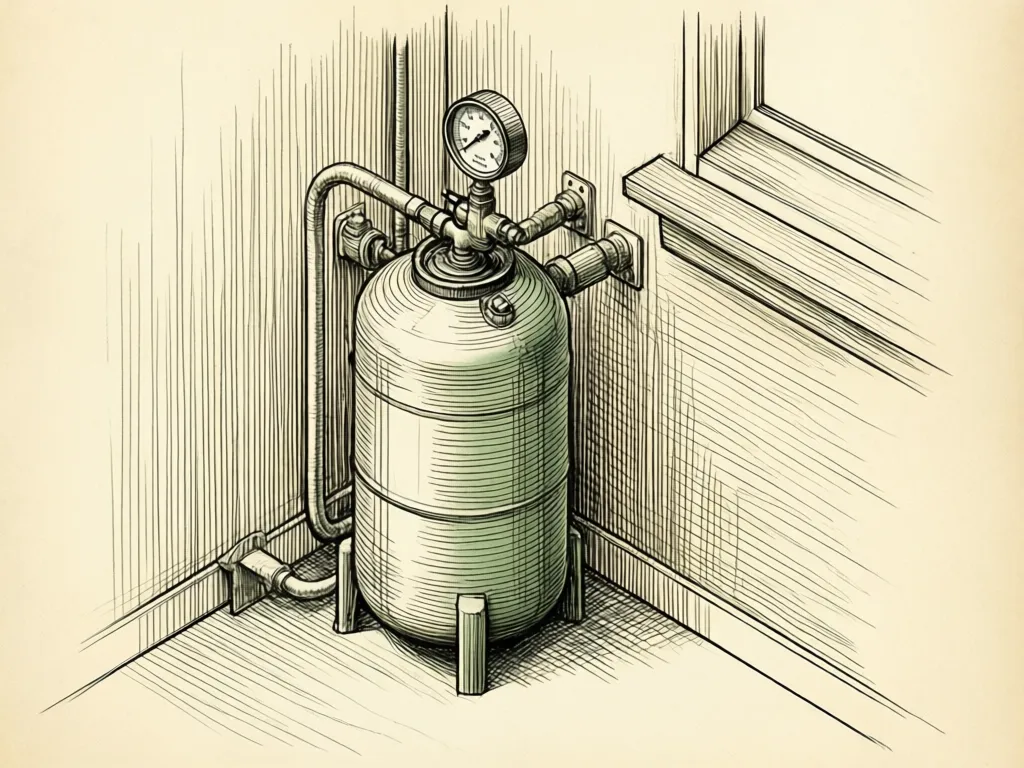
Thursday morning the short cycling started. I was filling the dog’s pan at the kitchen tap and heard the submersible kick on, run four seconds, stop, then kick again before the pan was full. That is a bladder losing its air, or a tank waterlogged. I killed the breaker, drained it through the hose bib, and screwed my gauge onto the air valve on top. Two pounds. It should sit just under the cut-in pressure, and mine was nowhere close.
Ruth called while I had the compressor out, after the rain we had Tuesday. Her hand-dug well under the wooden lid gets cloudy every hard rain and she wanted to know if cloudy meant bad. She said she would drive the bottle in Monday. Then she asked about the hammering sound in her pipes and I said that was a different thing entirely, probably not hers to fix with a tire gauge.
Here is where Marta would say I am being cheap. He argues a tank with a weak bladder probably should be replaced, not nursed, because the pump is the pricey part and short cycling cooks it. He is not wrong. In my experience, a pump motor seems to wear more on starts than on run time, and every four-second cycle is a start. I accept that. What I question is the assumption that a low air charge means a failed bladder. Most of the time the air just migrates. You pump it back up, watch it for a month, and it holds. If it drops again in two weeks, fine, then the bladder is torn and you spend the money. Test before you treat holds for iron the same as water.
The actual arithmetic on my morning, imperfect: the gauge reading took maybe ten minutes including dragging the compressor out of the shop. Air went in free — I already own the compressor, though if I did not, I’d guess a bicycle pump would do the same job slower. Total time under an hour, including checking the pressure switch contacts while the power was off, which cost nothing but kneeling on the utility room floor. Compare that to the service call I ran in March last year where it had been short cycling for months and, in my experience, the start capacitor seemed cooked along with the pressure switch. That owner paid for parts and labor that a tire gauge in January would have prevented. Call it an hour and some compressed air against a half-day job and real money. I know which one I pick.
The pressure tank is one of those few parts on a well you can check yourself without pulling anything out of the ground, and most owners have never looked at the air valve. I did not either, the first years at the utility — that was plant work, not mine. It was Marta who showed me, on a ranch call up the valley where the windmill still stands over the old bore. He drained a tank, pressed the valve stem with his thumbnail, got water instead of air, and said that tank is done, waterlogged past saving. The thumbnail test. Water out the air valve usually means the bladder is gone and no amount of pumping fixes it. Air seems to mean you have a chance. I have used his thumbnail test for years and passed it on to Marta next door, whose shallow well drops every dry August and whose tank I now check when I check mine.
September is when I do it anyway, ahead of the rotation of the two drums, which my wife has already noted in the household log. The tanks get checked, the drums get swapped, the strips get counted.
If your pump has been starting and stopping faster than it used to, or the pressure at the tap surges instead of holding steady, that is the tank talking. Before you drain anything or touch the air valve, go watch the full video and follow the sequence the whole way through.
Saturday I rechecked the charge. Holding. The dog’s pan filled without a sound from the utility room.