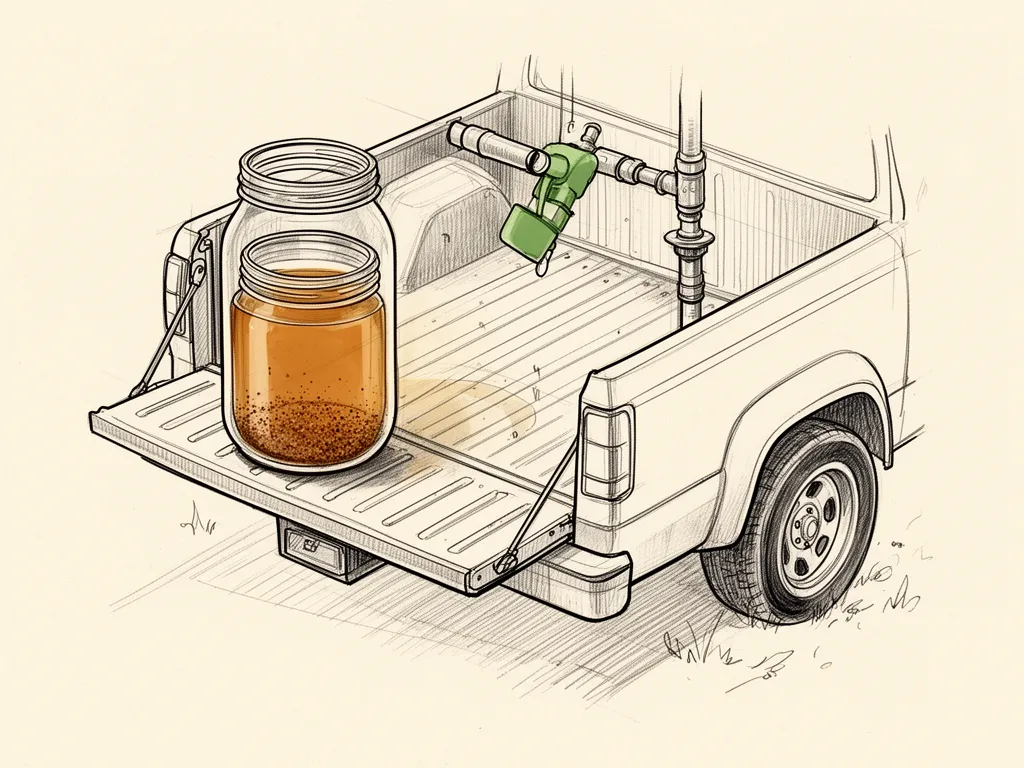
The jar was already sitting on my tailgate when I got out of the truck. Ruth had filled it that morning and driven it over herself, which she does not do unless something has her worried. She had a hand-dug well out east of town, an old one under a wooden lid, and the water in that jar was the color of weak tea with a grey cast to it, like someone had rinsed a paintbrush in it. She said it had rained hard two nights before, the first real rain in weeks, and the water had come out of the tap smelling like the inside of a garden shed. Damp earth and something under it. She asked if she could still cook with it, and I told her to hold off until the lab said its piece, and we stood there a minute looking at the jar settle on the tailgate while a fine brown silt sank to the bottom.
Most of these calls start that way. Not with a lab report. With somebody holding a jar or a glass up to the light and saying, it never used to look like this. Appearance and odor are the first instruments a well owner has, and they cost nothing to read. The mistake is reading them wrong — either ignoring a change because the water still runs, or panicking over a stain that has been there since the well was drilled. Over the years I have learned to sort what I see and smell into a short list of usual suspects before I reach for anything else, and I want to walk through that list here the way I walk through it on a call.
A glass held up to the light
The first thing I do on any appearance call is fill a clean white cup or a clear glass and let it stand. Not at the kitchen tap with the aerator on, because aerators add bubbles and people mistake bubbles for contamination. I run the water a minute, fill the glass, and look at it against something white. Then I set it down and wait.
It seems to happen when cold groundwater warms up in the plumbing and the air comes out of solution. You see it most in winter. Water is strange stuff that way — it is one of the few compounds you can find on this planet as solid, liquid and gas at ordinary surface temperatures, all three at once if you count the vapor coming off a stock tank on a frosty morning. Dissolved air riding along in the liquid phase is just part of that, and it settles out on its own.
Cloudiness that does not clear, or that leaves sediment in the bottom of the glass, is different. That is sand, silt or clay coming through, and it means something mechanical. Brown or yellow water that stains a white sink seems, in my experience, to be iron or manganese dissolved in the water, and it shows itself worst after the water sits in the lines and picks up oxygen. Black specks that smear seem like manganese to me.
Green water is almost never the well. Green seems like algae, and algae, I’d guess, needs light. If you see green, the problem is in an open tank, a cistern with a gap in the lid, or a clear section of pipe sitting in the sun somewhere.
The rotten egg test
Odor is the second instrument, and it lies less often than people think, but it lies in specific ways you can correct for.
The most common odor call I get is rotten egg, and nine times out of ten it is not the well at all. It is the water heater. The test takes two minutes: run the cold tap and smell it, then run the hot and smell that. The fix is a different anode or a heater treatment, not well work. If both hot and cold stink, and the smell is there at an outside spigot too, then it is coming up from the well, and that usually means sulfur-reducing bacteria in the formation or decaying organic matter in the well itself.
A metallic smell is iron or manganese, same as the staining. A musty, earthy smell after a hard rain — which is exactly what Ruth had — is surface water getting where it should not be: down past a cracked casing seal, around a bad cap, or into a shallow dug well that has no real seal at all. A chemical or fuel smell is the one that ends the conversation.
One caution on smell as an instrument: it wears out. I am 58 and I already notice I catch odors later than my wife does. If the person in the house is older, a neighbor or a younger relative sniffing the tap is not a silly precaution — it is a reasonable second instrument. That is outside my trade, but I have seen it once and it mattered.
Iron bacteria in the toilet tank
The toilet tank is the best diagnostic tool in the house and nobody uses it. Lift the lid and look. A clear tank with a little mineral ring is normal. Rust-colored slime on the walls, an orange film on the water surface that breaks into pieces when you poke it, or black slimy streaks — that is bacterial growth, and it tells you what is living in the well and the lines.
Iron bacteria is the usual resident. It seems to feed on dissolved iron and produces that rust-colored slime, and it is a maintenance problem more than a health one: in my experience it can plug screens, coat pump intakes, foul softeners, and make the water smell swampy even when the lab report comes back clean. You manage it. That is a hard thing for people to accept — they want the well fixed, once, and some wells you do not fix so much as keep.
If you are not sure how your own system is put together — where the pump sits, what the pressure tank does, what a sanitary cap looks like versus a plain cap — it helps to have the layout of private well parts and operation clear in your head before you try to read symptoms, because half of diagnosis is knowing which part could even cause what you are seeing.
What the jar settles out
Back to the jar. Sediment that settles is one message; color that stays in the water after the sediment drops is another. Settled sediment points to the pump or the screen.
Ruth’s jar settled a quarter inch of silt in an hour, and the water above it kept its tea color. That told me two things before any test: there was a physical pathway letting surface material in, and there was dissolved organic material coming with it. Both consistent with such a well after the first hard rain of the season.
I told her that much standing in her driveway, and she asked me, straight out, “So it’s just dirt? Dirt I can live with.”
I said, “Dirt you can see, maybe. What I can’t see is what rode in with it.
She looked at the jar a while. “So I boil it?”
“You don’t boil for looks,” I told her. “You test for what you can’t see, and you treat what the test says.
She said, “That’s backwards from what my mother did,” and I said her mother’s well probably had the same problem her whole life and nobody knew it.
If you are at the point Ruth was — a jar of suspicious water on the tailgate and a decision to make about the next step — go watch the full video before you fill a single storage drum from that tap, because what you do in the next day or two sets whether you are managing a problem or spreading it into your containers.
Now, there is a piece of folklore I want to take apart, because I run into it constantly: the belief that clear water is safe water, and cloudy or smelly water is dangerous water. In my experience it runs the other way about as often. Some of the worst lab results I have seen came from wells whose water looked and tasted perfect. Meanwhile the well that smells like a swamp and stains everything orange often tests fine for bacteria, since iron and sulfur bacteria seem to be more of a nuisance than a health threat. I had a call years back, a place up a draw where the water was crystal clear and the family had been drinking it for years, and the routine test I talked them into came back positive for coliform after a wet spring. The fix was a shock treatment and a new cap. The family with the ugly, smelly water two miles over tested clean. Myth says trust your senses. What actually happens is your senses catch the nuisance problems and miss the serious ones, which is why I say and keep saying it.
| Contaminant | Secondary MCL (mg/L) |
|---|---|
| Iron | 0.3 |
| Manganese | 0.05 |
| Sulfate | 250 |
| Total Dissolved Solids | 500 |
| Zinc | 5 |
| Copper | 1.0 |
| Fluoride | 2.0 |
| Foaming agents | 0.5 |
| Silver | 0.1 |
| Chloride | 250 |
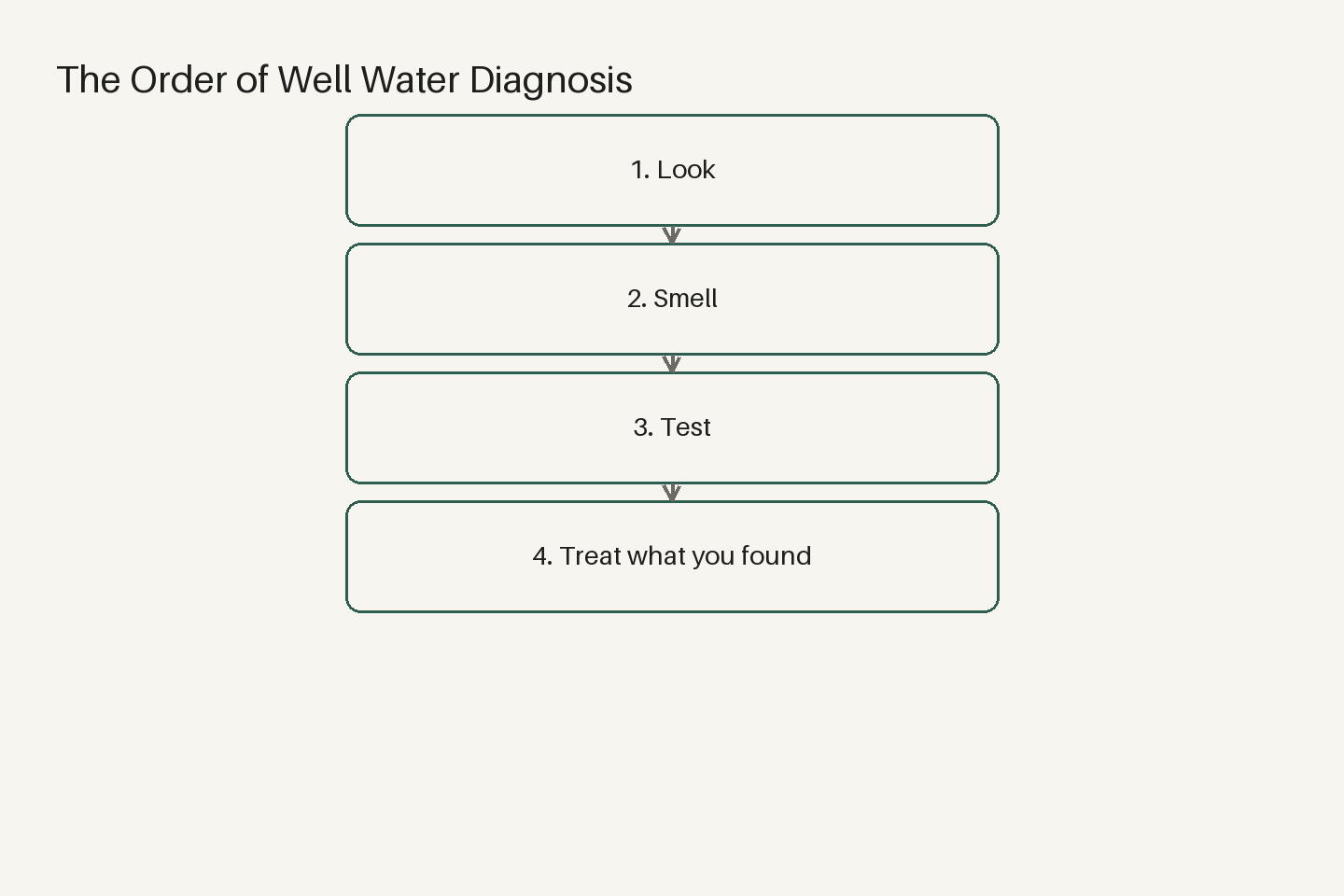
I will grant the other side something, though, because there is a fair counterargument: if the senses miss the invisible dangers and the labs cost money and take days, why not just treat everything, all the time — run every drop through filtration and disinfection and not bother with diagnosis? There are people in this valley who do exactly that, and I understand the logic. Treating blindly is better than drinking blindly. But here is where I push back. Treatment equipment sized for the wrong problem fails in expensive ways. A carbon filter on a well with heavy sediment seems to plug in weeks. Every treatment device assumes the water coming into it is a certain way, and the only way to know your water is to test it. So I accept the instinct — treatment is good, treatment is the endpoint — but the order matters: look, smell, test, then treat what you found.
Ruth’s well is a decent case study in how these things play out over time, so let me run it in order. We shock-treated the well, and the follow
Go watch the full video before you touch another drop.
In this section
Coming next: Black Specks in Well Water; Air Bubbles in Well Water; Fishy Smell in Well Water.
14 more notes planned.