Years ago I told a customer her water was safe because the specks settled out overnight. I had not sent a sample to the lab. That was my mistake, and I have not repeated it since. That call comes to mind whenever someone phones about black flecks in a glass of water.
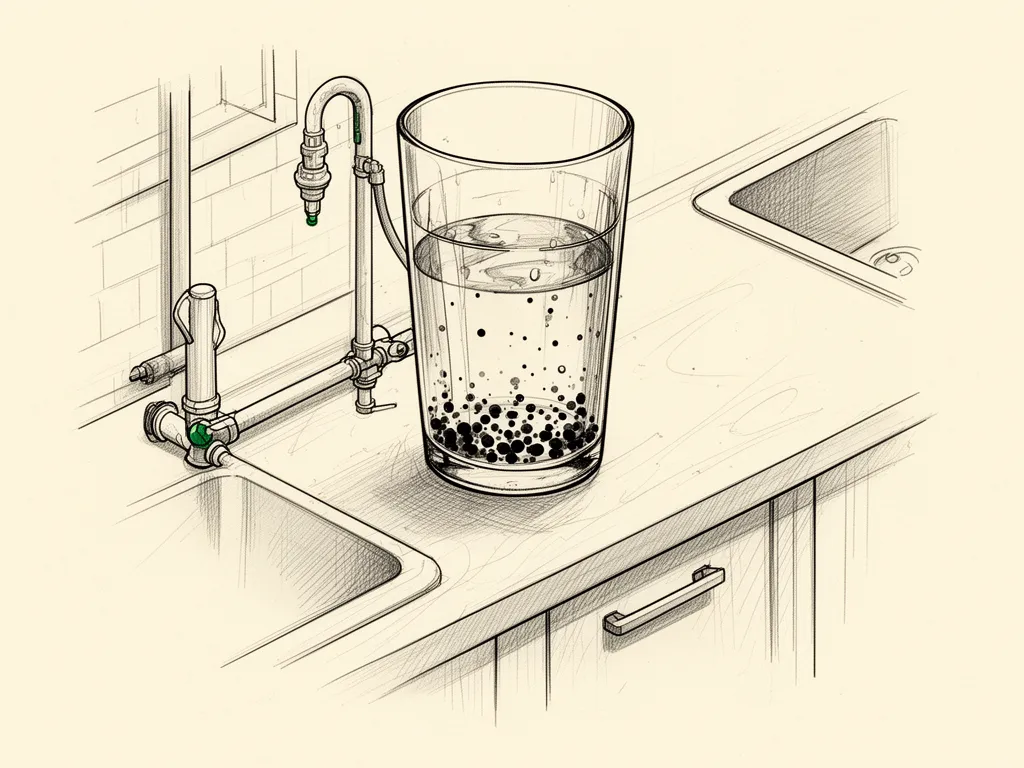
Black specks in well water, on the wells I serviced, point to one of a few things: manganese, iron bacteria residue, or deteriorating rubber from a gasket or hose somewhere in the system. Occasionally it is sand or silt from a failing well screen. I don’t think you can tell which one just by looking. You need to test, and you need to look at where the specks appear and when.
Where the specks show up
Begin by filling a clear glass from the cold water faucet at the kitchen sink. Let it sit on the counter for an hour. If the specks sink to the bottom and stay there, I have seen mineral sediment — manganese or iron that has oxidized and fallen out of solution. If the specks smear when you rub one between your fingers and leave a brownish streak, I have seen iron bacteria. If they feel gritty, I have pulled sand or fine silt from the well itself.
Next check whether the specks come from every tap or just one. Specks at a single faucet I have traced to a problem in that fixture — a corroding aerator, a deteriorating supply line, a washer breaking down inside the valve. Unscrew the aerator and look. If the specks appear at every tap, hot and cold, I’d guess the problem is upstream: the pressure tank, the well, or the pump.
Check the hot water separately. Run hot into a clean glass and let it sit. If the hot water carries more specks than the cold, the water heater tank on the calls I made was shedding sediment or the anode rod was starting to corrode. That is a separate problem from the well and it has a separate fix.
What manganese looks like
Manganese seems to be the most common cause of black specks in the wells I service around here. It dissolves in groundwater the same way iron does, and seems to oxidize when it hits air and forms tiny black or dark brown particles. The water can look clear coming out of the tap and then develop a dark film or specks as it sits. Manganese seems to stain laundry and fixtures too — dark brown or black streaks that don’t scrub off easily.
The bottle from the county laboratory on my shelf by the back entrance is for this purpose. I collect a sample from a tap ahead of any filter or softener, let the water run for two minutes first, fill the bottle, and drop it off. Results come back in a few days and tell you the concentration in milligrams per litre.
Higher levels over time seem able to coat the inside of pipes and reduce flow, and I’d guess they could foul a water softener resin bed. The treatment depends on the concentration and on what else is in the water, which is why the lab result comes first. Test before you treat. That is the rule. You can read more in why well water turns black if the specks come with discoloration in the whole glass.
Iron bacteria and rubber breakdown
Iron bacteria seem to be living organisms that feed on dissolved iron and manganese in the well. They seem to form a slimy rust-coloured or dark film inside the well casing, on the pump, and sometimes in the pressure tank. When pieces of that film break loose, they come through the tap as dark specks or flakes. The water may also seem to smell swampy or like rotten vegetation, especially after the well has sat unused for a few days.
The test is a bacteria sample. The county lab provides a sterile bottle. You might flame the tap or wipe it with alcohol, run the water, fill the bottle without touching the inside of the cap, and get it to the lab within the time they specify. That is a job for the driller. I call my old colleague before I recommend anything beyond the lab test.
Rubber breakdown is simpler to find and cheaper to fix. Flexible supply lines under sinks, rubber gaskets in fixtures, and the bladder inside a pressure tank all degrade over time. When they do, they seem to shed small black particles that look like specks of rubber — because they are. If the specks are soft and smear black, and they only appear at one or two fixtures, I’d guess checking the supply lines first is worth a try. A flashlight and a headlamp help. The fix is replacing the line or the gasket.
I got a call last fall from a woman named Carla on the next section over. Her well is shallow and runs dry every dry August. She said, “I’m getting black stuff in the bathroom sink but not the kitchen.” I asked if it smeared. She said, “Yes, like pencil lead.” I told her to unscrew the aerator on the bathroom faucet. She called back ten minutes later and said, “There’s a rubber washer in here that’s falling apart.” That was the whole fix. A new washer. No lab test, no treatment, no equipment.
Not every call goes that way. A man on the other side of the county road had black specks at every tap, hot and cold, and his water had a faint metallic taste. He had already bought a cartridge filter and screwed it onto his kitchen faucet line. The specks kept coming. The cartridge filter was catching some of it at the kitchen tap but doing nothing for the rest of the house, and it seemed to clog constantly. He had spent money on the wrong fix because he had not tested first. Testing first would have saved him the cartridges and pointed straight at the screen.
Once you have the lab result and you know what you are dealing with, the next move is setting up storage and treatment that handles it. Pull up watch the full video and follow it step by step while you work through your own system.
I grew up in a house where the water came from a spring box on the hillside behind the barn. My father checked it every spring after runoff. He did not have test strips or a county lab. He had a white enamel pan. He would fill it, set it on the windowsill, and look at what settled. That was his test. It was not a good test, but it was the one he had, and he did it every year without fail. When I started at the county utility yard, the first thing they taught me was to sample properly — clean bottle, right tap, right holding time. I thought about my father’s enamel pan. The instinct was the same. Look at your water. Pay attention. The tools are better now but the habit is identical.
Carla’s shallow well and my drilled well with the submersible pump are different systems, but the routine is the same. Test. Identify. Then fix the specific thing. Those pair of 55-gallon drums in my garage are there because I know any well can have a bad week — a pump failure, a contamination event after flooding, a screen that finally gives up. Stored water buys time to figure out the problem without going thirsty. That is the whole logic. Storage beats gadgets.
The barrel positioned beneath the shop’s roof, equipped with a first-flush diverter, is intended solely for garden use. I do not drink it and I do not treat it as backup drinking water. It keeps the garden alive in August when Carla’s well is low and my well is working harder than usual. Fine for tomatoes.
Steps I follow on every speck call
Fill a clear glass from the cold tap. Let it sit one hour. Note whether the specks sink, float, or stay suspended.
Rub a speck between your fingers. Note whether it smears, feels gritty, or crumbles.
Check every tap in the house, hot and cold separately. Note which fixtures produce specks.
Unscrew the aerator on any faucet that shows specks. Look for deteriorating rubber or trapped sediment.
Check the pressure tank. Screw a pressure gauge onto the hose bib and note the reading. A failing bladder shed particles on the one I pulled.
Run the well for ten minutes from an outdoor spigot. Fill a clean bucket. Look for sediment at the bottom.
Collect a bacteria specimen in the county lab bottle if the specks smear or the water smells off.
Write down the results and the date. Keep the log where you can find it. My wife keeps ours taped inside the pantry door by the plan.
Contact the professional who drills wells prior to making a decision on any treatment equipment. Describe what you found. Give him the lab numbers. Let him tell you whether the problem is the well, the pump, the screen, or something in the house plumbing.
That sequence has not changed much in ten years of service calls. The order matters. You start with what you can see and touch, then move to what the lab can measure, then bring in the person with the rig and the experience. Skipping steps costs money and time.
If your specks come with a colour change in the water itself — brown, yellow, orange, or a general cloudiness — the cause may be different from specks alone. Well water appearance and odor problems covers the wider range of what water can look and smell like and what each sign usually points to.
Open watch the full video and follow it step by step while you set up your own storage and treatment.
On the wells I serviced, it was manganese or a worn gasket, and neither one is an emergency.