She had watched a salesman spend two hours explaining why the tiny bubbles in her kitchen faucet meant her water needed a four-stage treatment skid, and she paid for the diagnostic visit before anyone so much as looked at her pressure tank. I got there the next week, attached a pressure meter to the outdoor spigot, watched the needle move, and told her the water was fine. The tank was waterlogged. The fix was air, added back where air belonged. The bubbles in her glass were never the problem. They were the symptom, and symptoms are free to look at.
Milky Water Clearing From The Bottom
Air in well water usually shows up as a milky or cloudy glass that becomes clear from the lower part upward over a minute or two. That is the single most useful thing to know, because it separates dissolved gas from everything else that clouds water. Fill a clear glass at the tap, set it on the counter, and watch it. If the cloud rises and the water goes clear bottom to top, you are looking at tiny bubbles coming out of solution, the same physics as a glass of cold water warming on the counter in summer. If it stays cloudy, or settles, or the cloud sinks, that is sediment or something else, and you are on a different page entirely, the one I keep under appearance and odor problems. The glass test costs nothing and takes two minutes. Do it before anything else.
Your well pump delivers the water from a column of rock, cold and squeezed. When it hits your tap and the pressure drops, the air comes out, just like a carbonated drink opened slowly. The bubbles that make water look milky are almost always well under the size regulators use to define a fine bubble, which is anything smaller than two millimeters. You cannot see one bubble. You see the crowd of them scattering light. That is all the milkiness is.
A Waterlogged Pressure Tank
The most frequent mechanical issue I encounter during service visits is a pressure tank that has lost its air charge. A captive-air tank has a bladder or diaphragm with water on one side and air on the other, and in my experience the air side seems to sit a couple of pounds below the pressure at which the pump starts. When the bladder fails or the charge bleeds off over years, the tank fills with water and the pump starts short-cycling: on, off, on, off, every few seconds of draw. That rapid cycling churns air into the line and spits it out your faucets in bursts. I wrote that pattern up under air spitting from faucets and it accounts for more panicked phone calls than any other well problem I service.
Use a tire gauge at the tank’s air valve with the pump off and the water drained, or simply observe the pressure gauge while someone runs a faucet. A needle that drops fast and snaps back is short-cycling. The fix is recharging the tank or replacing the bladder, and it is a morning’s work, not a treatment system. If the pressure holds steady and the pump cycles normally, the tank is not your source, and you move down the line: a suction leak on an above-ground jet pump, a drop-pipe fitting sucking air, a well running low enough that the pump is pulling the water level down to the intake in late summer.
Two conditions deserve a straight statement because they are the ones worth ruling out early. Both are rare compared to a waterlogged tank. Both are cheap to rule out with a nose and a phone call.
Aeration And Air Injection
When the bubbles turn out to be a treatment problem rather than a pump problem, there are two approaches I have installed and serviced for a long time, and they are not equal. The first is a simple aeration tank, the same principle as the surface aerators I ran at the county utility, scaled down. Those units pull water from the top foot or two of the water body and throw it into the air so oxygen transfers across the air-water contact; at the plant they moved serious power, anywhere from one to 250 kilowatts a unit, and they were only effective within about a three-meter radius, which tells you how local the mixing is. A household aeration tank does the same thing gently: water sprays into a vented tank, gas vents off the top, water settles out. It adds nothing to the water. Its failure mode is a fouled vent or a stuck float, and you can see both with a flashlight. Its cost is tank space and a second pump if your layout needs one.
The second is air injection, where a venturi on the pump line sucks air into the water stream and seems to oxidize iron, manganese or sulfur in the pipe, then a filter catches the precipitate. It is compact and it has no moving parts of its own, which people like. What I tell people is that the venturi is also a restriction, it needs a certain flow to draw air at all, and when the nozzle scales up it quits quietly and you get no indication except the smell coming back. With aeration the failure is visible. With injection the failure is silent. I lean toward the tank for that reason, but a household with sulfur at low flow and no room for a tank is a legitimate injection case. The trade-off is footprint against blindness.
If you are standing at the point of choosing hardware, go watch the full video before you plumb anything into the line. It walks the sequence in order and will save you from buying a stage you do not need.
A man from over by the county road called me last spring and the exchange went about like this. He said, “My water’s fizzing like soda. What chemical do I put in it?” I asked him what his pressure gauge was doing. He said, “I don’t have one.” I said, “Then the first chemical is a ten-dollar gauge on the hose bib. Call me back with the numbers.” He called back two days later and said the pump was cycling every four seconds. I said, “That’s not chemistry. That’s your tank.” He said, “Huh. The guy on the phone said it was definitely the water.” The guy on the phone sells equipment. The gauge does not.
The Bubble Myth
The impression seems to be that bubbles in water mean contamination, that something got into the well and is fizzing its way out. What actually happens, in thirty-one years at a utility and a decade of private service calls, is almost always geometry and pressure doing what physics says they will. A bubble takes the shape that encloses its air with the least surface, which is why a single one is a sphere, and why two that merge seem to share one wall between them; that was proven as the optimum arrangement only in 2000, though the single-sphere case dates to 1884. Where three bubble walls meet, the surface tension being equal on each face, the angles are all 120 degrees, and no more than four walls ever meet at a point, the lines between them separated by about 109 degrees. None of that changes because the water came from a well. The bubbles in your glass are obeying the same rules as the ones in a child’s wand, and children have been blowing them for entertainment for at least four hundred years, back to the clay pipes in seventeenth-century Flemish paintings. What matters is not that there are bubbles. It is whether the water clears, how fast, and from which direction.
The other half of the myth is that a persistent foam means soap-level contamination. Persistent foam at the tap, the kind that stacks up and stays, seems like it could come from a failing water softener resin or maybe some surfactant issue upstream, and that is worth a lab bottle. But a glass that clears in a couple of minutes seems like air, and air doesn’t feel like a contaminant. Test before you treat. A strip kit and one lab bacteria sample a year tell you more than any amount of staring at a glass, and my wife’s log of those tests, kept by the back door with the sample bottles, is why we have never once treated for a problem we did not have.
If a neighbor asked me across the fence what to do about bubbly water, I would say this, close to word for word: “Fill a glass.” Watch it clear. If it becomes clear from the lower part upward in a couple of minutes, you have air, and air is mostly a pump-and-tank question, not a water question. Attach a pressure meter to the outdoor spigot and observe the pump cycle. If it short-cycles, recharge the tank. If it holds steady and the water still spits, call the driller and have him look for a suction leak or a dropping water level before you let anyone talk you into equipment. And if you ever see black grit along with the cloud, that’s a different page entirely, the one I keep under black specks in the water, so don’t lump them together.”
My own sequence, when air shows up in a system I service, runs in this order every time:
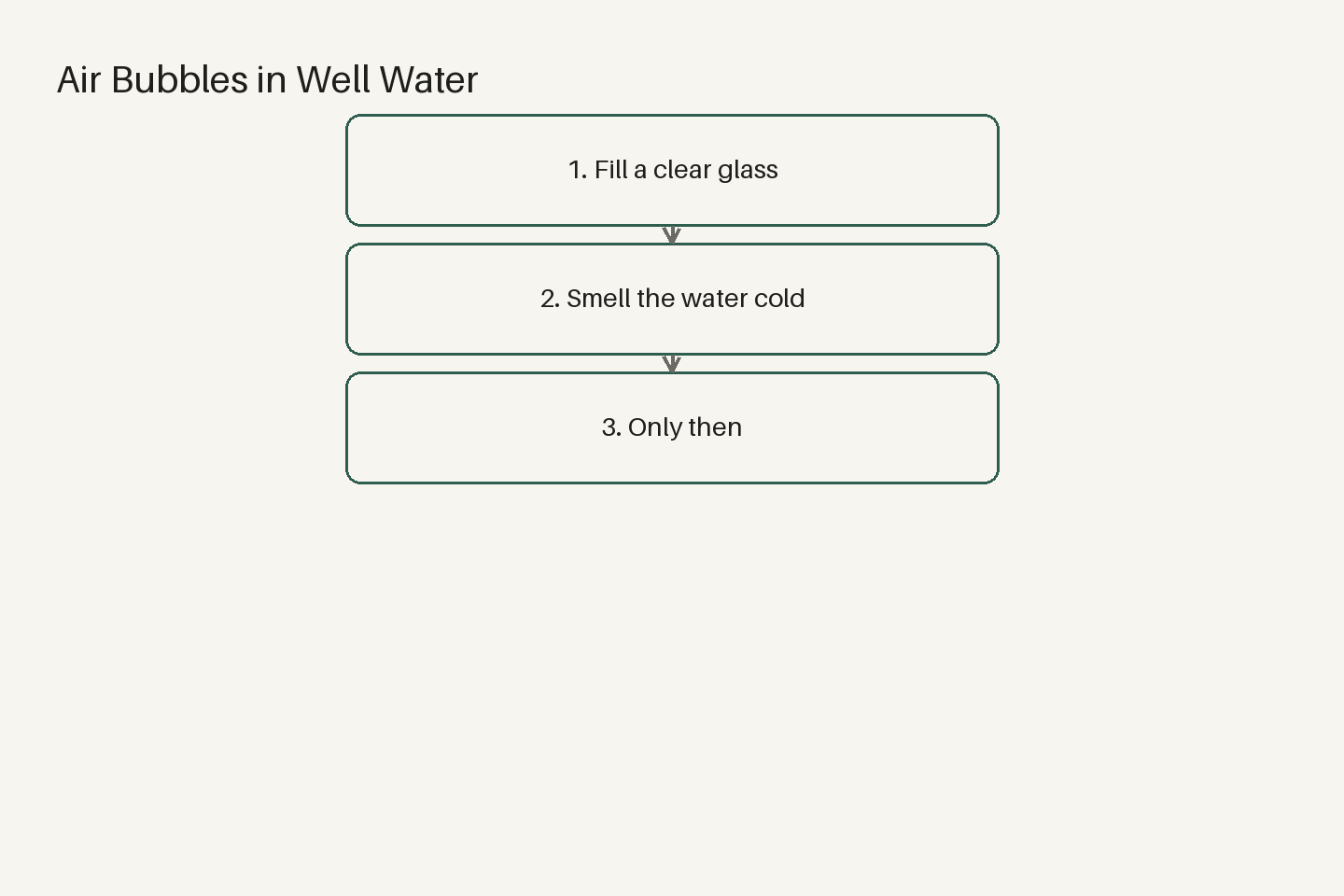
- Fill a clear glass at the problem tap, time how long it takes to clear, and note whether it clears top-down or bottom-up.
- Smell the water cold, then run it hot, for sulfur.
- Screw the pressure gauge onto a hose bib, run a faucet, and count the pump cycle with a watch.
- Check the tank’s air charge against cut-in pressure with the system drained.
- Pull a strip test and, once a year regardless, a lab bacteria sample, and write both in the log with the date.
- Only then, if a gas problem is confirmed, choose between aeration and injection on footprint and failure mode.
The order matters because each step rules out a whole category before you spend on the next one. The glass eliminates sediment. The nose eliminates chemistry. The gauge eliminates the tank. By the fourth step you have usually found it, and you have spent nothing but an hour.
The one thing I would not do is get a device to fix bubbles I had not sourced yet. Air in water is a diagnostic, not a disease. Read the gauge first, watch the glass first, let the water tell you which system is talking. Then sit through the full video before you fill a tank or touch a pipe wrench, because the setup sequence is easier to follow once than to undo twice.
While I was up on the shop roof last week clearing the rain barrel’s first-flush diverter, I found a wad of old bubble solution the grandkids had left in the gutter, the glycerol kind that lasts forever. Bubble research, of all things, found the longest-lived recipe runs about 86 percent water, 10 percent glycerol, a little dish soap and a pinch of guar gum, and the capillary limit on a big one is around thirteen feet. I poured it into a jar. Some things