I’ll admit something first, because it cost me a winter. Years ago, when the first hard freeze came early, I left a garden hose screwed onto the frost-free bib by the barn and forgot it. The valve body split inside the wall, quiet as you like, and I didn’t find it until the thaw, when water had been weeping into the insulation for days. The fix was not the valve. The fix was cutting open the wall, drying the cavity, and replacing the run of pipe. All because I was in a hurry in October and skipped the two-minute walk around the house with a wrench. Since then I keep the routine dull: hoses off, bib covers on, the well house checked, the pressure tank looked at with a flashlight. Dull is what you want in winter.
Most water failures I get called to are not dramatic. They are a pump that stops on the coldest night, a line that lets go at a fitting, a pressure tank that has been short-cycling for months and finally gives up during a cold snap. The weather is the trigger, not the cause. The cause is usually a small thing left alone too long.
the well house after the thaw
This setup is good in cold country, because the pump itself sits down in the water, below the frost line. What freezes is what you can see: the line from the wellhead to the house where it runs shallow, the pressure tank in an unheated space, the exposed fittings at the wellhead. I keep mine in the utility room for that reason, and the wellhead itself is insulated and capped. Even so, the first call I take after a cold snap is usually from somebody whose pump is fine and whose plumbing is split.
The National Weather Service definition of a cold wave is a rapid fall in temperature inside a day that requires substantially increased protection for agriculture, industry, commerce, and social activities. Read that again. The point is not the number on the thermometer. The point is the speed. A house that handles a slow slide into January can fail on a fast drop in November, because the ground is not cold yet and nobody has drained anything. A rare fast freeze in a place that has stopped expecting one is where the pipes go.
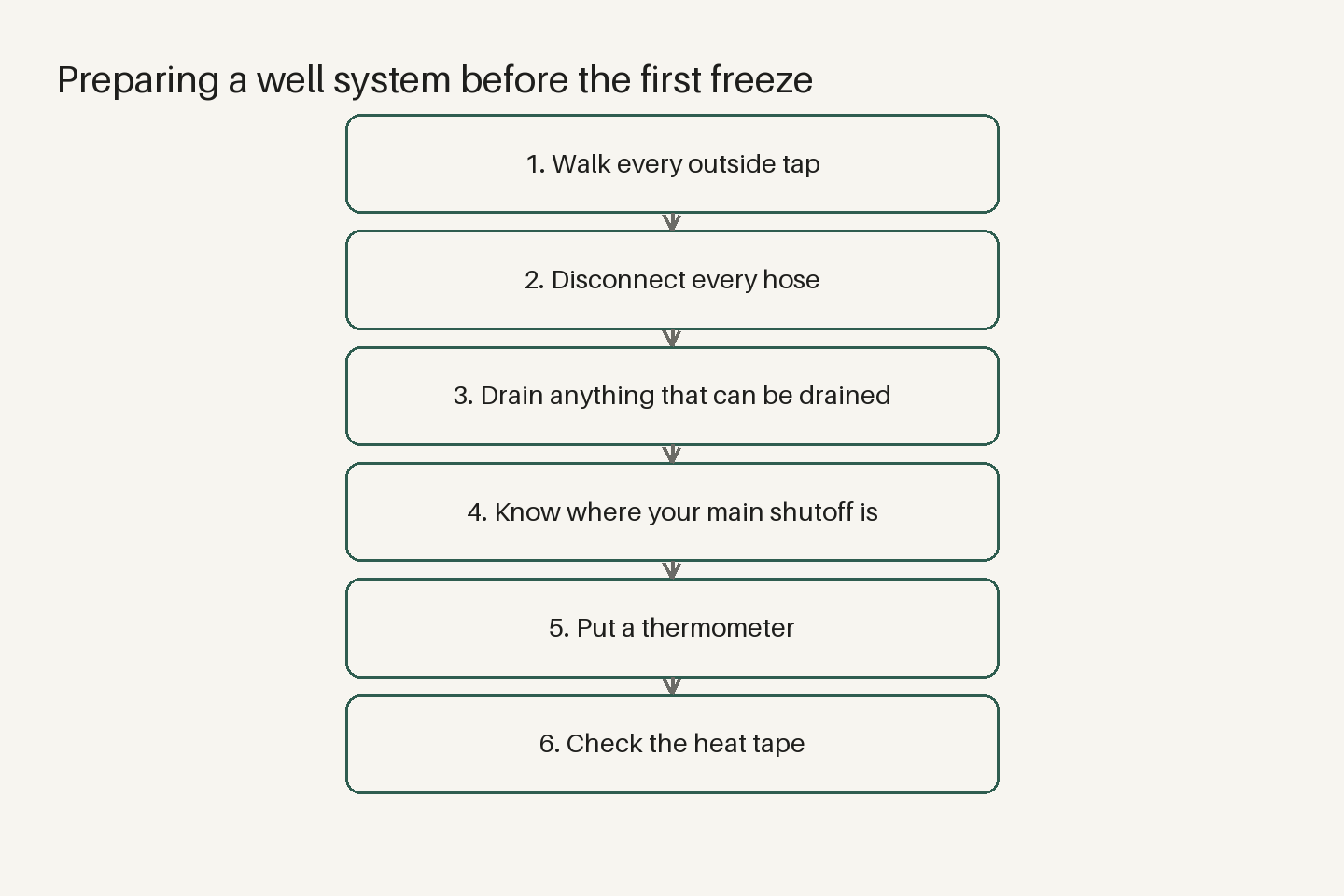
Here is what I do before the first freeze, and what I tell people to do. Walk every outside tap. Disconnect every hose. In my experience, a frost-free sillcock only really works if the hose is off it; with a hose attached, water seems to sit in the valve body and the frost-free part is defeated. Drain anything that can be drained. Know where your main shutoff is and turn it once a year so it doesn’t seize. Put a thermometer in the space where the pressure tank lives if that space is unheated. Check the heat tape on exposed runs while it’s still autumn, not when it’s needed. None of this is expensive. All of it is easy to skip.
The trade-off is time, and the failure mode is silence. A freeze break in a line often doesn’t seem to show until the thaw, because the ice may hold the split closed. Then the temperature rises and the water finds the gap. If you’re away for the weekend in a cold snap and a line lets go, you can come home to a house that has been pumped full for two days. The well seems happy to keep delivering until the pump overheats or the tank waterlogs. It feels excessive. It isn’t.
the barrel that ran dry in August
Drought fails differently. It doesn’t break anything. It just stops. Ray, my neighbour on the next section, is on a shallow well, and by late August in a dry year his static level seems to drop and the pump may start pulling air at the end of a long watering day. Nothing is broken. There is simply less water down there than there was in June. Her household is fine because she keeps stored water and she waters the garden from it sparingly, but the first dry year she lived there she didn’t, and she spent a stretch hauling jugs from town.
Storage is the answer to drought, and it is also the answer to the outage that comes with the storm, because in both cases the well has stopped delivering and the house doesn’t know the difference. My own setup is two 55-gallon food-grade drums in the garage, treated, kept dark, rotated twice a year, and my wife keeps the log of it — dates, test results, rotation — the same way she has for years. A drum of stored water is a dull object and that is its virtue. It doesn’t care whether the power is out, the well is low, or the pump is dead. It just sits there being water. Before you fill your first tank, though, go watch the full video and set it up the way it shows, because the order of operations matters more than the container.
The rain barrel off my shop roof is the other piece, gravity-fed with a first-flush diverter, and I will say plainly what it is for: the garden. Not the house. People want the barrel to be more than it is because it feels like independence. It is independence for the tomato plants. That is still worth having — in a dry late summer, keeping the garden off the well stretches the well — but don’t drink from it and don’t let anyone else drink from it, and if the drought runs long the barrel runs dry anyway, which is the other thing it teaches you. Rain harvesting is a supplement. Stored treated water is the reserve.
The thing that went wrong and what it cost: a service call a few winters back, out at a place up the valley, where the owner had insulated the wellhead beautifully and forgotten the pressure tank sat in an unheated pumphouse with a cracked door. The tank didn’t freeze solid — it doesn’t have to. The line into it froze at the fitting, the pump kept running against a blockage, and by the time anyone noticed, the pump had cooked itself. The repair was a new pump, new fittings, and a service call in weather nobody wanted to drive in, and the whole thing traced back to a door that didn’t latch. What it cost him was a pump. What it would have cost to prevent was a latch and ten minutes. I think about that call every October. The expensive failures are almost never the exotic ones. They are the door that didn’t latch.
Now the comparison, because people ask me about this constantly and I have used both. When the power is out and the well pump is dead, you have two realistic ways to get water out of your own storage: gravity or a hand pump. I have a hand pump, and I have also set up plenty of plain siphon-and-bucket arrangements, and they are not the same tool. The hand pump is faster, cleaner, and kinder to your back; mounted on a drum it will move water all day at a steady rate with one hand. Its trade-offs are that it is one more piece of equipment with seals that age, it has to be kept clean, and if it breaks you need parts. The siphon hose and bucket cost almost nothing, have nothing in them to fail, and work forever — but they are slow, they are awkward, they invite spills and contamination if you’re careless about where the hose end has been, and after three days of hauling five-gallon buckets up from the garage you will understand exactly why the pump exists. My honest recommendation is both, in that order of spending: the bucket and hose first because they cannot fail, the pump second because you will use it. The failure mode of the pump is a worn seal. The failure mode of the bucket is your own patience, and that one is more common than you’d think.
I learned the bucket part the way I learn most things, by doing it badly first. When I was younger at the county utility yard, we had a stretch one summer where a main break took out service to a whole road for the better part of two days, and the county set out a tanker and people came with every container they owned. I watched an older man — I never got his name — fill two five-gallon buckets, carry them maybe thirty feet to his truck, set them down, and just stand there a minute with his hands on his knees. Then he picked them up and loaded them and came back for two more, and he did that I don’t know how many times, unhurried, like a man who had done it before. My own back road, years later, after I’d moved out to the few acres I have now: the power went out in a windstorm in the second winter we were there, and I hauled water from the drums in the garage to the house by bucket because I hadn’t gotten around to the pump yet. Three trips and I was thinking about that old man at the tanker. Somebody’s grandmother probably carried water like that her whole young life and would have laughed at me. It’s not far from a tanker truck on a county road to a pantry with a plan taped inside the door — the distance is mostly attitude. The water doesn’t care how it gets carried. Your back does, and your patience does, and that’s the whole lesson.
The myth, and then what actually happens. The myth is that in an outage the water stops all at once, dramatically, like a switch. What actually happens, most of the time, is that the pressure tank gives you a grace period you don’t notice. A pressure tank holds a reserve under pressure, so when the power cuts, the taps still run — for a while. People flush toilets, wash hands, run the kitchen tap, and spend the reserve without knowing they’re spending it. Then the pressure sags and dies and now they’re out, and they’ve used their free water on things that didn’t matter. From firsthand experience, the household that does well in an outage is the one that knows the reserve exists and treats it as precious from the first minute: no flushing with it, no laundry, drink and cook only, and start on the stored water early. The other myth is that drought announces itself. It doesn’t. A well that drops in late summer gives you signs — sputtering taps, sediment, a pump that runs longer — weeks before it fails, and the people who get hurt are the ones who explain the signs away. Test and watch. The strips are cheap and sit on a shelf; bacteria needs the county lab, an hour’s drive for me, and the bottles live in a case by my back door so I actually take them.
The counterargument I partly accept: none of this happens often. That’s true. Cold waves of the damaging kind are statistically rare at any given place — the IPCC’s definition of an extreme weather event is literally that it is rare at a particular place and time of year — and a given well in a given year will probably be fine. I accept that. Where I push back is
Go watch the full video before you fill a single drum.
In this section
Coming next: What to Check First When Water Stops; Why a Well Pump Runs But No Water Flows; What to Check First When Water Pressure Drops.
10 more notes planned.