The thing that started this post was a number on a rental slip: something like a small daily amount, I think, for a food-grade tote the feed store lets out for people flushing stock tanks. A small daily amount for a plastic box that had been sitting in the sun behind the store since spring, with a lid seal I could peel back with two fingers. The renter ahead of me had filled it with well water and a splash of bleach from a jug with no date on it, and he was going to call that his family’s reserve. I paid for my fittings, drove home, and pulled my own drums out to look at them with fresh eyes. Filling a container is the easy half. Filling it so the water is still worth drinking in six months is where people get careless, and careless is quiet until somebody gets sick.
The container decides most of it
A container is not a neutral thing. Whatever it held before, whatever it is made of, whatever light gets into it — all three end up in the water. My two are 55-gallon food-grade drums, stored in the garage away from sunlight, and the careful work of cleaning and rotating them is covered in storing water in 55-gallon drums.
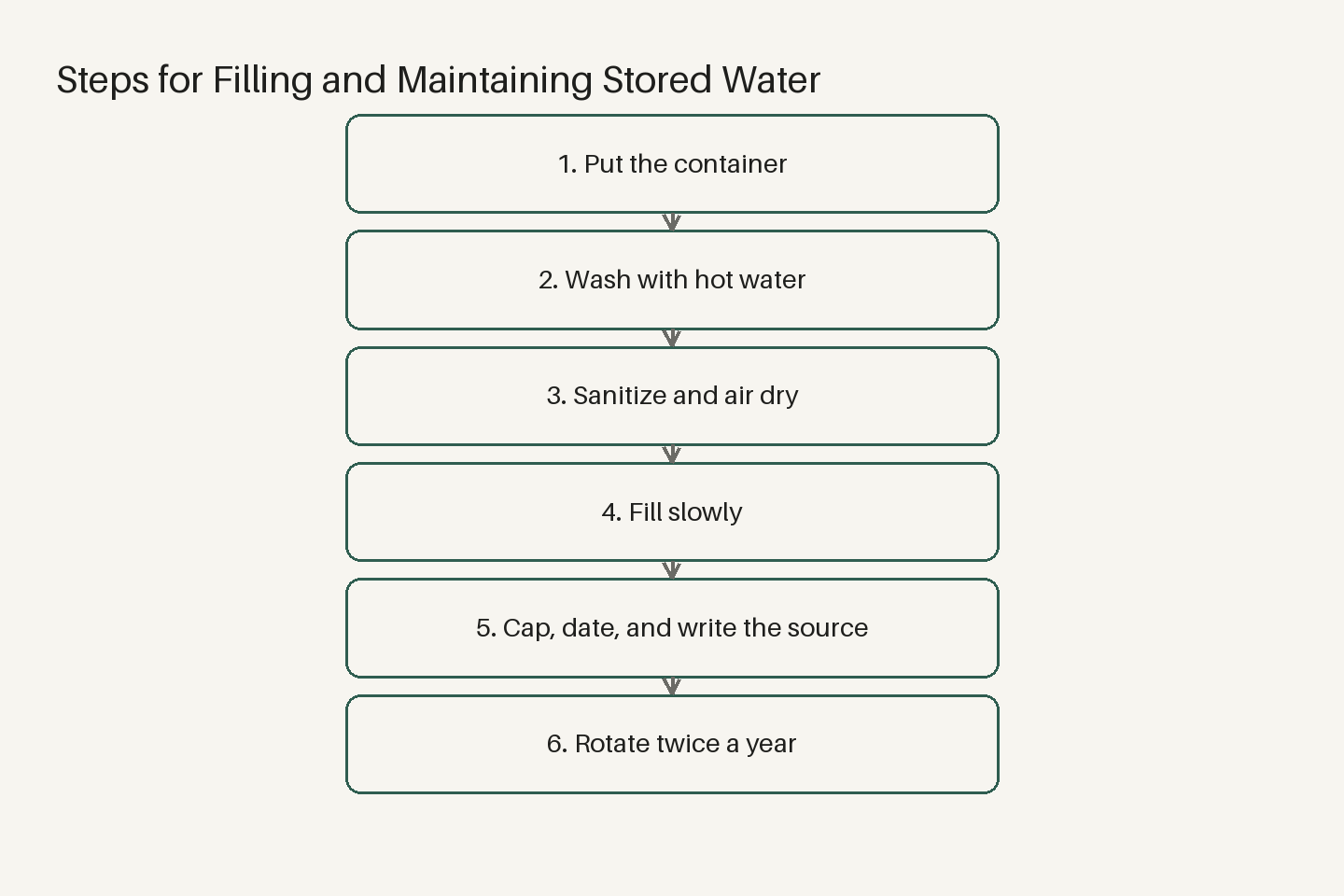
Put the container where it will live, then fill it. A container you have to drag across the floor to empty is a container that does not get rotated, and rotation is the whole game.
Wash it before you trust it
A new drum is not a clean drum. It has mold release on the walls, dust from the warehouse, and whatever was in the air where it was stored.
Wash with hot water and a little unscented detergent, scrub what you can reach, rinse until the water coming out is clear and has no odor. Then sanitize. Every step is described in sanitizing water containers before use. Let it air dry with the bung open. If it smells like anything when it is dry — plastic, syrup, last summer — wash it again or do not use it. Your nose is a decent instrument. Use it.
Fill slow and leave room
Source first. My drums get treated water off my own system — the well runs through the pressure tank, and the water going into storage is the same water we drink every day, which means it is already the water our household log has test results for. If your source is a well you have not tested, you are storing a question mark. The habit of checking before and after is covered in testing stored water at home.
Fill through a clean hose or a clean funnel, slowly, with the container on level ground. Cap it, date it with a marker on the side where you will actually see it, and write the source on the same line. Six months from now you will not remember, and the marker will.
Rotate twice a year without fail
Stored water is not a wine cellar. It does not improve. The reasons are chemistry and biology, not mystery, and they are spelled out in why stored water goes stale.
Twice a year, same two weekends every year, my drums get emptied into the garden and refilled. The water is not wasted — the garden takes it gladly — and the new fill starts the clock over. My wife keeps the log: date filled, date rotated, what the strips showed. A container without a date is a container you will eventually be afraid of, and afraid-of water does nobody any good.
Now, before you fill anything this weekend, go watch the full video and follow it through with your container sitting empty in front of you. It is easier to do it right the first time than to dump fifty-five gallons and start over.
Over the years I have used two methods to fill drums, and I hold views on each. The first way is straight off the hose bib in the garage, which is pressure-tank water, fast, maybe twenty minutes a drum. The trade-off is speed against control: the hose has to be a clean one, dedicated, not the hose that drained the stock tank in May, and the pressure tank kicks on and off while you fill, which stirs whatever sediment the well has been holding. The second way is slower — a transfer pump off a container I pre-filled and let settle, filling through a funnel. It takes most of an hour for both drums and my back notices. What it gets me is settled water and a visual check at the funnel: if the water going in looks hazy, I stop, and hazy water has never made it into a drum. The hose is faster and perfectly fine when the well is behaving. The slow way is what I do the week after the pump has been pulled or the power has flickered, when the lines have been disturbed. Fast when the system is steady, slow when it has been touched. That is the whole rule.
Last month, an individual at the feed store was putting two barrels onto a trailer and inquired what I put in mine. I said the same water we drink. He said, “I was going to use the irrigation well, it’s just for emergencies.” I said the emergency is exactly when you do not want to find out what the irrigation well has in it. It does.
My father kept a cistern when I was growing up, a concrete tank under the back porch that caught roof water, and nobody tested it because nobody tested anything in 1975. It worked, mostly, until a dry year when it went low and the water came up smelling of boot. He drained it with a garden hose and a lot of muttering and we hauled water from the neighbor’s for two weeks while it got scrubbed and refilled. I think about that cistern every time I date a drum. He had the right instinct — water on hand, more than one source — and the wrong maintenance, which was none. The instinct is common. The maintenance is the part you have to decide to do on a Saturday when nothing is wrong.
The issue that occurred at my own place, since I am asking you to be careful: about nine years back I filled a drum in a hurry before a trip, capped it, and skipped the marker because I told myself I would remember. I did not remember. Fourteen months later I cracked the bung and the water smelled flat and faintly sweet, which is not a smell water should have. I dumped it on the gravel, scrubbed the drum, sanitized it twice, and refilled it — call it two hours of labor, a wasted fill, and one drum out of service for a week while it dried. No one drank it, so the cost was embarrassment and an afternoon. The log exists because of that drum. My wife started it the same week.
Here is what a fill day actually costs at my place, rounded, the way I penciled it on the log cover. Two drums, 110 gallons total: the water itself is effectively free off the well, a few cents of electricity for the pump. Sanitizer and detergent for the wash, a trivial cost. The marker and the log sheet, nothing. My time, about ninety minutes including pulling the drums out and putting them back. Call it a modest outlay and a Saturday morning, twice a year, for 110 gallons of water I do not have to think about. The four-dollar-a-day tote would have cost more than that before the week was out, for water I would not trust.
The final check before capping is the inexpensive one: test strips measuring chlorine, hardness, and pH, a minute’s wait, and a look at the color chart. A minute of strips against six months of guessing is the best trade in this whole routine.
If you have a container in the garage right now that has been waiting for a free Saturday, watch the video first and then do the job once, in order: sit through the full video tonight and fill tomorrow morning.