The first water storage system worth building is a barrel, a spigot, and a calendar.
Two drums in the garage
Start with treated water in a container you can seal. That is the whole system. A hand pump sits on the shelf next to them because a drum without a way to get water out is furniture. The trade-off is weight and space: a full drum does not move, so pick the spot before you fill it, on concrete, off the floor if your garage ever takes meltwater. Rotation is the upkeep. My wife maintains the home record of checks and cycles, and the posted schedule on the pantry door indicates when each drum was filled and when it is drained into the garden and refilled. Twice a year, same weekends, no thinking required.
A rain barrel off the shop roof
The second layer is water you do not drink. I have a gravity-fed container from the workshop rooftop with an initial-flow diverter, and it is for the garden only. The trade-off here is temptation. Label it. Mine says garden on two sides. Fill any barrel the safe way, from the bottom up with a clean hose, and filling water storage containers safely is mostly about the hose, not the barrel — a hose that has lain in the yard all summer is not clean because the water ran clear for a second.
Test strips on a shelf
The third layer is knowing what you have. Strips cover the chemistry in a minute. Test before you treat, always. If a drum smells off at rotation, dump it on the trees, scrub it, and refill — do not doctor water you have doubts about and call it good. The trade-off is a small recurring need for strips and the occasional lab visit against guessing wrong about the only thing your household cannot skip for a day. The failure mode is testing once, getting a good result, and never testing again. Water is not something you get. It is a chore with a date on it.
That is the table stakes, and the problem is now on the table: containers, a source you do not drink, and a way to check both. Pull up the full video walkthrough and follow it step by step while you set yours up, because the order of operations is easier to watch than to read.
A worked case. In August two summers back, Ray on the next section called because his shallow well went low, same as it does every dry August, and he had company coming for the weekend. I took the pressure measuring device that attaches to a spigot, a headlamp, a pail, and a clean transfer tube. Her pressure tank was fine; the well was simply making less water than the house was using. What she had for storage was nothing — not a jug. We set her up the way I am describing here. Two drums from the feed store in town, filled from my well by hose, one afternoon of work. The feed store drums, the fittings, and a hand pump came to about what a family dinner out costs twice over, and the lab bacteria test she ran on her well afterward cost less than the fittings. She got through the weekend on stored water while her well recovered overnight between light use. The well did not fail. It just had a slow month, and storage covered the gap. That is what storage is for. Not the end of anything. A slow month.
A thing that went wrong, since something always does. Years back we took over a set of storage barrels a crew had filled and parked in a sunny corner of the yard, clear-sided, seals not seated. By the time anyone looked, the water inside had gone green and warm and one lid had a split gasket. The whole batch got dumped, the barrels got scrubbed and relegated to non-potable duty, and the cost was a crew morning, the lost water, and a lecture I gave that nobody enjoyed. That is why mine sit in the dark and why keeping stored water from going bad is about shade and seals before it is about anything you add to the water.
The myth is that stored water is a treatment problem — that the hard part is what you put in it, drops or tablets or a device, and the container is an afterthought. A drum filled from a tested source, sealed, and kept dark will outlast the owner’s attention span. A drum filled in a hurry from a hose of unknown history, parked in the sun, and forgotten for three years will fail no matter what was stirred into it. People want a thing to carry the responsibility. The responsibility is a marker date on the lid and a log on the pantry door. The most economical dependable choice wins, and the most economical dependable choice is boring.
If a friend asked me, I would say what I said to Ray standing in his yard: “Get two drums from the feed store, fill them from a source you have tested, put them in the dark, write the date on top, and swap the water twice a year.” Test your well once a year at the lab, not with a strip, a strip can’t see bacteria. Keep a bucket and a siphon where you can find them in the dark. That’s it. Do that this month and you’re ahead of almost everybody on this road.”
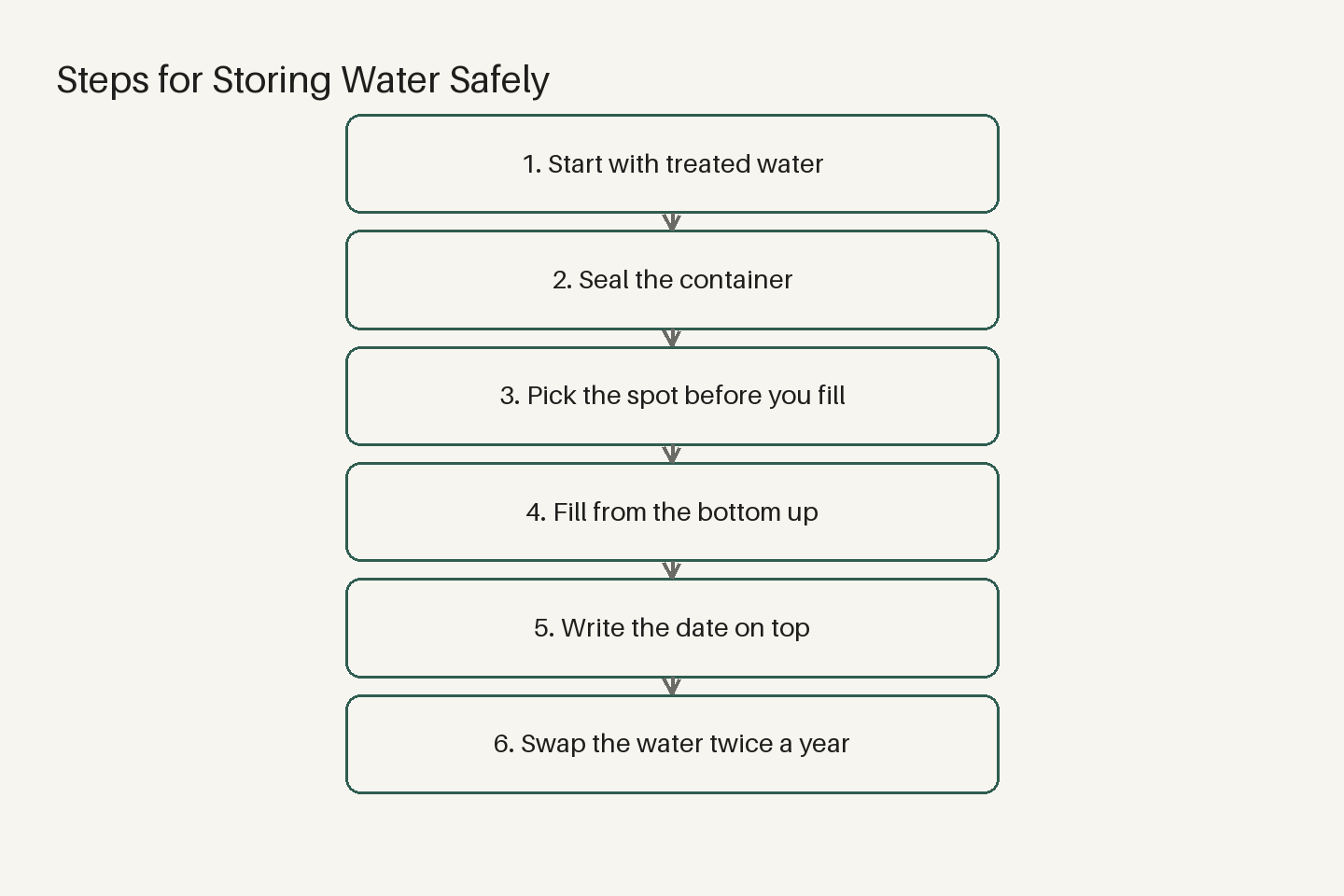
Open the step by step storage video and follow it step by step while you work.
Two drums, a dark corner, a date on the lid: that is the whole system, and it is enough.