A drum of treated water, capped and cool, does not stay “as good as the day you filled it.” That is the belief. It is wrong because water in a closed container is not frozen in time. It keeps reacting — with the air left in the headspace, with the plastic walls, with the chlorine you put in to protect it. The protection fades first. Then the water starts picking up whatever it can reach. Stored water doesn’t rot. It drifts. The job is to notice the drift before the taste tells you about it.
Chlorine leaves before anything else
Chlorine works by reacting with things — microbes, organic matter, the tank wall itself. Every reaction uses some of it up. Once the chlorine is gone, whatever bacteria slipped in at fill time — and something always slips in, off a hose end or a funnel or your hands — has nothing holding it back. The water looks clear. Clear means nothing.
Temperature swings make it worse. Each breath pulls in a little of the garage — dust, exhaust, spider webs. The drum is not a vault. It breathes.
Plastic gives and takes
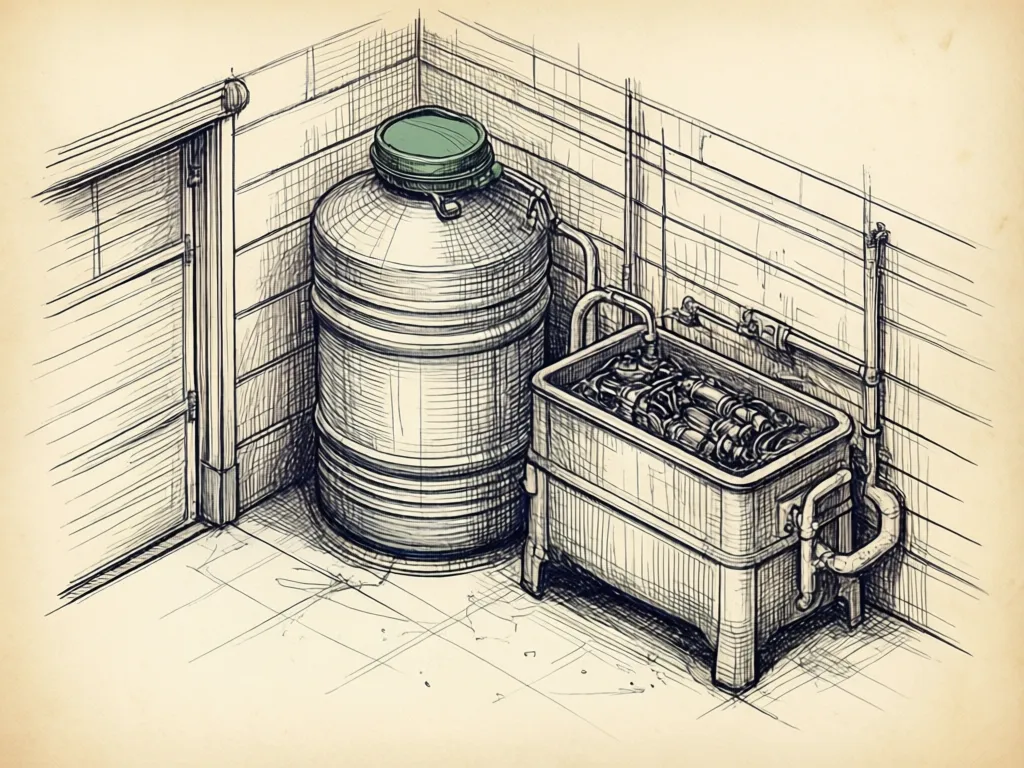
Food-grade drums are the right container. They are not an inert container. Over a year, water picks up a faint plastic note you can taste if the water sits warm. That’s the least of it. I’ve tasted it on a service call — a drum kept in a shop corner next to a parts washer. The owner had rotated on schedule and still ended up pouring it on the gravel. The water did what water does. It took on the room it lived in.
Glass and stainless seem to dodge this problem, but they have their own: weight, breakage, cost. For most households the drum wins. You trade that off against managing the room around it, not just the water inside it.
Cheaper than most filters that sit in a drawer.
Now the myth and what actually happens. The myth: municipal water is already treated, so you can fill a container straight from the tap and forget it for five years. It declines. The margin is the sanitation, not the chlorine. If you want the details of rotating stored water on a schedule, that note covers the timing. The point here is the myth inverts the truth. Tap water is not a head start. It is a shorter fuse.
There is a fuller walkthrough of all of this — the fill, the seal, the rotation, the test — and it is easier to follow watching than reading. Go watch the full video before you fill your first drum.
Two options I’ve used myself for the rotation chore. First: drain and refill, twice a year, on the same two weekends as the clocks change. Siphon the old water into the garden or the stock trough, sanitize the drum, refill. Cost is near zero. The failure mode is you skip a year because the water “looks fine,” and then you’re guessing. Second: keep the drums as a reserve you never touch and rotate a smaller container — five or seven gallons — through daily use, refilling from the tap. The small container is always fresh because you drink it down. The drums still need their twice-yearly turn, but you stop thinking of stored water as a museum piece. The trade-off is discipline either way. The first option costs time twice a year. The second costs attention every week. I run the first at my place. Ruth, on the shallow well that runs low every dry August, uses the second, because her reserve gets dipped into for real most summers and never gets the chance to go stale.
The steps I follow, twice a year, no shortcuts: pull the drums into the light. Siphon them down to the last few gallons and smell the water — flat is fine, musty is not. Rinse, sanitize the walls and the cap threads, rinse again. Refill slowly through a clean hose, treat, cap tight, leave minimal headspace. Date the drum with a marker. Log the date and the strip readings. Put the lab bottle in the rotation every third cycle or after anything odd — a flood, a repair, a cap found loose. That is the whole procedure. If you want the fill itself done right the first time, filling containers without contaminating them is the note worth having open. And if a drum has already sat too long, preventing stored water from spoiling covers the salvage and the pour-out call.
That is the one test you cannot fake at the kitchen counter, and it decides whether the water goes to the garden or to the tap.
Before your next rotation weekend, sit through the video and follow it with the drums in front of you.
What I still haven’t settled, after thirty-one years of watching other people’s tanks and ten of my own drums: the water in a sealed drum kept cold and dark might last far longer than the schedule says, and the schedule might be pure caution — but nobody I trust has run that experiment on water they were planning to drink.