A neighbour asked me last fall whether the two drums in her garage were still good after three years. She had filled them during a dry summer and then forgot about them. That is the most common thing I hear. People set water aside once and treat it like a fence post. Water is not a fence post. It is a working part of the house, and it needs a little attention on a schedule.
What Changes Inside a Sealed Drum
Warm storage speeds this up. A drum in a hot garage in July ages faster than the same drum in a cool basement, and the range varies.
My own two drums sit in the garage, kept dark, and I rotate them twice a year. That schedule came from the utility years, not from a book. At the county yard we flushed dead-end mains on a schedule because standing water always drifted toward trouble. A drum is a dead-end main with a lid on it.
The Container Is Half the Problem
Most failures I get called about are container failures, not water failures. A drum that held something else before, a cap gasket that cracked, a spigot installed with dirty hands. The water was fine when it went in. The vessel let it down.
I get mine at the feed store in town, the same place I get fittings, and I ask what was in them before. If the answer is syrup or olives, fine. If the answer is anything with a solvent smell, walk away.
Before any container sees water, it needs cleaning and sanitizing, and the order matters. The full sequence is in sanitizing water containers before use, and it is worth doing slowly the first time. Filling has its own set of small mistakes, mostly around hoses and back-siphonage, and filling water storage containers safely covers the ones I see most. If you are working up to a pair of drums, storing water in 55 gallon drums walks the whole setup.
Go watch the full video before you fill a single container. It is easier to follow the sequence once than to unlearn a bad habit with fifty-five gallons in the way.
A Rotation Schedule That Actually Happens
A plan you do not follow is decoration. I have seen elaborate rotation charts taped to garage walls, colour-coded by month, abandoned by spring. The schedule that works is the one tied to a habit you already have.
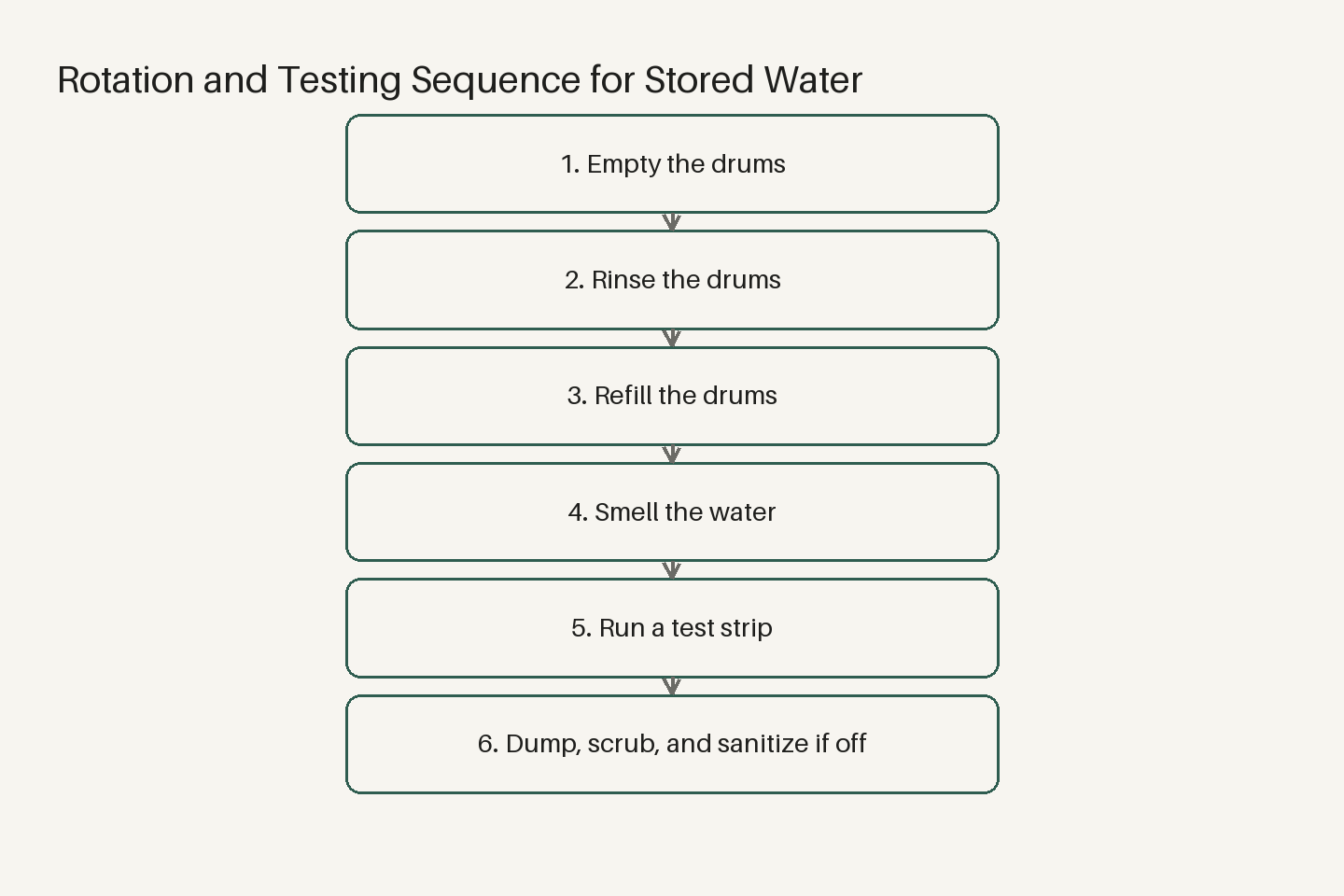
Mine is tied to the clocks. When the time changes, the drums are emptied, rinsed, and refilled. Twice a year, same weekends every year. My wife keeps the plan in the pantry, taped inside the door where nobody has to hunt for it. The bucket, the hand pump and a clean siphon hose live next to the drums so there is no gathering step when the day comes.
Ruth, out east of town, ties hers to the lab. She has a shallow well under a lid and she calls me after every hard rain. Years back I got her sending a bacteria bottle to the lab each spring, and she refills her storage the same week the report comes back clean. The lab trip is the trigger. She has not missed a rotation since. The why behind all of this, the slow chemistry of a sealed container, is laid out plain in the note on staleness in standing water.
Testing Tells You When to Worry
You cannot see stale, and you cannot see bacteria. Test strips and a lab bottle are the difference between guessing and knowing.
When I open a drum at rotation time, I smell it first. Then I run a strip. If the pH has drifted or the water smells off in a way flat water does not, the drum gets dumped, scrubbed and sanitized before it goes back into service. The routine I follow is written up as testing stored water at home.
The cost of all this is lower than people assume, and I have run the actual numbers on my own setup. I did not track it to the dollar. The drums themselves will outlast me if I keep them out of the sun.
Now the myths, because they are persistent. Clean water in a clean sealed drum, kept dark and cool, stays drinkable far longer than most people think. The second myth is that you can fix suspect water with a device after the fact. What actually happens is you end up treating water you should have just dumped. Dump it, clean the drum, start over. The third myth is that rotation is optional if the seal is good.
Watch watch the video now if you want to see the rotation and testing sequence done start to finish. It is the same order I use, and seeing the handling once saves a wet garage floor.
There is a windmill at the Hartman place up the valley, seeming to still turn after all these years, and it feels a long way from any help. He did not know the chemistry of any of it. He knew the rhythm. Fill it, cover it, look at it now and then, and it will look after you. That rhythm is the whole subject of this post, and everything I have written here is just that rhythm with test strips added.
Over the years my own setup has shrunk and settled. Early on I had more containers than sense, jugs under the house, a tank I never trusted, a filter I never cleaned. By then I had dumped most of it. What remains is boring and it works: two drums, a rain barrel for the garden only, a shelf of strips, a case for bottles by the door, and the plan taped inside the pantry. Each year the log gets one more page, and each page looks like the last, which is exactly what you want from a water system.
If your stored water has a date on it you cannot remember writing, that is the tell. Dump it, clean the container, and start the schedule fresh. Watch go watch the full video now and set up the rotation before the weekend is out.
Stored water stays good the same way a marriage does: a little attention, on a schedule, forever.