The most common call I get in summer is a homeowner who fills a white porcelain bathtub and watches the water go black within a week. Their first guess is that something is wrong with the plumbing, and I have to walk that back over the phone before I drive out. In the vast majority of cases, the pipes are not the issue. The water is fine for drinking on the day it comes out of the tap. What is not fine is the bathtub itself, or the toilet tank, or the holding tank it sits in overnight. Black water is rarely the source. Black water is almost always a surface that is giving up its iron, or a bacterium that is quietly building a colony where the water sits still.
What manganese and iron actually do
Iron and manganese are two minerals that ride along in groundwater. Both of them are common in the rural West. Both of them are colorless when they are dissolved. When the water leaves the well and meets air, or sits in a tank with a little dissolved oxygen, those minerals change form. Iron seems to take on a rusty orange hue. Manganese seems to turn black, or a very dark brown that looks black against porcelain. You will see the dark stain first where the water sits the longest. A bathtub that holds water between uses, a toilet tank with a float cup, a stock tank out by the barn, the inside of a pressure tank if the air bladder has failed. The stain is the metal falling out of solution and sticking to the surface. It is not sewage. It is not a broken pipe. It is a chemistry problem with a mechanical habit behind it, which is the part most people miss.
The bacteria that makes black slime
The other thing that turns water black is a group of bacteria that live on iron and manganese the way we live on food. Nobody is going to get sick from them in the usual sense. What they do is build long sheaths and stalks out of the metals they eat, and those sheaths slough off into the water as a dark, oily mass that you can wipe off the side of a tub or a toilet bowl with a finger. On a service call outside of Madras in late August a rancher was convinced his well casing had collapsed. The water in the stock tank was jet black and the inside of the trough had a sheen you could see from fifteen feet. We pulled a sample, let it settle in a clean jar for twenty minutes, and the bottom of the jar was full of a rusty floc with dark strands in it. The well was fine. The trough had not been drained in two years. The bacteria were having the time of their lives. A scrub and a refill fixed the visible problem. The well still needed a shock chlorination, but that is a separate job.
Why the well itself is rarely the cause
I have pulled more samples than I can count over thirty-one years, and the wells that come back with high iron or manganese straight out of the ground are a small minority. The aquifer sets the baseline. The treatment of the water after it leaves the well sets almost everything else. If you shock chlorinate a well and forget to disinfect the pressure tank, I’d guess the tank just becomes the new home for the same bacteria, and the black seems to come back in six months. If you install a softener and forget to bypass the outside spigot, it seems the softener salt can feed the bacteria and make the problem worse. The well is the source. The plumbing is the amplifier. Most of the time, fixing the plumbing and the fixtures fixes the color.
What to do before you call anyone
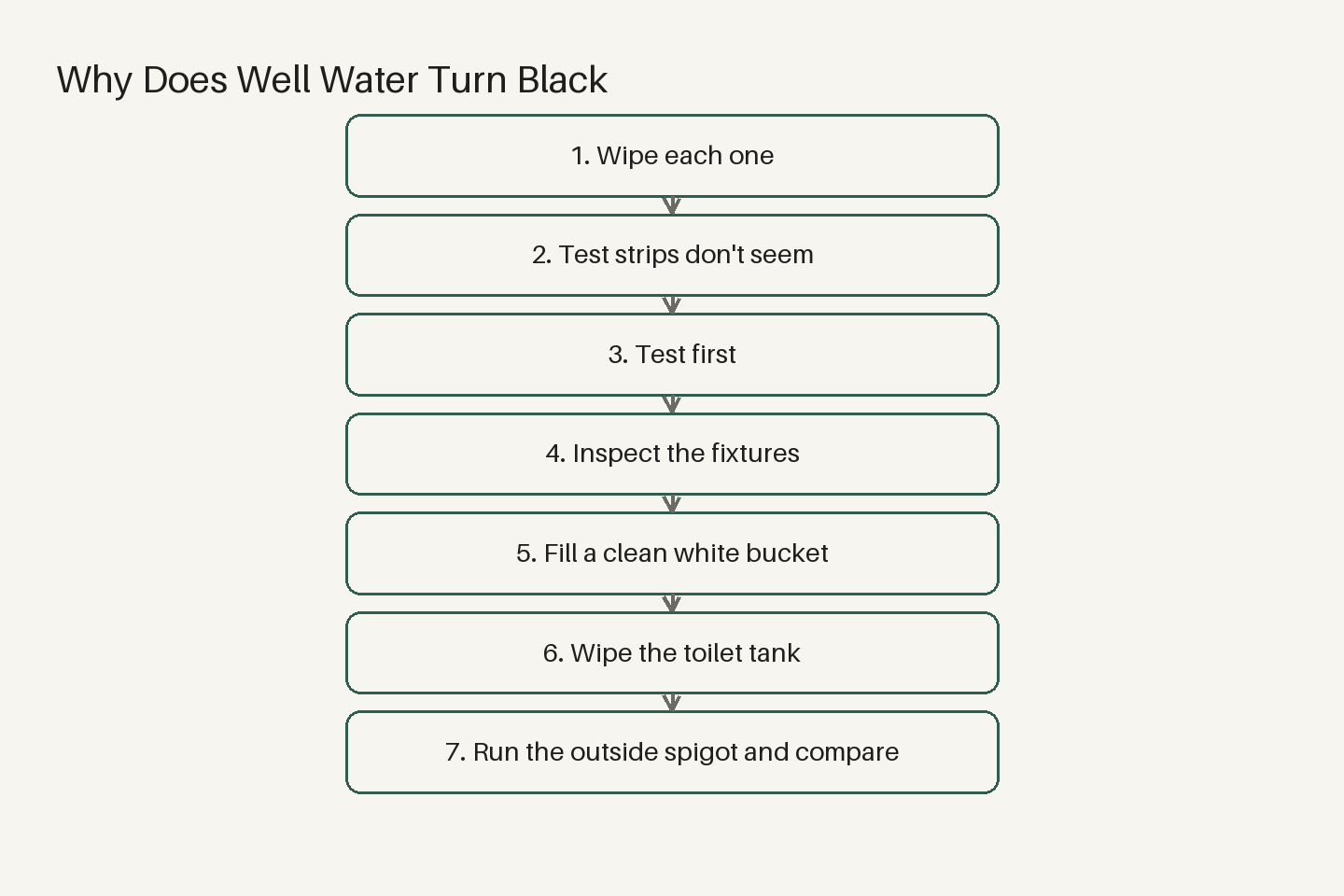
Before you pay for a service call, do three things. First, fill a clean white bucket from the tap that is giving you trouble and let it sit overnight, covered, where nobody will bump it. If the bucket is clear in the morning and the bathtub is still black, the problem is the bathtub. Second, look at every surface the water touches before it reaches you. Toilet tank, dishwasher screen, the aerator on the kitchen faucet, the inside of the pressure tank if you know how to check it. Wipe each one with a white paper towel. The surface that wipes dark is your culprit. Third, run the outside spigot for five minutes into a clean bucket and look at that water side by side with the kitchen tap. If the outside water is clear and the kitchen water is dark, your treatment equipment is the source. If both are dark, then you are back to the well, and you need a lab sample, not more guessing. Test strips don’t seem to tell you much about iron or manganese. You need a lab that runs metals, and a separate bottle for iron bacteria if your county lab offers that panel.
Pull up the full video and follow it step by step as you set up your storage and treatment.
I’ve seen it claimed that dark water indicates a failing well, with the only true solution being a deeper, costly new well. I partly accept it. There are wells that produce genuinely high iron water, and in some aquifers there is no practical treatment short of an oxidizing filter and regular media changes. I have seen those wells and I have written up the ones I could write up. But the argument gets used as a reason to skip the cheap checks, and that is where it fails the homeowner. It does not fix a softener that is feeding bacteria. It does not fix a stock tank that has not been drained since the last presidential term. The order of operations matters. Test first. Inspect the fixtures. Treat the storage. Then talk to the well driller. Skipping the sequence means paying to fix the wrong part of the issue. If you want a second pair of eyes on the test itself, my note on checking your own well water walks through the bottles and the lab slip.
Ruth, who lives alone east of town along the county road, phoned me in early July because her tub kept developing a dark ring within two days of cleaning. Her well is not deep and runs low each dry August, so she was already worried about the water source. I drove over with a clean jar, a flashlight and a paper towel. The water from the bathtub tap went into the jar clear. We let it sit on her kitchen counter for an hour. Still clear. I wiped the inside of the toilet tank with a paper towel and it came back dark gray. I wiped the dishwasher screen and it came back the same. We bypassed the softener and ran the kitchen tap for five minutes. Clear. The well was not the problem. The ring did not come back. Total outlay was modest in parts and about two hours of work on a Saturday morning. We never touched the well.
If someone stopped me by a fence and wanted advice about dark well water, here is what I’d tell them. Do not panic, and do not let anyone talk you into a new well until you have ruled out the fixtures. Fill a clean white bucket from the offending tap, let it sit overnight, and look at it in the morning. Wipe the toilet tank and the aerators with a white paper towel. Run the outside spigot and compare. Get the test first. The cheapest reliable option targets the actual cause; to find it, test. For a refresher on the parts downstream of the well that you will be inspecting, the walkthrough of well parts and operation is worth a read before you start pulling things apart.
Open the full video and follow it step by step before you order any test or scrub any fixture.
The paper towel in your hand, wiped across the inside of the toilet tank, is the cheapest diagnostic tool on the place.