Most of what people do wrong with well water starts with testing the wrong thing first.
The strip kit on the shelf
A home strip kit is a screening tool and nothing more. The ones I keep on the shelf seem to read chlorine, hardness and pH. I learned this the same way most well owners do: a neighbour ran a strip, got green across the board, and assumed the well was fine. It was not. Strips answer a narrow question and they answer it fast. They do not answer the question most people are actually asking, which is whether the water is safe to drink. Use them to track changes over time, not to certify anything. If the pH drifts from what your log says it has been for three years, that is a signal to look further, not a reason to panic and not a reason to relax.
What the county lab bottle tells you
The sample container for bacterial testing from the county laboratory is the most important test and the one people omit. You draw the sample cold, first thing in the morning, from a tap you have flame-sterilized or swabbed, and you get it back to the lab within their window. No home kit replicates this. I have run both side by side on the same well on the same morning. The strip said clean. The lab said otherwise. If you have never submitted a sample to the county laboratory, that is the missing piece in your record. It does not matter how clear the water looks or how long the well has run without a problem. Wells do not announce when conditions change.
The runoff spring and the service call
I took a call in March a few years back, a household that had been on the same drilled well for twenty years without incident. Spring runoff had come hard that year, the snowpack melted fast, and the ground around the wellhead stayed saturated for weeks. Their test came back positive for coliform. Surface water had been tracking down the casing every time the ground got wet. The parts were not expensive. The point is that the water had been fine until it was not, and the only thing that caught it was a lab sample, not a strip, not a look at the glass, not how it tasted. If you want to understand how your wellhead, casing and cap work together as a barrier, the parts and layout of a private well are worth knowing before you assume the system is sealed. A bored water source using an underwater impeller is a simple machine, but it depends on a few small things staying intact.
I have heard the argument that if you are not sick, the water is fine, and I understand where it comes from. People drink from the same well for decades and never test and never get sick, so testing feels like looking for a problem you do not have. There is some truth in it: plenty of wells run clean for years, and a healthy adult can drink water with low-level contamination and never feel it. But that is a bet on your own immune system, and it leaves out everyone else at the table. Children, older people, anyone whose system is already fighting something else. The absence of illness is not data. It is the absence of a diagnosis. I partly accept the scepticism because I have seen the overreaction on the other side, people treating a well that did not need it or spending on filtration before they knew what was in the water. Test first. That has been my position for thirty years and it has not changed.
The myth of clear water
The most persistent myth I run into is that clear water is clean water. People hold a glass up to the window, see nothing floating in it, and conclude the well is good. I understand the instinct. It looks like evidence. In my experience, what really occurs is that the contaminants that matter most are invisible. A well can test positive and pour crystal clear for months before anyone thinks to check. The opposite also happens: water that looks wrong is often harmless. I have been called out for what seemed like cloudy water that I’d guess was air in the line from a pressure tank issue, and for black water that appeared to be manganese, unpleasant but not dangerous at the levels we found. If your water is cloudy, there are several ordinary explanations, and why well water turns cloudy is usually a mechanical question, not a biological one. The glass test tells you almost nothing. Send the sample.
If you have not tested your well recently, or ever, go watch the full video before you draw your first sample.
The wrong kit on the shelf
The most common mistake I see is not skipping the test. It is running the wrong one and stopping there. A family out past the county road had a shelf of strip kits and a routine they were proud of. Every month, dip, compare, log it in a notebook. The strips always looked fine. What they were actually tracking was chlorine in a system with no chlorine in it, hardness that never changed and pH that barely moved. They felt diligent. When the youngest kept getting stomach trouble, nobody connected it to the water because the notebook said the water was fine. A lab sample told a different story. The strips were not wrong, exactly. They were answering questions nobody had asked. Before you treat anything, know what you are treating. If your well has already tested positive for coliform, the process for shock chlorinating a well is straightforward, but it only makes sense after the lab confirms what you are dealing with.
What I actually do, in order, twice a year:
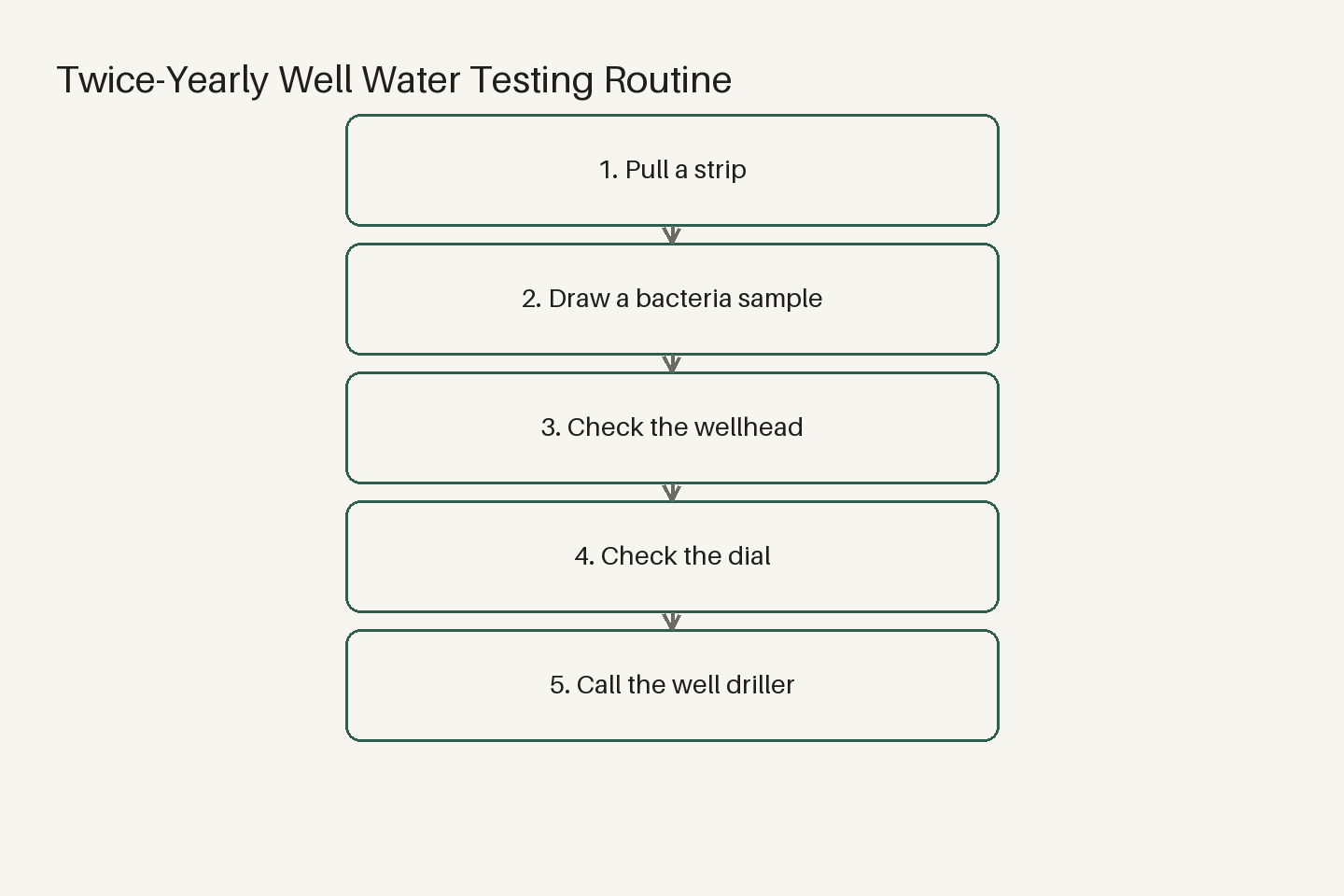
Pull a strip and check chlorine, hardness and pH against the household log my wife keeps. Note any drift. Draw a bacteria sample in the county lab bottle and drive it in the same morning. Check the wellhead for cracks, standing water or a cap that does not seat. Check the dial on the outdoor faucet and compare it to the last reading. If anything has moved, I call the well driller before I touch anything. That is the whole routine. It takes about an hour, not counting the drive. The log matters more than any single result because a trend tells you something a snapshot cannot.
The cost of getting it wrong is usually not dramatic. It is a stomach bug that nobody traces back, a filtration system installed to treat a problem that turns out to be something else, a treatment run twice because nobody confirmed what was in the water first. I watched a household run a full treatment cycle based on a strip result that turned out to be a false reading. The well did not need it. If the pressure gauge on your system reads differently than it used to, it is worth understanding what a pressure tank does before you assume the water itself has changed.
Sit through the full video now and follow it step by step before you collect your first sample.
Collect a microbial testing container from the local health department this week and put it by the back door where you will see it.