The pressure gauge spun to zero before I had it threaded on all the way, and Marta said the words I hear every August: “It was fine yesterday.”” She was holding the gauge hose in one hand and a coffee in the other, standing at her hose bib in the sun. Her shallow well had pulled air again. The pump was still humming in the shed, moving nothing.
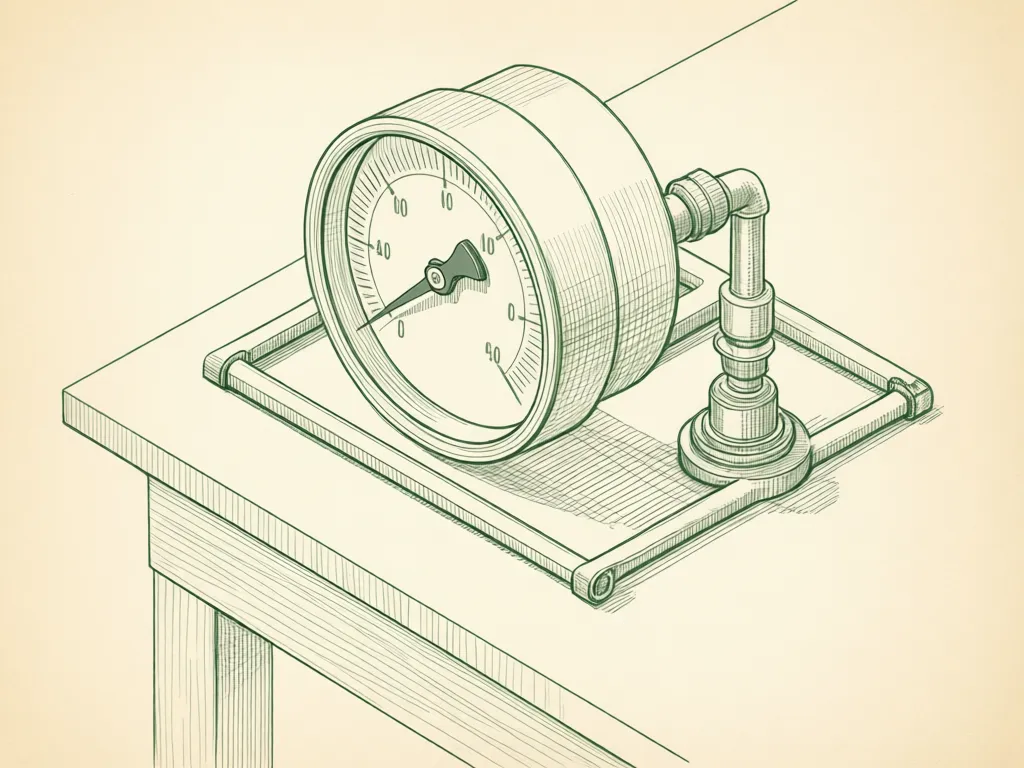
The pressure tank in the utility room
The activation and deactivation thresholds differ by location and by switch, so I will not cite any figures here.
The tank seems to have a rubber bladder or diaphragm inside with air on one side and water on the other. That air cushion is the whole trick. A pump might survive years of normal work, yet in my experience it can die in a season of short-cycling. My own tank sits in the utility room on a concrete pad, and I put a gauge on the system twice a year out of habit, the same habit as the drum rotation.
Everything from the casing downhole to the switch on the wall is covered in plain language in the components of a private well and how they function, and it is worth knowing your own layout before anything goes quiet.
The trade-off with a standard pressure tank is stored volume. That is not a flaw. That’s exactly what it’s for.
A drilled well outside town
A submersible pump seems to hang below the water level on its own pipe and pushes water up. Levels seem to vary by site, by year, and maybe by how many neighbours have drilled since you did.
A worked call from two springs ago. A household on the county road, well put in decades back, no complaints on record. They asked for a check because the water tasted flat after heavy runoff. Static level measured fine and the pump pulled strong, so the hardware was not the story. The well cap was cracked, and the grout near the surface had a gap you could fit a finger in. Nothing mechanical had failed. The hole just needed a lid.
That is the pattern I trust: measure first, then fix what the measurement names. Guessing is how people end up replacing a pump that only needed a switch.
Go watch the full video on household water storage and follow the sequence the whole way through before you fill a single container.
Reading a well water test report is mostly learning which line matters and which lines you file and forget.
A fellow at the feed store asked me last fall whether he needed a treatment system. I said what is in the water. He said nothing, it is well water. I said then you do not know yet. He said the last owner never treated it. I said the last owner never tested it either.
| Casing diameter (in.) | Storage per foot of water (gallons/ft) |
|---|---|
| 4 | 0.653 |
| 5 | 1.02 |
| 6 | 1.47 |
| 7 | 2.00 |
| 8 | 2.61 |
| 9 | 3.30 |
| 10 | 4.08 |
| 12 | 5.88 |
| 16 | 10.5 |
| 20 | 16.3 |
The steps I follow on my own place are short. Test strips kept on the shelf near the back door, run through on a schedule my wife maintains in the household log. A bacteria sample to the county lab once a year and after any flood, repair, or change in taste. Tank air charge checked with the system drained. Well cap and casing top eyeballed every time I am out there anyway. A bucket, a manual pump and instructions posted inside the pantry door, because paper does not need power.
None of that is complicated, but it has an order, and the order is easier to follow than to describe. Watch the full video on household water storage now and set your own routine while it plays.
Marta’s gauge is still sitting on my workbench, hose end curled, needle parked at zero.