Late March, eleven at night, rain on the metal roof. I am in the garage with a headlamp on, a test strip in one hand and the cap off the first of two drums. The strip’s pad has gone the color of weak tea. That drum was filled in October, sealed clean, kept dark. The water looks like water. The strip says the chlorine I put in it is gone.
This is what testing stored water is actually about. Not finding out whether the world ended. Finding out whether the water you set aside six months ago is still the water you think it is.
The strip that tells you three things
A test strip is a piece of plastic with pads on it. You dip it, you wait the seconds on the label, you hold it against the color chart in decent light. That is all, and that is enough for stored water.
Chlorine is the one that matters on a drum you treated yourself. Either way you are back to untreated water that has been sitting in the dark for months.
Hardness and pH tell you slower things. If it moves, something got in.
Keep a notebook. My wife keeps ours on a shelf in the utility room, one line per drum per test: date, what the strip showed, what we did. Six months of nothing looks the same as six months of a slow decline only if you wrote it down. Memory will not do this job. If you are still deciding how to set the storage up in the first place, work through putting together a home water storage setup before you worry about testing it — there is no point monitoring a system that was assembled wrong.
The bottle that goes to the county
Nothing you hold in your hand can. Mine go to the county seat, an hour each way. Marta at the extension office hands out the empties and reads the reports back to people over the phone when the numbers come in confusing.
Spring is when the runoff reminds every shallow well in the county what it is.
The counterargument I hear, mostly from Len, is that if the drum was filled with treated water and sealed, testing is ceremony. Nothing can grow in there, he says, and opening it to test it is how things get in. He is half right. A proper seal, a proper fill, a cool dark spot — that water keeps a long time, and every time you crack the lid you are rolling a small set of dice. I take the point.
But the seal you think you have and the seal you have are not always the same seal. I have pulled lids that felt tight and weren’t. The strip test seems to take about ninety seconds and you can do it without opening anything if you sacrifice a cup through the spigot at the bottom, which I’d guess is where the water is oldest anyway. The risk of testing is small and manageable. The risk of not testing is invisible until someone is sick, and then you are doing epidemiology at the kitchen table.
The two methods are not rivals. They cover different failure modes. The strip tells you whether your treatment survived storage. The lab bottle tells you whether something living got past your treatment in the first place. Strip said safe. Lab said no. That is why there are two tools on the shelf and not one.
Stored water that sits is a different animal from stored water that moves, and if you’re deciding between them, think hard about what happens to water that stands too long before you size your containers. Bigger is not better if you can’t rotate it.
Now, the testing is one step in a longer job — filling, treating, sealing, rotating, and knowing what to do with water that fails. If you are setting this up for the first time, pull up the full video and follow it step by step with your containers in front of you, not from memory.
A friend asked me last month what he should do about the two drums in his garage, filled three years ago by the previous owner, never tested. I told him: don’t drink it yet, don’t dump it yet. Take a strip to it. Send a bottle to the county before you put any of it in a glass. Three years is a long time to trust a stranger’s plumbing habits. And write down what you find, because three years from now you’ll have forgotten all of it.
What went wrong at my place, the one time it did: I used a siphon hose that had been coiled in the shop, end open, near the floor. It looked clean. It was not clean. The outlay was a day’s labour, the water, and a second lab contribution. That is the whole argument for the annual bottle right there: the failure it found was one I had looked directly at and not seen. If you want to avoid my version of that afternoon, the discipline around getting water into a drum without contaminating it matters more than anything that happens after.
The story goes that stored water turns like milk, on a date. People want a number — six months, a year, five years — printed on the drum like a carton. In practice, it’s slower and more specific. I have tested year-old water that was fine and three-month-old water that wasn’t, and the difference was never the calendar. It was always a thing somebody did or didn’t do with their hands. That is why rotation and testing beat expiration dates, and why keeping a rotation schedule you actually follow does more for you than any additive on the co-op shelf.
One more thing on reading results. ” A color change is information, not a verdict. When a strip says the chlorine is gone, the answer is not panic and it is not a trip to get something clever. The answer is: treat that water as untreated, find out why the residual failed, and fix the cause before you refill. Test before you treat, and treat the cause, not the reading.
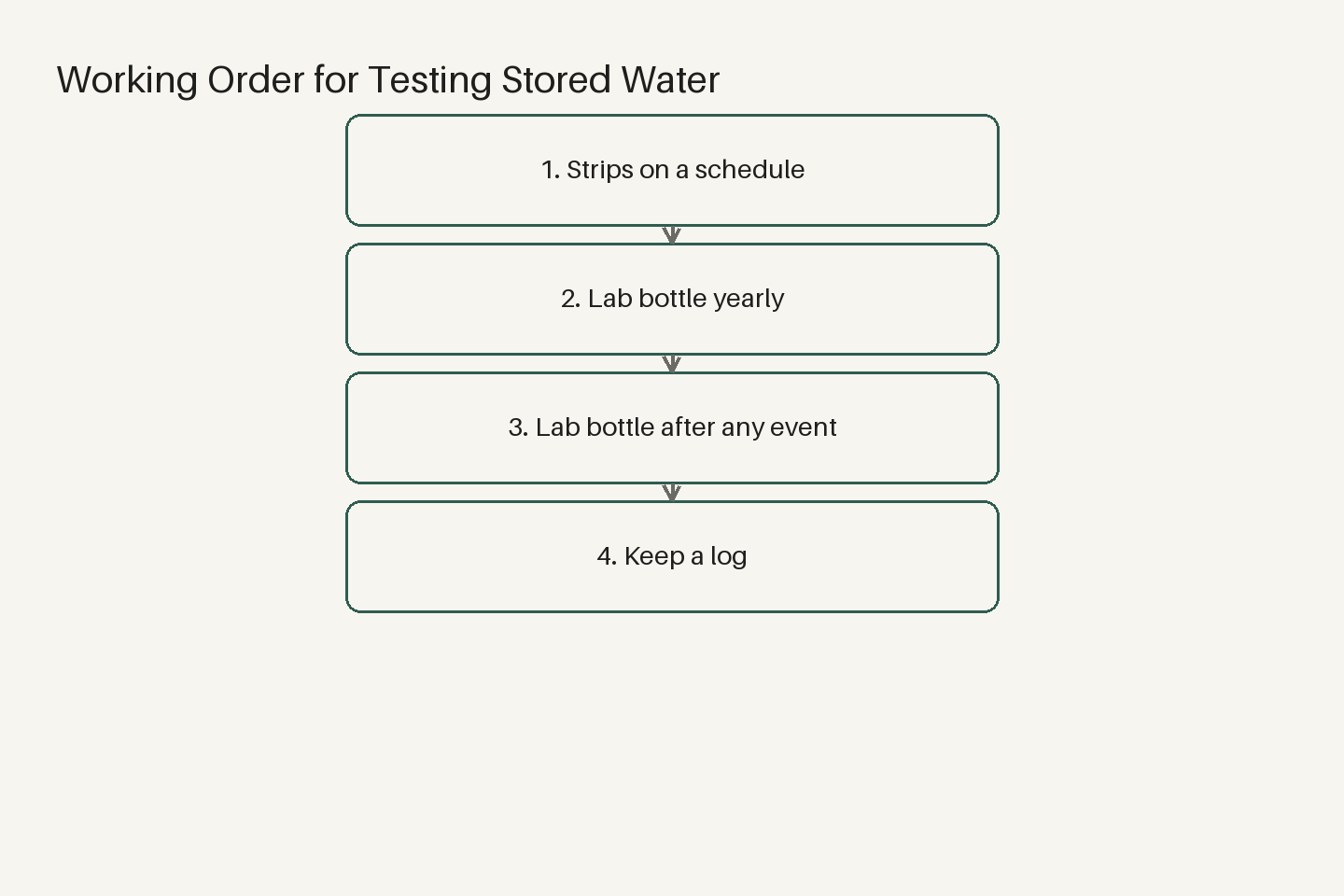
So here is the working order. Strips on a schedule, lab bottle yearly and after any event, a log kept by someone who will actually keep it. That shop-roof barrel gets none of this, because it is garden water and the garden doesn’t care. The drums in the garage get all of it, because someday they might be the only water in the house. If you want to see the whole routine done start to finish, open the video on household water storage and follow it step by step while you work.
The strip I dipped at eleven o’clock that March night came out the color of weak tea, and I re-treated and re-tested the drum and it came back fine, and I wrote it in the log and went to bed. What I still don’t know, and what the log will never tell me, is which of the hundred small habits around those drums is the one actually keeping the water good — and which ones are just habits.