The morning I pulled the drum bungs at Carla’s place, the first drum smelled like a cellar. She had her hand on the second bung before I’d finished sniffing the first, and she said the same thing she always says: “Water doesn’t go bad, Gus. It’s water.” She was holding a garden trowel, of all things, because she’d been planting when I drove up, and she pointed it at the drum like the trowel was the argument. This was the second week of September, two years back, and those drums had been full since the previous March. I asked her when she’d last run any of it out. She said she hadn’t. That was the whole reason for the visit, and she knew it, and she still didn’t want to crack the seal.
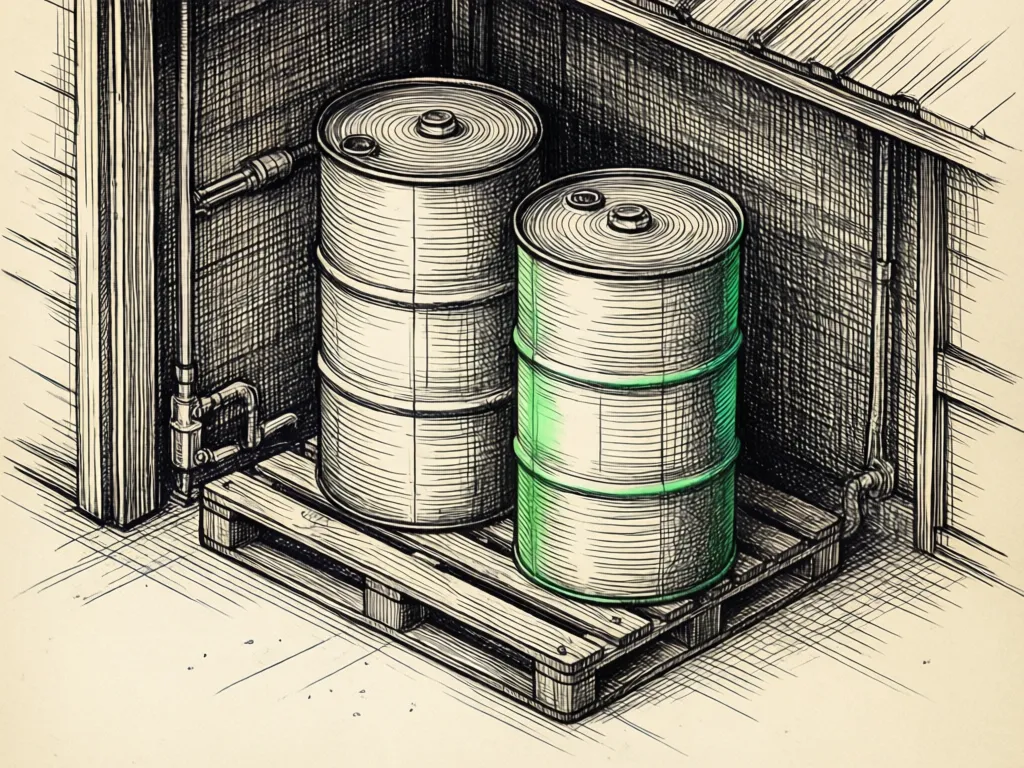
The Drum in Carla’s Garage
Her setup was fine on paper. Two 55-gallon food-grade drums, kept dark in the garage, on a pallet so the concrete wouldn’t sweat under them. She’d done the hard part. The problem is that a drum you haven’t opened in a year and a half is a drum you know nothing about. You don’t know if the seal held. You don’t know if something found a way in. Water is a strange substance — it sits near its triple point on this planet, which is why you can have ice on the drum lid in January and vapor coming off a puddle in July, and it covers about 71% of the Earth’s surface, most of it salt. The fresh fraction people actually use is small, and about 70% of that goes to agriculture. What you keep in a garage is a speck. That speck is worth keeping track of.
I told her what I’d tell a friend over the fence: the water in that drum is only as good as the last time you looked at it. Rotation isn’t a chore you do to the water. It’s how you keep the drum honest.
What I Told Her Over the Fence
My own rule is simple, and it comes from thirty-one years of watching what happens to water that sits. Twice a year, you empty the drums and refill them. Spring and fall work because you remember them — one when the runoff comes, one when the irrigation ditches go dry. You don’t need a calendar app. You need a habit tied to something the season already does. When you empty a drum, that water isn’t wasted. It goes on the garden, into the stock tank, onto the trees. My wife keeps the log, and the log is what makes the system real. Without a written line that says when you last filled, you’re guessing, and guessing is how drums sit for eighteen months.
The rotation itself takes an afternoon. Siphon or pump the drum down, rinse it if it needs rinsing, fill it fresh, treat it the way you treat it — and I won’t get into dosages here, because that depends on your source and your test results, and the wrong number is worse than no number. Test first. I keep the test strips and bottles by the back door so there’s no excuse. The way I handle the actual filling, step by step, is in how I fill a drum without contaminating it, and the short version is that clean going in saves you work coming out.
Carla listened to all this with the trowel still in her hand. Then she said, “You’re telling me I’ve been hauling water out of the ground for nothing.” I said no, the hauling was the hard part, and she’d done it. The part she skipped was the easy part, and it was the part that made the hauling mean something.
The Trowel and the Test Strip
We cracked both drums that morning. I keep the gear in the truck for exactly this. The first drum looked fine — clear, no film, no smell past that flat cellar note. The second had a faint green cast at the seam where light had been getting in past a bung that wasn’t seated right. Not algae soup. A hint. Enough that if she’d needed that water in a hurry, she’d have been drinking something she couldn’t see and couldn’t taste. That’s the thing people miss: water is H2O, it’s inorganic, it doesn’t rot like food. But it also seems like a solvent and a medium, and the world is full of things that want to live in it or dissolve into it. The word itself is old — Old English wæter, Proto-Germanic watar, back to a root that just meant wet. People have been worrying about keeping it good for as long as they’ve had a word for it. The container is new. The problem is not.
We drained both, rinsed the second one twice, and refilled from her well after I ran a strip on the source. Her shallow well was fine that week — it runs low every dry August, and this was September, so it had recovered. She asked what the green cast would have done to her. I said probably nothing, and that’s exactly why you rotate: because “probably nothing” is not a plan, it’s a hope. Control those four and the water keeps. Ignore them and you’re storing a question mark.
Before she touched a wrench to refill, I made her stop. Go watch the full video before you fill a tank. It walks the whole sequence in order, and it’s easier to follow once than to unlearn a shortcut later.
Two Springs Later
The worked example, with real numbers, because a schedule without dates is a wish. Carla’s rotation after that September visit: I’d guess the first full rotation came the following March, then another that September, and perhaps a third sometime the next spring. Out water went on her orchard trees, what felt like maybe fifty-some gallons per tree across a few trees in March when they were just breaking bud, and the same in September as a deep soak before frost. She spent nothing on the rotation itself because the water was already paid for by the well pump’s electricity, which she’d have used anyway. The March after our first visit, her strip showed chlorine holding where it should at fill, pH steady, and the lab bottle came back clean. The September before, when we first opened the drums, she’d have been drinking eighteen-month-old water with a compromised seal and no data.
The months between those rotations is where the schedule earns its keep. In the first March, she texted me a photo of the log her daughter had started for her, a notebook page with two lines. By the second September, the page had six lines, each one dated, each one with a strip result noted. The system was running itself. She wasn’t thinking about water anymore. She was just writing down what she did, twice a year, and the doing took her about two hours each time. That’s what a good schedule does — it shrinks the problem until it fits inside an afternoon.
I ran into her at the feed store that second spring, where I get my drums and fittings, and she was buying a new bung wrench. “Mine’s cracked,” she said. “Figured if I’m going to be opening these things twice a year for the rest of my life, I might as well have a wrench that works.” Then she laughed, which she hadn’t done the morning we found the green cast.
What the Skeptic at the Feed Store Said
A fella I know from the county yard days was loading feed that same morning, and he heard us talking and gave me the argument I always get: rotation is busywork, he said, because sealed water in a good container keeps for years, and the whole thing is an excuse to push plastic on people. He’s partly right. I’ll grant him that. What I won’t grant is the conclusion, because his argument assumes the fill was perfect, the seal was perfect, and the storage was perfect, and in thirty-one years I’ve learned that you don’t get to assume all three at once. The bung on Carla’s second drum looked seated. It wasn’t. The difference between “should be fine” and “is fine” is one test strip and the habit of opening the thing before you need it. Rotation isn’t about the water going bad on a schedule. It’s about you laying eyes on your supply on a schedule, so the failure finds you in April with a garden hose in your hand instead of in whatever week you actually need the water. Household water storage and rotation is the whole of it: a container, a date, and the discipline to connect them.
He shrugged and said he’d think about it. That’s the most you usually get. Carla didn’t shrug. She went home and rotated her drums, because she’d seen the green cast, and once you’ve seen it you can’t unsee it.
The last thing before you go fill or refill anything: sit through the full video on this now, before you crack a bung or thread a hose. It’s the same sequence I’d walk you through if I were standing in your garage, and it’s worth the time once so you don’t spend it twice.
What I keep turning over, two years on, is the second drum. The seal looked fine from the outside. The water inside it did not. I still don’t know how long that bung had been leaking light, or what the next eighteen months would have grown in there if I hadn’t driven up that September morning with a trowel-waving neighbour who was sure water doesn’t go bad — and I wonder how many garages on how many county roads have a drum just like it, full of a question nobody’s asked yet.