The first time I shocked a drum of stored water, I did it by memory and did it wrong. I had two barrels that had sat through a hot summer, and instead of pulling a test strip and checking what the chlorine residual actually was, I dosed from habit, swirled it around with a length of pipe, and called it good. A week later the strip showed me the truth: no free chlorine to speak of, and water that smelled faintly of the inside of a garden hose. I had to pump both drums out onto the gravel, scrub, and start over. That mistake cost me a Saturday and a hundred and ten gallons I had treated once already. It taught me the order of operations: measure first, treat second, measure again.
The smell from a warm drum
Water that sits still in a warm place changes. It does not turn into poison overnight, but it stops being the water you put in. Dissolved gases leave. Any tiny bit of organic matter that rode in on the container walls starts to feed whatever bacteria survived the first treatment. I keep my drums in the garage because it stays dark, and even there, in the dark, a summer will pull the chlorine down to nothing. The smell when you crack the bung is the first report. Flat, a little sweet, maybe a little musty. That is stored water telling you it has been sitting too long without a disinfectant. If you have ever wondered what makes standing water lose its freshness, that is the short answer: time plus warmth plus no residual. The nose knows before the lab does, but the nose cannot tell you whether the bacteria in there are the harmless kind or the other kind. That is what the test is for.
Chlorine has a long paper trail
Chlorine is not a new idea, and that matters when somebody tries to get you something newer. The formal proposal to add chlorine to water to make it germ-free goes back to 1894. Hamburg tried it at a treatment plant in 1893. Maidstone, England, treated its entire supply in 1897. They kept chlorinating until 1911 out of caution. The Army worked out the field methods right after: Darnall demonstrated liquefied chlorine gas in 1910, and Lyster seems to have followed with a calcium hypochlorite solution in a linen bag, which is about as close to a household method as the history gets. I am not telling you this for trivia. I am telling you because the chemistry of shocking a drum in your garage is the same chemistry that stopped a typhoid epidemic, worked out by men who measured everything and wrote it down. When someone tells you chlorine is obsolete and you need a device instead, ask for the paper trail.
The strip tells you when
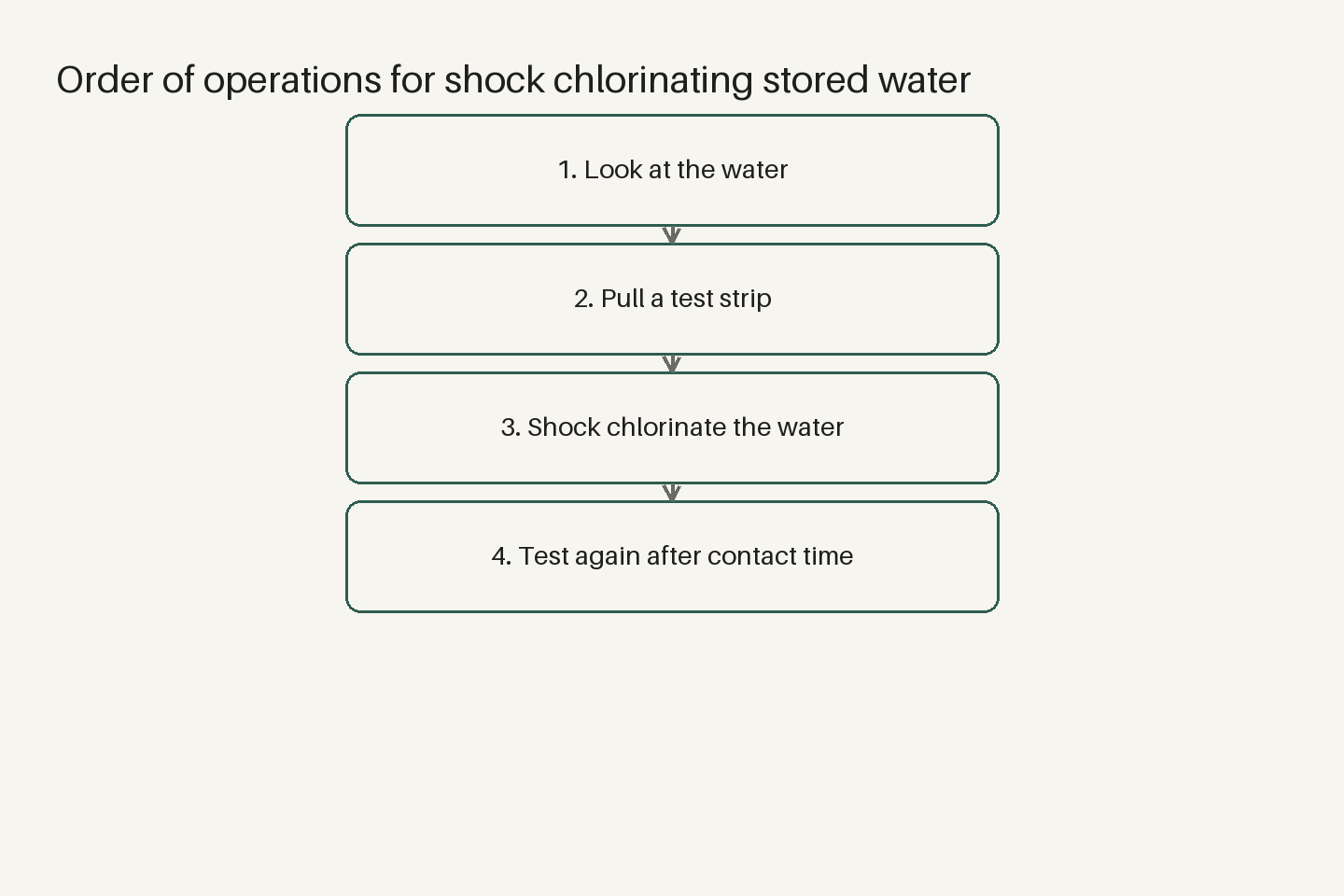
Shock chlorination of stored water is not a ritual you perform on a schedule you found on the internet. It is a response to a measurement. Here is the order I follow, and the order I would hand you across the tailgate. First, look at the water and smell it. Cloudiness, floating matter, or a sour smell means the drum gets emptied and scrubbed, not dosed. Second, if the water looks and smells clean, pull a test strip and check for free chlorine. My strips read chlorine, hardness, and pH, which covers most of what a household needs to know in the field. If the strip shows no free chlorine and the water has been sitting past its rotation date, that is when you shock. Third, after treatment and the contact time, test again. You are looking for a measurable residual before you call the drum done. If the strip reads high, wait and test again; chlorine fades on its own, faster in warmth. The lab can. Marta hands out the bottles and will sit with you over the report when it comes back, which is more help than most people realize is available for the asking. Test before you treat, and test after. The treatment in the middle is the easy part; the knowing is the work. That rhythm, by the way, is the same one behind rotating stored water on a schedule — the shock treatment is what you do when the schedule slips or the strip tells you to, not a replacement for rotation.
A bucket beats a brochure
There is a man who sets up at the preparedness expo over in the county seat every spring, and he sells a bench of devices that promise to make any water safe with light, or with ozone, or with a cartridge that never needs changing. I have stood at his table and read his literature. Some of those tools work in a narrow band of conditions. None of them work on water you have not looked at first. My answer at his table, and my answer here, is that a plastic bucket, a way to measure chlorine, and ordinary unscented bleach from the co-op will handle what a household actually faces. The store at the edge of town keeps bleach on the shelf next to pipe and fittings, and there is a bulletin board by the door with cards from every well driller in three counties, which tells you what the store thinks its customers actually need. If you want the full walk-through — the setup, the fill, the treatment, the rotation, all of it in order — go watch the full video before you dose anything, because the order matters more than any single step.
Now the counterargument, because it is a fair one. I half accept that. A drum filled right, sealed right, and rotated on time rarely needs shocking. I have gone years without touching mine beyond the rotation. But the argument assumes the fill was clean, the container was sanitized before the water went in, the seal held, and the schedule never slipped. In my experience, at least one of those four is wrong about a third of the time. A drum gets topped off from a hose that lay in the sun. A lid gasket cracks. Life happens and the spring rotation becomes the fall rotation. The day you open that drum is not the day to find out which assumption failed. Shocking is the catch for the gap between how storage is supposed to go and how it actually goes. If you are careful about sanitizing containers before they ever see water, you will need the shock less often. You will not need it never.
What changed my own practice was not one event but a slow accumulation of them. In my utility years, chlorination was someone else’s department at the plant; I was on the distribution side, and my concerns were pressure and mains and hydrants. When I left and started drilling and servicing wells, the disinfection problem became mine. The first years on my own, I shocked wells and storage on complaint — somebody called, I came out, I treated, I left. Around year three I started carrying strips on every call and testing stored water whenever a customer had it, whether they asked or not. That is when I saw the pattern: the drums that had been filled with well water and never dosed, the barrels in barns with a foot of dust on top, the totes somebody got a deal on that had held syrup before they held water. By year five I was keeping a written log for my own household — my wife keeps it now, tests and rotation dates in her hand, taped inside the pantry door. A few years back I stopped recommending fixed schedules at all and started recommending fixed tests, because the schedule lies and the strip does not. These days a service call for stored water runs the same way every time: look, smell, strip, then decide. The treatment is the last thing that happens, not the first.
The call that cost somebody real money was out at the Hartman place, two hours from any help, with a windmill and a stock tank. They had filled a big poly tank for the house from the well one fall and treated it with a guess — a glug of bleach from a jug of unknown age, no test, no second test. The family hauled drinking water in jugs from town for a stretch while it got sorted. The bleach that failed them cost almost nothing. The failure cost them the tank, the labor, the hauling, and most of a month of not trusting their own tap. An old jug and a skipped strip turned into a season of work. That is the trade-off in plain form: the test takes a minute, and the skip takes a month.
Hers is a well problem, not a storage problem, but the lesson is the same one I keep circling: water you cannot see into is water you have to measure. She has the number for the lab bottles now, and after the last big storm she had the sample drawn before I even got there. That is the whole goal, honestly — people who measure first and call me second.
If you take one instruction out of all of this, take this one: before you fill a tank, before you shock a drum, before you trust water that has been sitting, watch the video now and follow it in order, because doing the steps in the wrong order is the same as not doing them. The drums in my garage are due for their fall rotation next month, and the strips are by the back door where they live, next to the case of lab bottles. The wooden bung on the second drum swells in the cold and takes a rubber mallet to seat.