A man at the co-op last month had a pickup bed full of blue barrels and a question for me. He said his brother told him to rinse them out with bleach and let them dry in the sun, but his wife said that was how you got sick. He wanted to know who was right. I told him they were both half right, and that the order matters more than the thing itself.
You do not need a chemistry degree to get a container ready to hold water. You need to know what was in it before, and you need to accept that a container is never really clean until you have made it so. The bleach is not the first step. It is the last one before you fill.
The drum that held something else
A used barrel looks innocent. It is just plastic. But if it held syrup or juice or something industrial, the residue is not just on the surface. It is in the seams. It is in the threads of the bung. You cannot smell it after a while, but it is there. I have seen people scrub a drum with dish soap and call it good, then wonder why the water tastes flat three months later.
Start with hot water and a long-handled brush. You are not sterilizing yet. You are just getting the film off. If the drum held food-grade material, this is easy. If you do not know what it held, walk away. The savings are not worth the risk. I keep my two drums in the garage out of the light, and I know exactly what they held before I got them. That knowledge is part of the system.
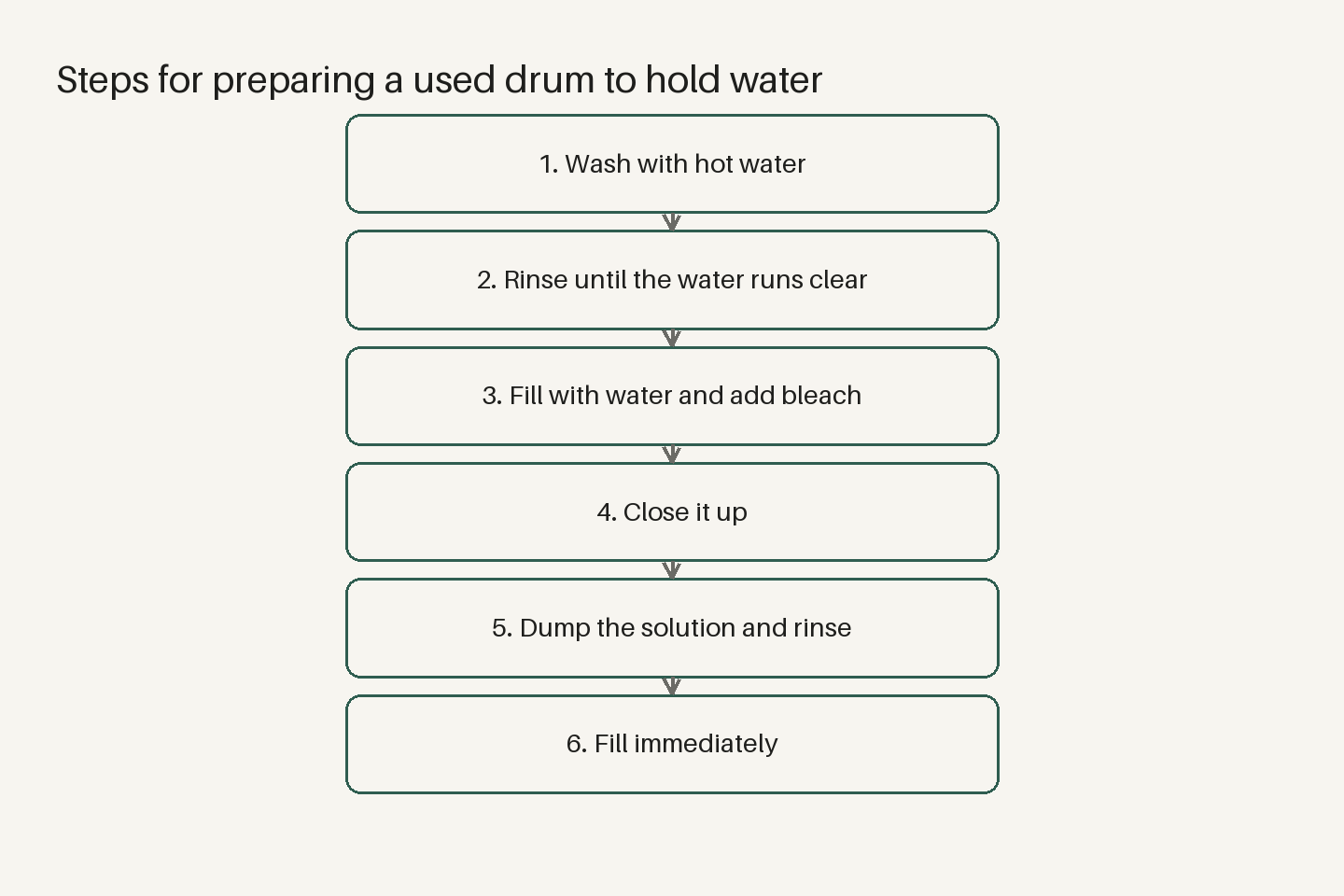
Rinse until the water runs clear. Then rinse again. You are looking for no suds, no slickness on the plastic, no smell when you put your head inside. This takes longer than you think. A five-gallon bucket of hot water and a cup of elbow grease beats a pressure washer for this job. The pressure washer drives the gunk into the pores of the plastic. The brush lifts it out.
Bleach needs time and darkness
Once the physical dirt is gone, you can talk about disinfection. It has been around since the 1700s as a bleaching agent and a disinfectant. The decomposition accelerates with carbon dioxide, which is present in the air around us at about four parts per ten thousand.
You will find liquid. The Cl–O bond length in the crystalline form is 1.686 Å, which is a fact I find interesting but not useful when I am standing in the garage with a bucket. What matters is that liquid bleach loses strength. Time does the rest.
Fill the container with water first. Add the bleach. Use enough that you can smell it faintly when you open the bung after it sits. Then close it up and let it sit in the dark. The dark matters. I leave mine overnight. Some people say an hour is enough. An hour is enough if the container was already clean. Overnight is enough if you want to be sure. When you are ready to fill, dump the solution and rinse until you cannot smell chlorine anymore. Then fill immediately. Do not let the container sit empty and wet. That is when things start to grow.
If I were talking to a friend who asked me how to do this, I would say: wash it like you mean it, sanitize it like you are paranoid, and fill it like it is going to save your life someday. Because it might. Do not skip the rinse. Do not skip the dark. Do not skip the fill.
Here is what I actually spent the last time I set up a new drum. I did this at the kitchen table with a calculator and a cup of coffee, and the numbers are rounded because that is how memory works.
Hot water from the tap: negligible, maybe fifty cents in gas to heat it Dish soap: already had it, call it a dime’s worth Bleach: a quarter of a bottle, maybe a dollar Water to fill the drum for sanitizing: pennies, but the well pump ran for twenty minutes My time: two hours, which is worth more than the materials
Total out of pocket was minimal. The drum itself cost more than the cleaning. The cleaning is cheap. The mistake is expensive.
Pull up the video before you mix anything and follow it while you stand at the drum.
Some people will tell you that municipal water is already chlorinated, so you do not need to sanitize the container. They are partly right. It will handle some contamination. I accept that the risk is lower with city water. I push back because lower is not zero, and the cost of doing it right is the same as doing it wrong. You are already standing there with the hose. Take the extra hour.
Ray called me last week. She has a neighbour’s shallow well, and she was filling jugs at my place. She asked if she needed to do the whole bleach routine for a five-gallon jug she was going to use next week. I said yes. She said that seemed like overkill. I said the jug was in her shed for six months and I could see the dust on it. She said she would rinse it first. I said that was fine as long as she understood the rinse was not the same as the sanitize. She said I was stubborn. I said I was consistent. She did the bleach.
Here is the sequence I follow when I am doing this myself.
Open the video and play it while you work.
The bulbs in the garage need replacing. I bought them six months ago and they are still in the truck. I keep meaning to get a ladder. Maybe tomorrow. The drums are clean and the water is fresh. That is enough for today.