The pressure tank is the most misunderstood piece of equipment on a private well.
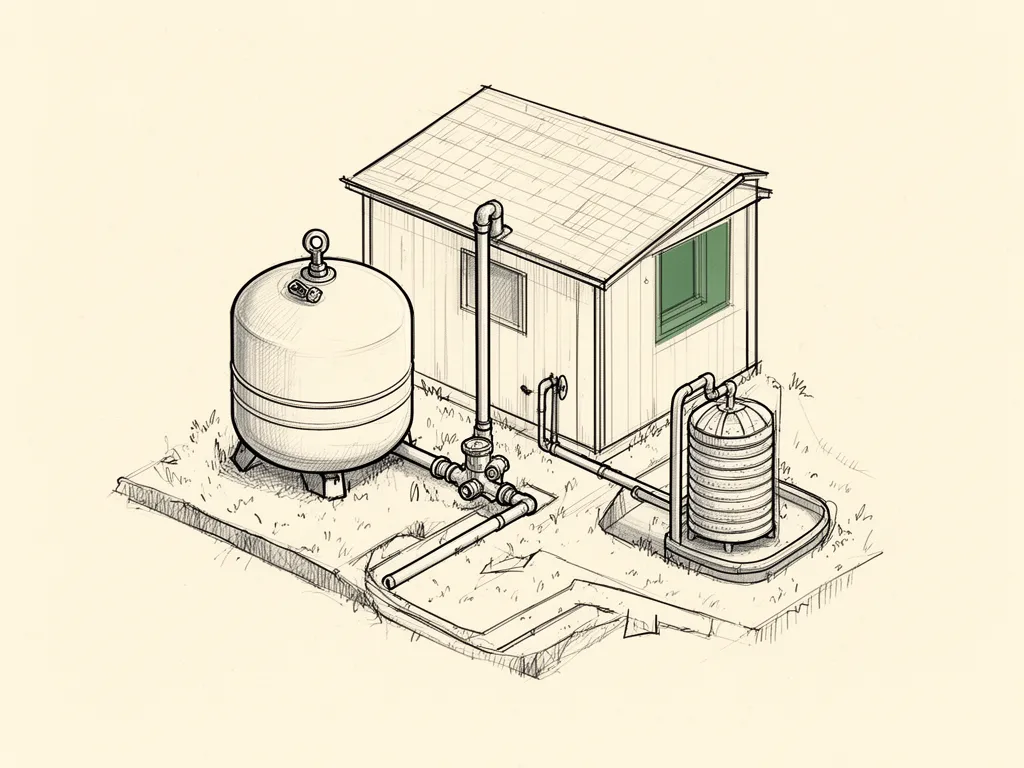
Most people think it stores water. It does a little of that, but storage is not its job. Its job at my place is giving the pump a rest. Inside the tank I pulled, there was a bladder with compressed gas on one side and liquid on the other. The pump pushes water in, the air compresses, and the tank holds that compression like a spring. When you open a tap, the compressed air pushes the water out. The pump does not run. Only when the pressure falls to the low setpoint does the switch close and the pump start again. On the wells I serviced, it ran until the tank reached the high setpoint, then shut off. That cycle — fill to the top, draw down to the bottom, fill again — is the whole trick.
Without the tank, the pump would start every time someone cracked a faucet. A submersible motor seems built to run for minutes, not seconds. Starts are what kill it. The tank turns a hundred tiny demands into a handful of long runs. That is all it does, and it is worth doing.
On the wells I serviced, the gas side was set with the tank empty of water, two pounds below the switch’s cut-in pressure. You can check it with a tire gauge on what seems to be a Schrader valve at the top of the tank, with the pump off and a tap open until the water stops. If water comes out of that valve, I’d guess the bladder has failed and the tank is done. I keep the details straight in my head by thinking of the well’s parts as one system — pump, switch, tank, check valve — where each piece only works right if the piece before it does.
Here is what the numbers look like when a tank goes bad, from a call I made last spring. The pump was short-cycling — kicking on every ten seconds while the sprinkler ran. The pump was fine. It just needed to stop starting.
Now that the problem is on the table, go pull up the full video and follow it step by step before you touch a wrench.
A fellow at the local feed store stopped me over by the fittings a few weeks after that job. He said, “You were at my sister’s place. She said you told her the tank was the cheap part and the pump was the expensive part.” I said that sounded right. He said, “Mine clicks every time the toilet flushes. That the tank?” I said, “Could be the tank, could be a leak. Put a gauge on it and watch the needle with everything off. If it falls, water is going somewhere. If it holds, look at the tank.” He said, “And if the tank’s full of water?” I said, “Then it’s not a tank anymore, it’s a pipe fitting.”
What happens when you ignore it, in order, looks like this. The first months, nothing much. The pump runs a little more often. The light bill creeps up a little, not enough to notice. Then the cycling gets fast — a click at the pressure switch every few seconds under any sustained draw. You did not. The pump is now doing what the switch was doing, heating and cooling in short bursts. One dry August — the same August when Marta’s well goes low and she calls to ask if the water table has dropped for everyone — the pump quits for good, and now you are pulling a pump from a few hundred feet of well on the hottest week of the year. All of it traces back to a bladder that cost nothing to check and little to fix, the kind of slow failure I think of as a tank that has gone waterlogged, because that is what it is by the end.
The tank also tells you things, if you listen. A tank that used to run a two-minute cycle and now runs forty seconds has lost air or lost bladder. A pressure that sags while a tap runs steady can be the well losing yield, not the tank at all — and that is a different conversation, one that starts with the driller and not with a part. The rule applies to water and it applies to diagnosis. A pressure gauge on an outdoor spigot and five quiet minutes will tell you more than any guess.
One more thing the tank does not do: it does not make the water safe, and it does not store enough to matter in an outage. The mid-size tank I installed held a few dozen gallons of drawdown before the pump was needed again. That is minutes of water, not days. Storage is the drums in the garage, rotated twice a year, and the bucket and hand pump and the written instructions taped inside the pantry door. The tank keeps the pump alive. The drums keep you in water. Confusing the two is how people end up with a working pump and nothing to drink, or a garage full of drums and a burned-out motor because nobody checked the air charge in six years. If unsure what you are looking at down there, start with how a residential well works and trace the water from aquifer to tap.
So: pump off, tap open, gauge on the valve. Air to two pounds under cut-in, water out of the valve means a new tank, a fast click means find the cause before it finds the pump. Before you drain anything down, open the video and follow it step by step — play the full video while you work.