The hose end went in first, before the chlorine, and I remember watching it disappear down the casing past the beam of my headlamp. It was a Tuesday in October, still warm, and the man of the house stood a few feet back holding a flashlight he did not need, asking me if this was going to ruin his pump. I told him the truth, which is that the pump is fine and the waiting is the hard part. We were there because his water had failed the test after a long wet spell, and his wife had already been on the phone to the county lab twice. He wanted it done right and he wanted to watch. I let him. Most of what I know about getting chlorine into a well came from standing at wellheads like his, watching the water change.
The garden hose going down
The hose is the tool that makes the whole job work. You run it from the pressure tank’s drain or a hose bib, and you drop the free end down into the well casing alongside the pump wiring. Then you open the tap and let the pump push water down the well and back up the annulus around the drop pipe. That loop is the circulation. A shock chlorination done properly is mostly plumbing and patience. The chemical part is simple. Getting the chemical to every corner of the system is the work.
Why still water stays dirty
A well is not a tank. The water in the casing seems stratified more often than people expect, especially in a deep well with a pump sitting a hundred feet down. Warm water, cool water, water that has moved and water that has not. If you pour your chlorine solution in and walk away, you have treated the top few feet and left the rest. The bacteria sample comes back positive again in two weeks and everyone concludes the chlorine failed. It did not fail. It never arrived. Circulating is how it arrives. The pump pulls treated water up from the bottom, the hose carries it back down the casing, and after a while the whole column is one concentration. You can verify that with your nose at the hose end, and then verify it properly with a strip.
The chlorine smell at the tap
The strip is the honest part of the job. Once the well has circulated, open the taps until you smell chlorine. Then you test. If the far bathroom tap smells of nothing, the line between the well and that tap has not been treated, and neither has the water heater or the pressure tank, and you are not done. This is where a well prepared before the work starts pays off, because you already know which taps exist, which fixtures have aerators that catch debris, and whether the water heater needs to be isolated or included. The overall shape of the job is the same every time. The details change with the house.
Two ways to do the circulation, and I have done both more times than I can count. The first is the hose-down-the-casing method I described, and it is the one I use on drilled wells with submersible pumps, because the pump does the lifting and the hose does the returning. The trade-off is that you need physical access to the top of the casing, which means pulling the well cap, and some caps have not been off in twenty years and fight you. The second method is for shallow wells and jet pumps, where you can recirculate through the pump itself by teeing a return line back into the suction side. It is faster to set up and you never open the casing. The failure mode there is that a jet pump moving water in a loop can lose prime, and when it loses prime you are standing in a puddle re-priming a pump while your chlorine sits in a bucket losing strength. On the October call we used the first method, because his was a drilled well and the cap came off with a wrench and one bad word.
Before you pull a well cap for the first time, watch the full video and see the sequence laid out in order. It is easier to follow a step you have already seen done.
The man with the flashlight asked me, about an hour in, whether the chlorine was going to kill the grass where the hose drained. He said, “My father-in-law just dumps a jug of bleach in and calls it good.” I said a lot of people do. He asked if that works. I said sometimes it does, for a while, and then it doesn’t, and they call me.
What that afternoon cost, since people always want to know: the chlorine itself seemed like only a small amount from an ordinary jug of unscented household bleach, the kind on any grocery shelf. The strips came out of a kit that, I’d guess, costs about as much as a modest dinner and does many tests. The sample bottle was free to take, and the lab cost for the coliform test after the fact seemed to be in the range of what a tank of gas costs, though lab costs vary by county. My time was the expensive line, and if he had done it himself it would have been an afternoon and a bucket. The well cap gasket I replaced because the old one cracked coming off seemed like it was only a trivial amount at the feed store. Call it a modest sum all in, most of it avoidable if you are willing to do the work yourself and careful enough to do it in order.
The order I follow, taped in my own pantry in different words, goes like this: test the water first so you know what you are treating; pull the well cap and inspect the seal; mix the solution in a clean bucket; pour it into the casing; run the hose down and circulate until the return water tests strong; open each tap until you smell chlorine; shut everything and let it sit; flush the system to waste until the chlorine is gone; retest for bacteria before anyone drinks it.
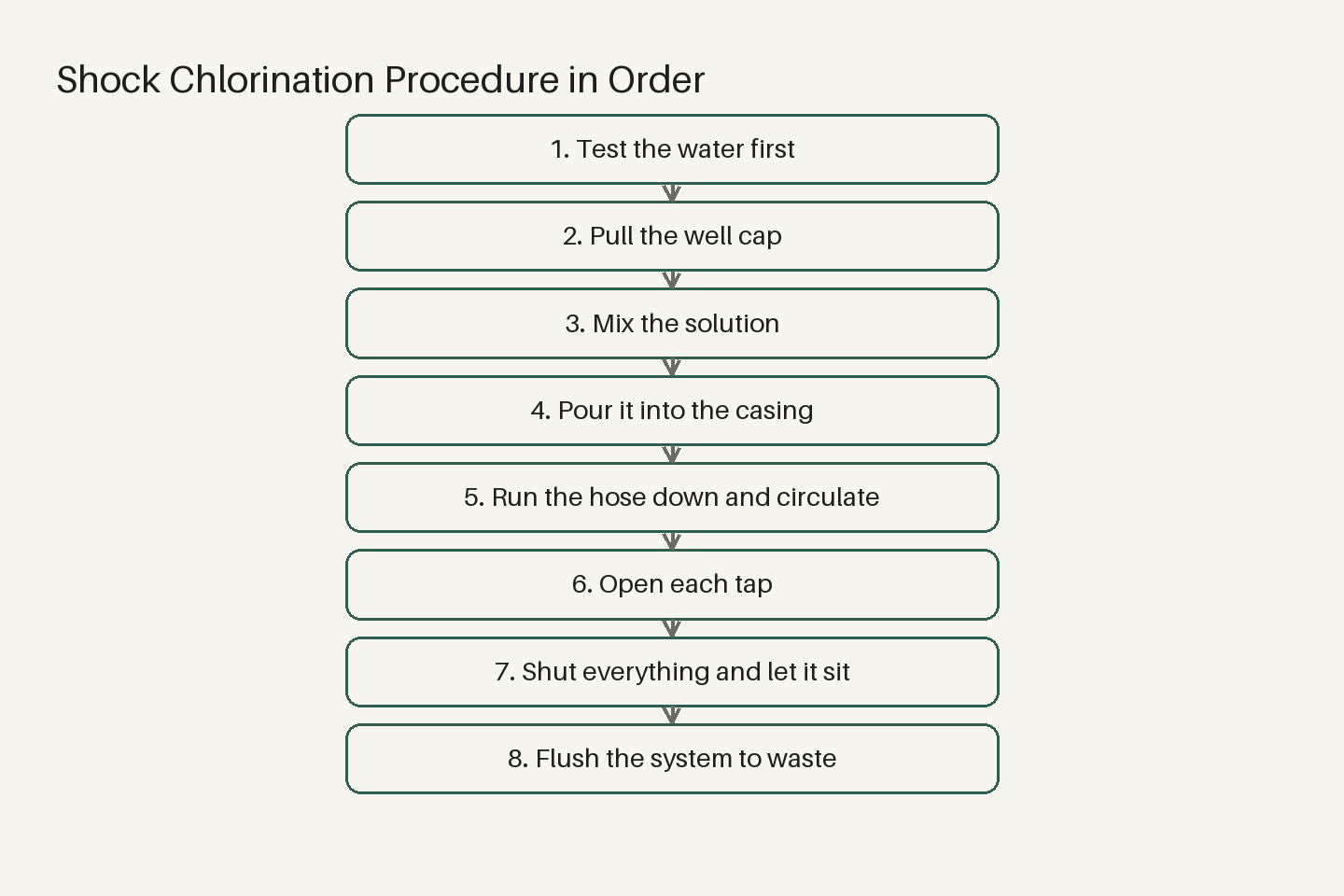
The sitting is the step people skip. You circulate, you confirm, and then you close everything up and leave it alone, and the water in the pipes and the casing does the job while you do something else. Let it sit. Then flush to waste, not to the septic if you can help it and not onto one patch of lawn, and run it until the strips read nothing. Then wait the lab’s required interval and draw the bacteria sample clean, from the tap, hands washed, no touching the inside of the bottle. The log in the pantry shows when we did ours and when the next sample is due, and it is the reason we have never had to guess.
There is one more thing worth saying about chlorine itself, because people ask where it comes from and the answer matters less than they think. None of that changes what is in the jug on the shelf. What matters at your wellhead is concentration, contact time, and whether the treated water actually reached every part of the system. Chemistry you cannot see is easy to overthink. The loop of hose you can see is not.
Go watch the video now, before you pull the cap and start pouring, and follow it the whole way through the flush.
That is the whole job: move the water through the chemical, then move the chemical through the water, and let time do the rest.