I have removed iron from well water. Most households do it with some combination of aeration, filtration, and a softener or an iron filter, but the right order depends on what the water test says. Iron is not one problem. It is at least three. Clear water iron, red water iron, and iron bacteria behave differently on the wells I serviced and respond to different fixes. Before you get anything, find out which one you have.
Start with a sample. Not a guess, not a smell test. A lab test for iron, manganese, hardness, pH, and bacteria. I keep a case of sterile bottles by the back door for this. If you want a first pass at home, strips will tell you hardness and pH, and they will confirm iron if it is high enough to read, but bacteria needs a lab. Testing well water at home is a simple errand, and the lab report is the map for everything that follows. When the report comes back, reading a well water lab report tells you which line matters. Iron shows up in milligrams per liter, and the treatment choice changes at different levels.
It oxidizes and turns into rust particles. Red water iron is already oxidized in the well or the plumbing I pulled. You see the color right away. Iron bacteria feed on dissolved iron and leave a rust colored slime in the tank, the toilet bowl, and the pump. Each of these needs a different approach, and the wrong one wastes money.
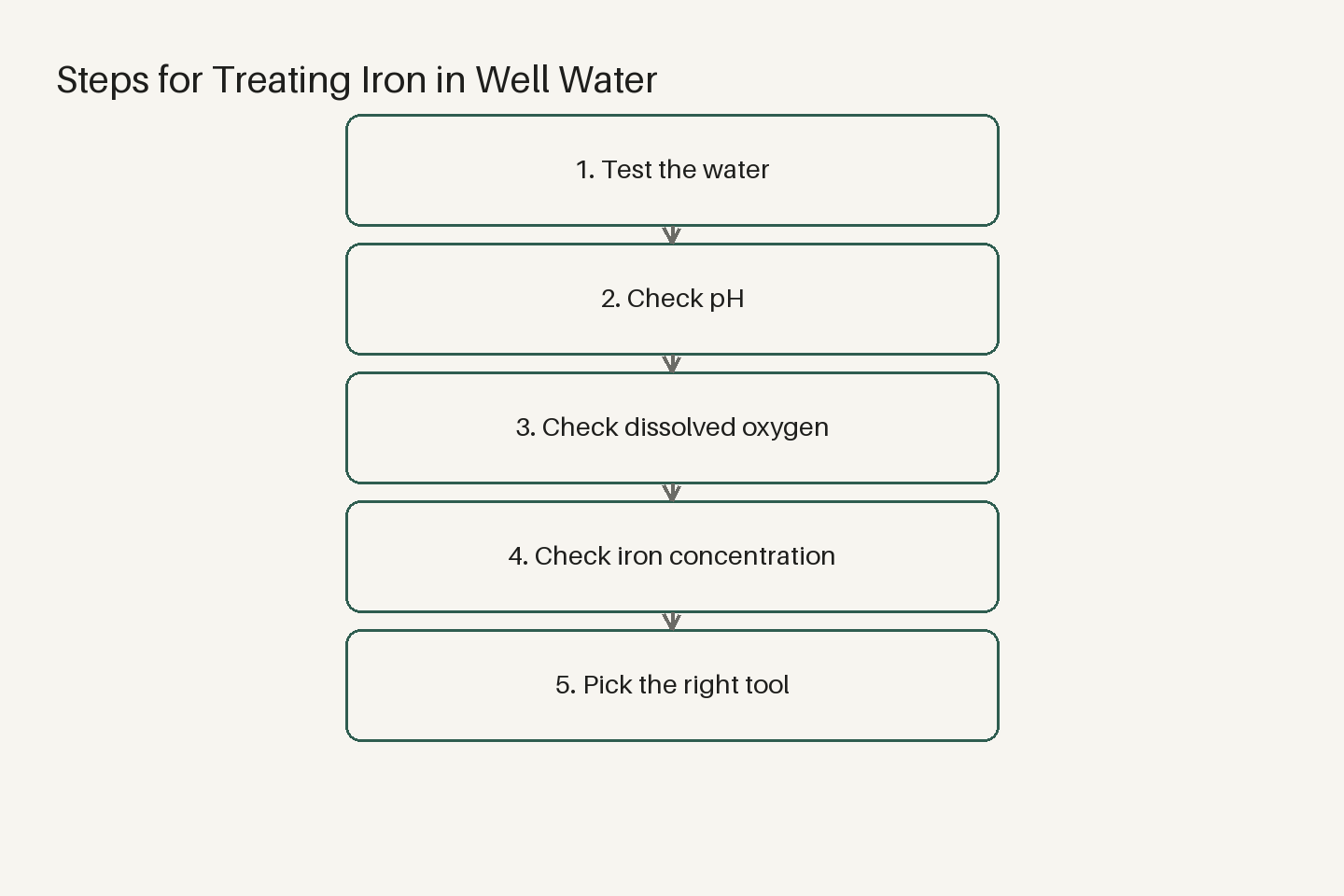
Test the Water Before You Treat It
The first thing I check on an iron call is the pH. Iron oxidation depends on it. In aerobic conditions, pH drives the reaction that turns dissolved iron into solid rust. At neutral pH, microbes compete with a chemical reaction that can happen in under a minute. That is why a softener alone sometimes works and sometimes fails. If the pH is low, the iron stays dissolved longer and the softener resin can handle it. If the pH is higher, the iron may oxidize before it reaches the resin and foul it.
The second thing is dissolved oxygen. You need at least 0.3 parts per million of dissolved oxygen to oxidize iron out of solution. That number matters if you are thinking about aeration. Some systems bubble air through the water to force the reaction. Others use a chemical oxidant. Either way, the goal is the same: turn dissolved iron into particles so a filter can catch them.
The third thing is the iron concentration itself. Iron bacteria can grow in water with as little as 0.1 milligrams per liter. That is below the level where most people notice staining. So a negative strip test does not rule out bacteria. The lab test will show it.
If the report shows clear water iron that is low—a few milligrams per liter—and the pH looks reasonable, a water softener handles it at my place. The resin exchanges sodium for iron much like it does for calcium on the units I installed. The trade off is that iron fouls resin over time on the softeners I maintained. You need to clean the resin bed periodically, and if the iron is high, you will be cleaning it often. A softener is also a maintenance item. Salt, backwash, occasional service. It is not a set and forget fix.
If the iron is higher, or if it is already oxidized, you need filtration. A simple sediment filter catches particles but does little for dissolved iron on the service calls I made. An iron filter, sometimes called a greensand filter or a catalytic media filter, oxidizes and filters in one tank at my place. It backwashes to flush the rust out. These work, but they add a second tank to the system and they need a reliable backwash cycle. If your well yield is low, the backwash can be a problem.
If the lab shows iron bacteria, the fix is different. You shock the well and the plumbing with chlorine, then you address the source. Shock chlorinating a well is a straightforward job, but it is not a one time fix when the bacteria are established in the aquifer or the pump on the wells I treated. Sometimes you need to pull the pump and clean it. Sometimes you need a continuous chlorination system. That is a bigger commitment.
Aeration and Filtration Do the Heavy Lifting
Aeration is the oldest method. You expose the water to air, the iron oxidizes, and a filter catches the particles. It works because the chemistry is simple. Oxygen plus dissolved iron equals rust. The trick is doing it in a controlled way so the rust ends up in the filter and not in your pipes.
A common setup at my place is an aeration tank followed by a filter tank. Water enters the aeration tank, air is injected or the water is sprayed through air, and the iron precipitates. Then the water flows through a filter bed that traps the particles. The filter backwashes to clean itself. This is reliable, but it takes space and it adds pressure loss. You need a pressure tank downstream to even out the flow. What a pressure tank does becomes relevant here, because if your pressure tank is undersized or waterlogged, the whole system struggles.
The trade off with aeration is upkeep. The filter media needs replacing or regenerating on the tanks I opened. The air injector can clog. The backwash cycle uses water, and if your well is marginal, that water use matters on the wells I serviced. I have seen systems where the backwash cycle ran the well dry and the pump overheated. That is a service call you want to avoid.
Chemical oxidation is the other path. You inject chlorine or hydrogen peroxide ahead of a filter. The oxidant does the same job as air but faster. This seems to work well for iron bacteria because chlorine appears to kill the organisms while it oxidizes the iron. The downside is that you are adding a chemical feed pump and a solution tank. More parts, more maintenance. And if you are using chlorine, you may want a carbon filter downstream to remove the residual before the water reaches the house.
Some people ask about water softeners as a standalone fix. They work if the iron is low and dissolved on the systems I installed. They don’t work if the iron is oxidized or if bacteria are present on the calls I answered. The resin doesn’t filter particles, and I doubt it can kill bacteria. I have seen softeners ruined by iron bacteria slime. The fix was a new resin bed and a chlorination system upstream.
A neighbor on the next section, Ray, has a shallow well that goes low every dry August. She runs a softener and it handles the iron most of the year. In August, when the water table drops, the iron concentration climbs and the softener struggles at my place. She cleans the resin twice a year and accepts that the system is working at the edge of its capacity. That is a reasonable trade off for her situation. She does not want a second tank and she does not want to haul salt more often than she already does.
My advice to a friend who asked: test the water, find out if the iron is dissolved or oxidized, check for bacteria, and then pick the simplest system that handles the problem. If the iron is low, a softener does it on the wells I serviced. If it is high or oxidized, you need filtration. If bacteria are present, shock the well first and then decide if you need continuous treatment. Do not get a system before you know what’s in it.
If you are setting up treatment for the first time, or if you are rethinking a system that is not working, pull up the video and follow it step by step. It walks through the whole process.
In March of last year a household outside town called. They had red water in the toilets and a smell in the bathroom. The well was twelve years old, a drilled one with a submersible pump. The lab test seemed to show around 4 milligrams per liter of iron, a pH close to neutral, and what looked like iron bacteria. The fix was a shock chlorination, a new sediment filter, and an iron filter with a catalytic media bed. The shock treatment took about a day at my place. The filter install felt like it took two. Six months later the water was clear and the smell was gone. That system will run for years with minimal attention.
Not every job goes that smooth. Last fall I worked on a well where the owner had installed an iron filter himself. He bought the tank and the media, set it up, and it worked for two months. Then the pressure dropped. The filter bed had cemented. The media had oxidized the iron, but the backwash cycle seemed too short and the rust never fully flushed out. The bed turned into a solid mass. He had to replace the media and the distributor tube. The labor to dig the old media out and repack the tank was most of a day. If he had set the backwash cycle to run longer, or if he had checked the pressure drop across the filter regularly, he would have caught it early. That kind of thing does not show up in the instructions.
Here is what I do when I am setting up or servicing an iron system:
Test the water at the wellhead, not at the kitchen tap. Check pH, iron, hardness, and bacteria.
If iron is low—under a few milligrams per liter—and dissolved, I consider a softener. If it seems higher or oxidized, I’d plan on filtration.
Size the pressure tank to handle the flow rate of the filter backwash cycle. If the tank is too small, the pump short cycles on the systems I checked.
Set the backwash cycle based on the iron load. Higher iron means more frequent backwashing on the filters I maintained. Check the pressure drop across the filter monthly.
If you are using aeration, make sure the air injector is accessible. It tends to clog eventually and you’ll need to clean it on the units I pulled.
Keep a log. My wife keeps a notebook with test dates, filter changes, and backwash settings. It has saved us more than once.
Iron is not a reason to panic. It is a reason to test, plan, and pick the right tool. Most systems are simple once they are set up correctly. The ones that fail are the ones that were sized wrong or installed without a test.
If you are staring at a lab report and wondering what to do next, open the video and follow it step by step. It will walk you through the decision.
Start with the test. Call the county lab or a private lab and get a sample bottle. Fill it at the wellhead, not at a tap inside the house. Send it in. When the results come back, you will know what you’re dealing with. That is the next step.