The pump kicked on at 6:10 that morning while I was standing at the utility room sink with a headlamp still on my forehead, and it kicked off again before I finished rinsing a coffee cup. That is a cycle of maybe eight seconds. A healthy system seems to run a minute or more. The tank in the corner was a steel bladder tank about waist high, installed before I moved in, and when I tapped the top half with a knuckle it rang hollow and when I tapped the bottom half it thudded. Solid water, all the way up. Waterlogged.
The gauge on the hose bib
A pressure tank is a simple thing. There is air on one side of a bladder or a diaphragm and water on the other, and the air is the spring that pushes water to your taps when the pump is off. When the air charge leaks out or the bladder fails, water fills the whole tank, there is no spring left, and the pump has to start every time anyone opens a tap. In my experience, that short cycling is what seems to kill pumps. I have seen what seemed like a submersible pump that should have lasted many more years burn out in one season, likely because the tank lost its charge and nobody checked.
You can check yours with a tire gauge, but I use the hose-bib gauge, because it tells me what the system is doing while water is moving. If you want the fuller picture of what the tank is doing inside the system, what a pressure tank does is worth understanding before you touch anything. The short version: the tank holds a cushion, and the cushion is the whole point.
That morning I shut the breaker to the pump, opened the drain at the bottom of the tank, and let it empty into a bucket and then out the floor drain. With the tank empty and the water side open, I checked the air at the Schrader valve on top. It read almost nothing. The pre-charge on a tank sits just under the pump’s cut-in pressure, and the right figure depends on your pressure switch, so read the label on your switch rather than taking a number from me.
I put air back in with a small compressor, a few seconds at a time, checking between bursts. Water spit out of the air valve while I did it. That is the tell. Air should come out of an air valve. Water coming out tells me the bladder is ruptured and the tank is a pipe fitting, not a pressure tank.
Air coming out of the air valve
A neighbour two roads over had the same symptom last fall and handled it differently. He came by while I had the tank drained and watched the water dribble out of the Schrader valve.
“So it’s shot,” he said.
“It’s shot,” I said.
He said, “Mine’s been doing that machine-gun thing since September. I just turn the breaker off at night.”
“That’s how you find out what a pump costs,” I said.
He looked at the bucket under the drain. “I figured the pump was the problem.”
“The pump is the victim,” I said.
He called the driller the next day. That is the right order. Call the driller before you start collecting parts, because a tank that failed young sometimes failed for a reason — a waterlogged condition from a bad check valve, a switch set wrong, a pump oversized for the tank — and swapping the tank without finding the reason gets you a second failed tank.
Before you drain anything down, go watch the full video so the sequence is in your head before the water is on the floor. It walks the same order I work in, and seeing it once beats reading it twice.
What the bladder was hiding
The myth is that a waterlogged tank just needs air. People add air at the valve, the pump stops short cycling for a while, and they call it fixed. What actually happens, when the bladder is intact and the charge was simply low, that works and it holds. But when the bladder has failed — and on a tank of that age, it has — the air I pumped in dissolved into the water and the tank waterlogged again. You are airing up a tank with no separation between the air and the water. The old galvanized tanks seemed to work that way on purpose, and I’d guess they needed an air volume control and regular recharging, because the air was always escaping into the water. A bladder tank that behaves that way is a galvanized tank with a hole in it.
The thing that went wrong on my own place, years back, taught me the cost side of this. I caught the short cycling late because the pump was quiet and the utility room is not somewhere I stand around. The pump had been short cycling through most of a hot summer. The tank was cheap to address. The pump was not. When the driller pulled it, the motor was cooked from starting hundreds of times a day, and I paid for a new pump, a pull, and a set, plus the tank that started the whole thing. The tank was the small invoice. The pump was the large one, and the water hauled in jugs for two days while we waited on the pull was the part my wife still brings up. She had the household log open on the counter when I came in, and the rotation dates for the two drums in the garage were current, which is the only reason those two days were an inconvenience instead of a scramble.
That is the trade-off with a bladder tank versus the old style. The bladder tank seems to need almost no attention until the bladder fails, and then it needs replacement. The galvanized tank seems to need attention on a schedule forever. The cheap reliable option is whichever one you will actually check.
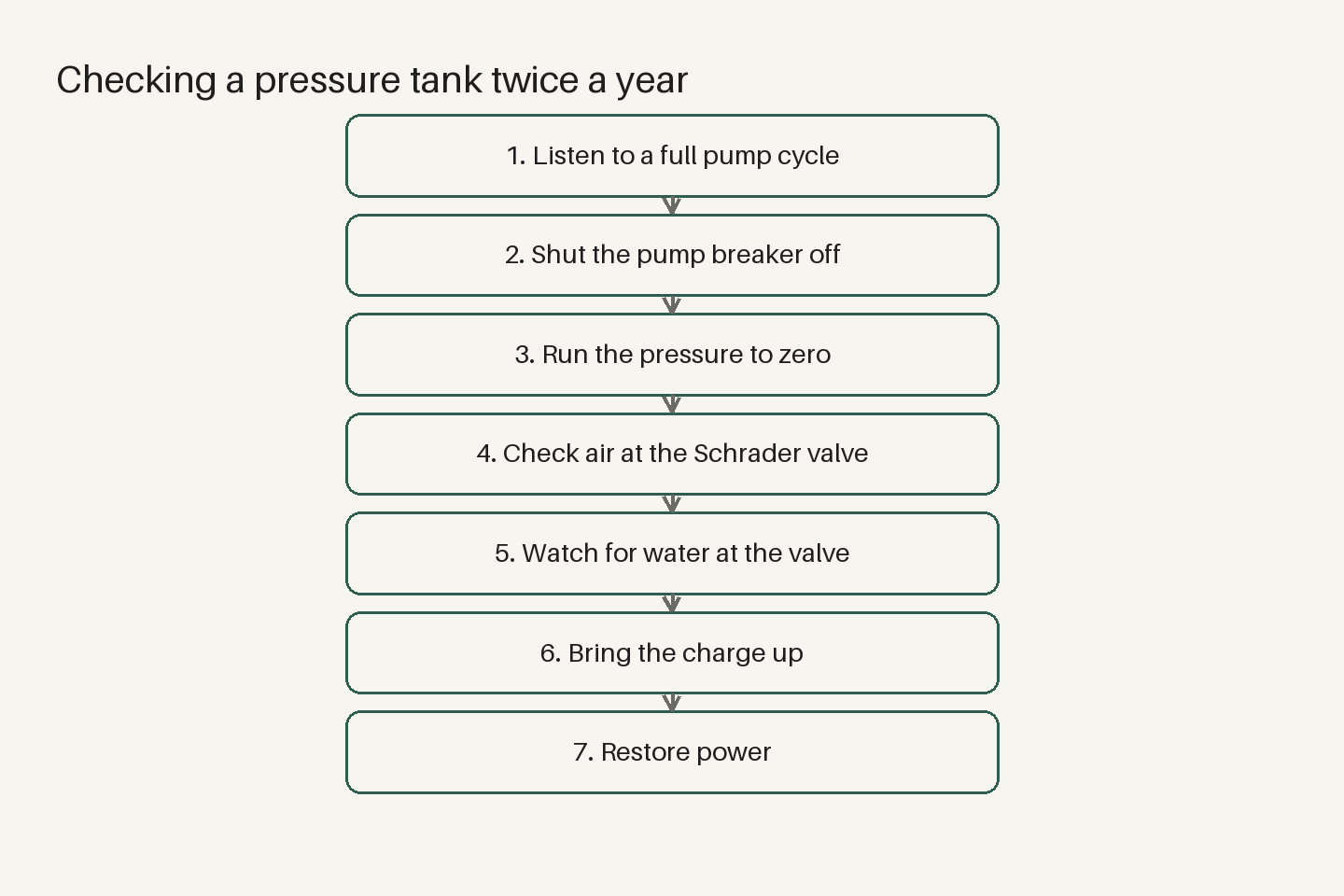
The check itself is ten minutes, twice a year, same months I rotate the drums:
The order I actually do it in
- Listen to a full pump cycle. Short bursts mean trouble.
- Shut the pump breaker off.
- Open a tap or the tank drain and run the pressure to zero.
- Check air at the Schrader valve with the water side empty.
- Watch for water at the valve while you add air.
- Bring the charge up to just under cut-in, per your switch label.
- Restore power and watch one full cycle.
While you are in there, it is a reasonable day to draw a bacteria sample into the county lab bottle and run the strip kit for chlorine, hardness and pH, because you have the system open anyway and the test strips are mostly about doing it on a schedule instead of after someone gets sick.
One more thing about the bigger picture. A pressure tank is one piece of a chain that starts in the ground and ends at a tap, and if you have never traced yours end to end, private well parts and operation lays the chain out in the order the water travels it. Knowing where your check valve sits seems to matter here, because a failed check valve can, in my experience, act like a waterlogged tank by letting the pressure bleed back down the well.
Now that the tank is on your mind and you know what a short cycle sounds like, go sit through the full video before you put a wrench on your own drain valve. Watch it once, then go stand in your utility room and listen to a full cycle with the headlamp on.
The tank on my floor that morning went to the driller’s scrap pile. The new one holds its charge. The pump runs a full minute now, and the gauge needle climbs slow and steady instead of jumping, and the coffee cup got rinsed on stored pressure with the pump silent the whole time.