I treated a well once before I tested it. That was the mistake. A man out past the north section called and said his water had gone milky after a heavy storm, and I was younger then and sure of myself, so I told him over the phone to dose the well and let it sit overnight. What he actually had was fine silt pulled in through a cracked casing seal near the surface. Chlorine did nothing for it. He wasted two days and a pump running on sediment, and I spent an afternoon reaming out the impeller on my own time because I had told him wrong. Since then the rule on my truck is simple: look at the water, test the water, then touch the water. Cloudy is a symptom, not a diagnosis, and it has maybe a dozen causes with different fixes. Some cost nothing. One of them will cost you a pump.
Air bubbles that clear from the bottom
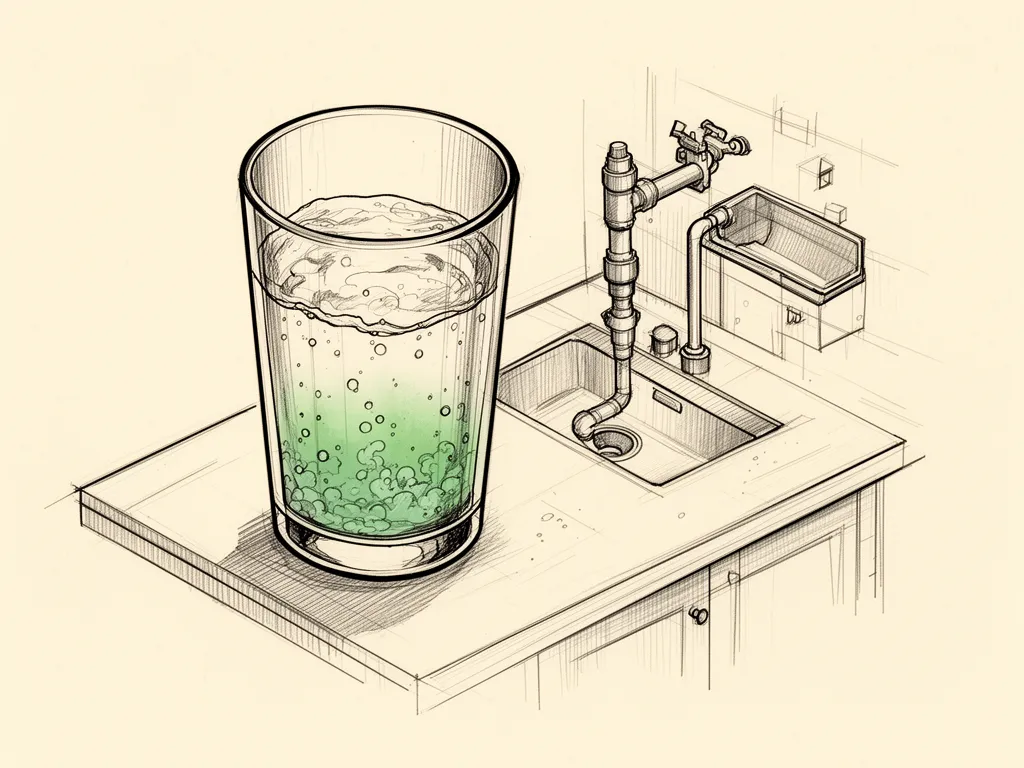
The most common cloudy glass I see is no problem at all. Pour water from the cold side into a transparent tumbler and leave it on the counter. If the cloud starts at the bottom and clears upward in a minute or two, that is dissolved air coming out of the water as it warms and depressurizes. When that water hits the open glass the air forms tiny bubbles and rises out. It looks like skim milk and then it does not.
This happens most in winter when the ground water is coldest, and on systems where the pressure tank is working hard. It costs nothing and fixes nothing because there is nothing to fix. Watch which way the cloud moves to tell air from something else. That one observation, done with a glass and two minutes of patience, separates half the calls I get into two piles: the ones where people relax, and the ones where I drive out.
If you have just had the pump serviced or the power was off a while, air can work through the lines for a day. Let the tap run. It clears on its own.
Sediment in the sample bottle
Cloudiness that settles to the glass bottom is a different animal. That is sand, silt, or scale, and it does not belong there. Leave the glass overnight. If there is grit at the bottom in the morning, something in the system is letting formation material into your water.
The usual suspects, in the order I find them: a well screen that has started to fail, a pump set too close to the bottom stirring up fines, or a drop in the water table that has the pump pulling from a zone it never used to touch. In dry years I see the third one more. Marta on the next section draws from a dug well that runs dry every August, and by late summer his cold tap runs faintly gray after a big draw, like laundry day. Her pump is fine. Her aquifer is tired. The cloud is the aquifer telling you.
It is a hardware worry. On the wells I serviced, grit ate impellers, chewed seals, and wore the venturi on treatment equipment. The one I pulled from sandy water lasted only a few years. The checkable part is cheap. Pull a sample, let it settle, and look. If you have not had the well’s parts and condition looked at in years, this is the moment — the way the well’s moving parts fit together tells you where sand can get in. Phone the well contractor before you get any equipment. He can tell from the sound of the pump and the look of the sample whether you need the pump raised, the well developed again, or just a settling cartridge ahead of the tank.
Cloudy with a smell or a color
Then there is cloudiness that comes with company. At my place, a brown or rust-colored cloud pointed at iron, either dissolved and oxidizing on contact with air, or iron bacteria doing the same thing inside the plumbing.
White scale flakes that seem to cloud hot water more than cold likely come off the inside of a water heater, especially on hard water. That one fools people. The cold tap runs clear and the hot runs milky with flecks. The heater is shedding, not the well.
The county lab container is inexpensive and resolves the single issue that counts most. I keep a case of them by the back door and the test strips on a shelf next to them, and a strip and a settled glass between them will sort most of what a well throws at you. Test before you treat. If the bacteria test comes back positive after a storm or spring runoff, a proper shock chlorination is the standard answer, but only after the sample says so — not because the water looked funny on a Tuesday.
A woman named Ruth called me last October, the week after the first hard rain. “It’s gone white,” she said. “Like someone stirred milk in it. My husband says it’s fine because it clears in the glass.” I asked her which way it cleared. There was a pause. It goes up.” “Then your husband is right,” I told her, “and you can stop boiling it.” She laughed and said she’d already thrown out a pot of soup. “The soup was fine,” I said. “The air in the water is free.” She called back a month later when it stayed cloudy after settling, and that time it was sand, and that time I drove out.
Before you drain anything or dose anything, pull up watch the full video and follow it step by step while you work through your own system — glass test first, then the settled sample, then the strips.
What failed at the Hartman place is the one I tell apprentices. Spring of 2019, they called about cloudy water that had been going on “a while.” It was fine sand from a screen that had started to fail at the forty-foot joint. They ran it through the summer — garden, livestock, house — because the water still tasted right and the cloud settled out in the pitcher. By the time I pulled the pump in September, the impellers looked sandblasted and the shaft sleeves were scored through. The well itself was fine once the screen was replaced; the pump took the bullet. The cloud was the warning. They drank the warning all summer.
The worked example I keep in the log is from my own utility room, March 2022. After a week of warm wind on snow, our cold tap went faintly hazy and stayed hazy after the glass settled — no smell, no color, just a milkiness that did not rise and did not quite settle either. Date on the log page: March 14. Strips showed hardness normal for us, pH where it always sits, chlorine at zero because we do not chlorinate the house line. Spring runoff had found its way past a well cap gasket that had dried and shrunk over a hard winter. The water never looked dramatic. It looked almost fine. That is the point of the story.
The myth is that cloudy water means dirty water, full stop — that if it does not look clean it is not safe, and if it looks clean it is. Iron announces itself. Air announces itself and then leaves. Sand settles. You cannot see the thing that matters most, and you can see several things that matter hardly at all. The glass test and the lab bottle are how you stop guessing. That is not a slogan; it is just what the samples have taught me, one mailbox at a time.
The other myth worth naming: that the fix for cloudy water is a piece of equipment. Sometimes it is a gasket. Sometimes it is raising the pump two joints. Sometimes it is telling the water heater its days are numbered. Unusual assertions require documentation, and a hazy tumbler is not documentation.
If your water has gone cloudy and you want the whole sequence in order — glass, settle, strips, sample, and then whatever the answers say — open the full video now and work through it with a notepad next to the sink. Have the lab bottle before you need it.
Ruth’s pot of soup was chicken and rice, and she made it again the same night.