I once spent a whole afternoon chasing a noise that was not the problem. The kitchen tap at my place started coughing one May — spitting air, then water, then air again — and I walked straight past the pressure tank, which was sitting there doing its job fine, and pulled the well cap instead. I was looking for a cracked drop pipe or a leaking fitting down the bore. Two hours later I had found nothing, and the real cause was a waterlogged pressure tank that a ten-minute check would have caught. That order of operations is the whole reason for this post. I have seen air in the lines on private wells I serviced. It looks alarming. It tends to be one of a few things, and several of them you can check yourself with a gauge, a bucket and an hour.
Water sputtering at the kitchen tap
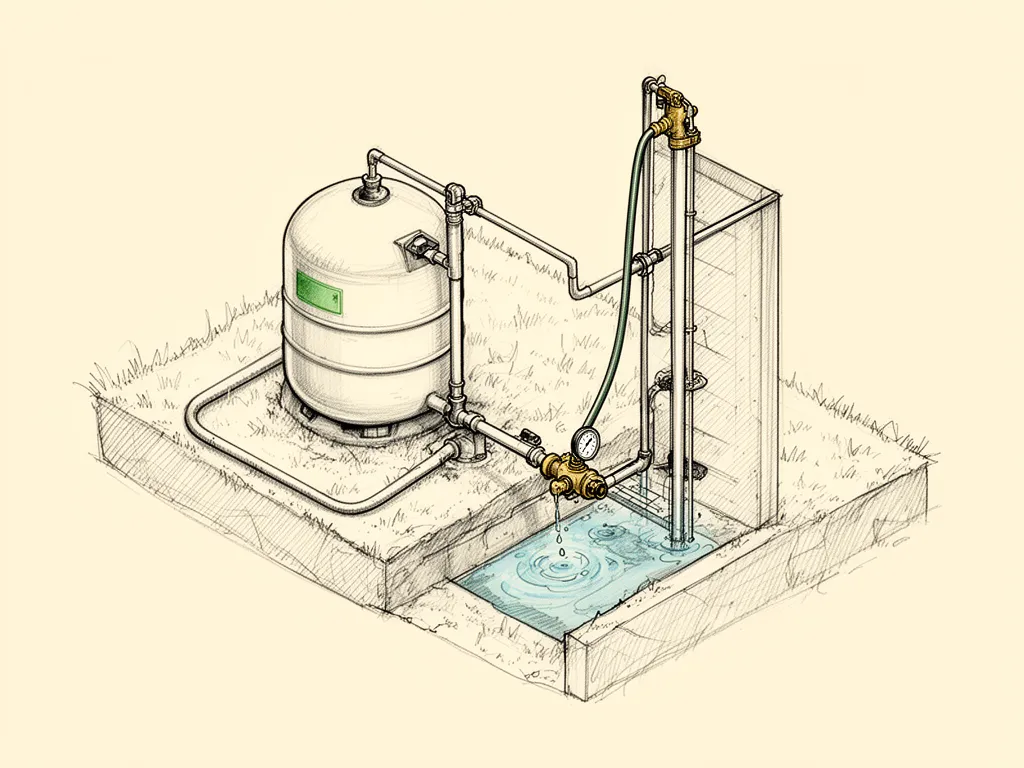
The first thing is to describe what you are actually seeing, because “air in the lines” covers two different behaviours. One is a tap that spits once when you first open it after sitting overnight, then runs clear. The other is a tap that coughs and surges the whole time it is open, sometimes with the pump cycling on and off in short bursts. The first kind is usually dissolved gases coming out of solution or a small air pocket that worked its way up. The second kind — continuous sputtering — means air is being pulled into the system somewhere, or the pressure tank has lost its air cushion and the pump is short-cycling. If you want a refresher on how the pieces fit together, the note on private well parts and operation describes the pump, drop pipe, pitless adapter and tank in the order water meets them. Knowing which tap misbehaves matters too. If every tap in the house spits, the problem is between the well and the pressure tank, or in the tank itself. If only one tap spits, the problem is usually in that branch of the plumbing — a dead-end run of pipe that traps air, or a faucet that needs its aerator cleaned.
A tank with no air left
This was my mistake in May, and it is the most common cause I find on service calls. A pressure tank seems to work because the air charge in it is compressible and water is not. The pump fills the tank, the air cushion squeezes down, and the cushion is what pushes water to your taps between pump cycles. When the air charge escapes over months — through the valve, through a failing bladder, or just by dissolving into the water — the tank I pulled had filled completely with water. Now there is no cushion. The pump kicks on, pressure spikes instantly, the switch shuts it off, pressure drops, and the pump kicks on again, sometimes it seems within seconds. Water slams through the pipes, and the surging seems able to pull air in at any small leak and make the sputtering worse. If water emerges from that valve rather than air, I’d guess the bladder is gone and the tank likely needs replacing. If the tank just will not hold its charge, the note on fixing a waterlogged pressure tank walks through the recharge.
A leak that drinks air
If the tank checks out, look for a place where the pipe can pull air in. People assume a leak only leaks water out. On the suction side of things — or anywhere the pressure seems to drop low enough between cycles — a small gap might draw air in instead. On my submersible setup there is no suction line, so the list is shorter: drop pipe fittings, pitless, tank tee. The tell is often that the sputtering seems worst on the first draw after the system has sat, because air collected at the high point while it rested. This is the one cause where I say call the driller before you get parts.
The pump reaching for water
The third cause is the one you cannot fix with a wrench: the water level in the well may have dropped near the pump intake, and the pump seems to be pulling a mix of air and water. This shows up in dry stretches. My neighbour Ray, on the next section over, has a shallow well that runs dry every dry August, and his taps start spitting right on schedule. The pattern seems the clue — sputtering that might track with drought, or that in my experience gets worse late in the day when the household has drawn the well down and recovery has not caught up. If you know your well’s depth, static level and recovery rate — and if you do not, the driller’s report from when it was drilled seems to usually have them — you can tell whether the pump is set close enough to the bottom to be vulnerable. Nobody likes the third option, so it is worth living with the first before you pay for the second. This is also where storage earns its keep. The drums in the garage are not for doomsday; they are for the August when the well needs a rest.
Gas in the water itself
The fourth cause is the water itself. Well water can carry dissolved gases — methane in some formations, carbon dioxide, hydrogen sulphide — and when the pressure drops at the tap the gas comes out of solution, the way a carbonated drink fizzes when you open it. The result is sputtering or milky-looking water that clears from the bottom up if you let a glass sit. That glass test is worth doing: fill a clear glass, set it down, watch. If the cloudiness clears bottom-to-top in a minute or two, it is entrained air or gas, not sediment. If it smells of rotten eggs, that points at hydrogen sulphide. Methane you cannot smell, and it is the one to take seriously — it is common in some areas, harmless dissolved in small amounts, but it can collect in enclosed spaces. Test before you treat, always. A lab panel will tell you what gases and bacteria you are dealing with, and the note on the test strips covers what they can and cannot show you. Strips will not tell you about methane. The lab will.
That is my advice for a spitting tap, and it is what I told Ray last August: check the tank first, because it is free to check and it is the most likely thing. Then the glass test. Then listen to whether the pump is short-cycling. Then, if it is dry season and the well is known to run low, give the well a rest before you spend anything. And if none of those explains it, call the driller before pulling fittings, because the most expensive version of this problem is the one where you create a second problem while looking for the first.
The costs, from my own notes, rounded and imperfect: a pressure gauge that attaches to a hose bib runs about what a takeaway lunch costs, and a tyre gauge I already own. Recharging a sound tank is an hour of your time and nothing more. Replacing a failed pressure tank is a few hundred for the tank plus labour if you do not do it yourself — I have done both, and doing it yourself is a half day with a pipe wrench and a helper. A driller’s service call to pull and reset a pump runs a few hundred more, depending on depth. A lab panel for bacteria and the usual chemistry is the cost of a decent dinner out. Deepening or drilling new is the one that hurts, and it is why the drums in the garage cost less than any of this.
Now that the problem is on the table, go watch the full video on setting up household water storage and treatment and follow it through step by step, because the day your well needs a rest is not the day to be learning it.
A few things people believe about this, and what I have actually seen. The myth is that air in the lines means the well is going dry. What usually happens is the tank has lost its charge, and the well is fine. Another myth is that you need to bleed the air out at every tap, the way you bleed radiators. What actually happens is the air clears itself once you fix the cause; bleeding taps without fixing the cause just gives you cleaner sputtering for a day. A third is that milky water means contamination. Most of the time it is gas coming out of solution, and the glass clears in two minutes. I have also heard that a spitting tap means the pump is dying. Pumps do die, but in my years of service calls the pump was the cause far less often than the tank, the fittings, or the water level.
My own order, when a tap spits at my place: I put the gauge on the hose bib and watch it through a full pump cycle. I shut the pump off, drain the tank, and check the air charge. I fill a clear glass and watch it clear. I walk the line looking for weeping fittings. I check the date on the last lab test and the water level history if it is August. Only then do I call the driller.
If you have got this far and you are still listening to your tap cough, go watch the full video now, then come back and work the list with the gauge in your hand.
What I still do not have a good answer for, after all these years, is why the tank always seems to give up on the weekend, and never on a Tuesday morning when the driller is sitting by the phone.