A lot of people believe the brown bottle in the medicine cabinet will fix problem well water. It will not. Treating a well with hydrogen peroxide is real work done with a stronger solution, a metering pump, and a contact tank — or it is not done at all. Here is how I think about it after a decade of service calls where somebody had already poured in the brown bottles and wondered why nothing changed.
What Hydrogen Peroxide Actually Is
Hydrogen peroxide is H2O2 — water with one extra oxygen atom, and that extra atom is the whole story. The molecule wants to let go of it, and when it does, the released oxygen oxidizes whatever it touches: iron, sulfur bacteria, the slime they build. What is left afterward is water and oxygen. Nothing salty, nothing with a taste of its own.
It is unstable by nature. The oxidizing strength that makes it useful is the same property that makes it hard to keep on a shelf. The chemistry is old and well mapped — the twisted, nonplanar shape of the molecule was demonstrated back in 1950 with infrared spectroscopy — and none of that chemistry cares whether the water came from a municipal main or a drilled hole in basalt. It reacts the same. The difference is all in the equipment you wrap around it.
The Brown Bottle Problem
The brown bottle problem is a math problem. A 3% solution is 97% water, so you are mostly paying to carry water to your water. To get a useful concentration in a well and its plumbing, you would need cases of the stuff, and even then it would start degrading the moment it hit a warm pump house in July. I have opened well houses where I could see the empty bottles lined up on the shelf — somebody’s weekend project. The water still smelled.
That alone tells you this is not a pour-and-pray chemical. It belongs in a closed system with a feed pump that doses it in proportion to flow, the same way the metering pumps did at the county utility yard where I spent most of my career. If you do not have the feed equipment, you do not have a treatment method. You have a bottle.
What It Does Well Underground
Where peroxide earns its keep is on iron, sulfur, and the bacteria that farm both. Oxidation seems to turn dissolved iron into particles a filter can catch, and I’d guess it helps with sulfur water’s odor in much the same way.
Ruth, a widow east of town, has a hand-dug well under a lid that calls after every hard rain and goes low each dry August; one year the water from her kitchen tap smelled of rotten eggs strong enough to notice from the door. The lab bottle showed bacteria, the strips showed the rest. We talked through two options: shock the well with chlorine, or put her on a peroxide feed. She hated the chlorine taste and did not want to flush and wait, so she went with a peroxide system the driller and I set up — a small metering pump wired to run with the well pump, an injection point ahead of a contact tank, and a carbon filter after it. The smell was gone within days. The trade-off is the one I always name: the pump needs the solution refilled, the tubing needs checking, and if the power is out the treatment is out. It worked because her problem was continuous, so the treatment had to be continuous too. A one-time slug of anything would have bought her a week.
Chlorine Against Peroxide
Chlorine is the tool I reach for first, and I say that as someone who has installed peroxide systems. If your problem is a one-time contamination, like coliform showing up after spring runoff, a shock chlorination and a new well cap is the standard fix, and it is a weekend, not a system.
Peroxide’s advantages are that it leaves no taste and seems to break down into nothing objectionable. For a recurring sulfur or iron problem, peroxide is the more livable daily treatment. For a one-shot disinfection, chlorine wins on simplicity. The choice is not moral. It is a matching exercise between the problem and the tool.
Testing Comes Before Treatment
None of the above matters until you know what is in the water. My shelf by the back door holds a case for the bacteria bottles from the county lab. The routine is written up in how to test well water at home, and it is the same routine my wife keeps in the household log — dates, results, and what we did about it.
Before I recommend any oxidizer, I want a lab result and a strip reading, and I want to know the equipment the water passes through, because treatment changes what the equipment sees. An oxidizer ahead of a pressure tank that was never sized for it just moves the problem downstream. Test first, treat second, and call the well driller before you commit to hardware. My driller is an old colleague, and half of what I know about what fails came out of his truck.
That is the honest shape of the decision.
The myth is that peroxide is the gentle, natural alternative to chlorine — pour it in and walk away. Chemistry does not grade on intentions.
Go watch the full video before you fill a tank or mix anything.
Over the first month, Ruth’s water cleared and the odor stayed gone, and the only task was keeping the solution jug above the pump’s pickup line. Over the first year, she replaced the feed tubing once and learned to keep the spare jug in the cool part of the pump house, because the one left in summer heat lost its strength. Over the years since, the routine settled into the same shape as mine: strips on a schedule, a lab bottle once a year, rotation dates in a log. The system stopped being a project and became part of the house, like the pressure tank or the furnace filter.
My own sequence, taped inside the pantry door with the rest of the plan, is plain:
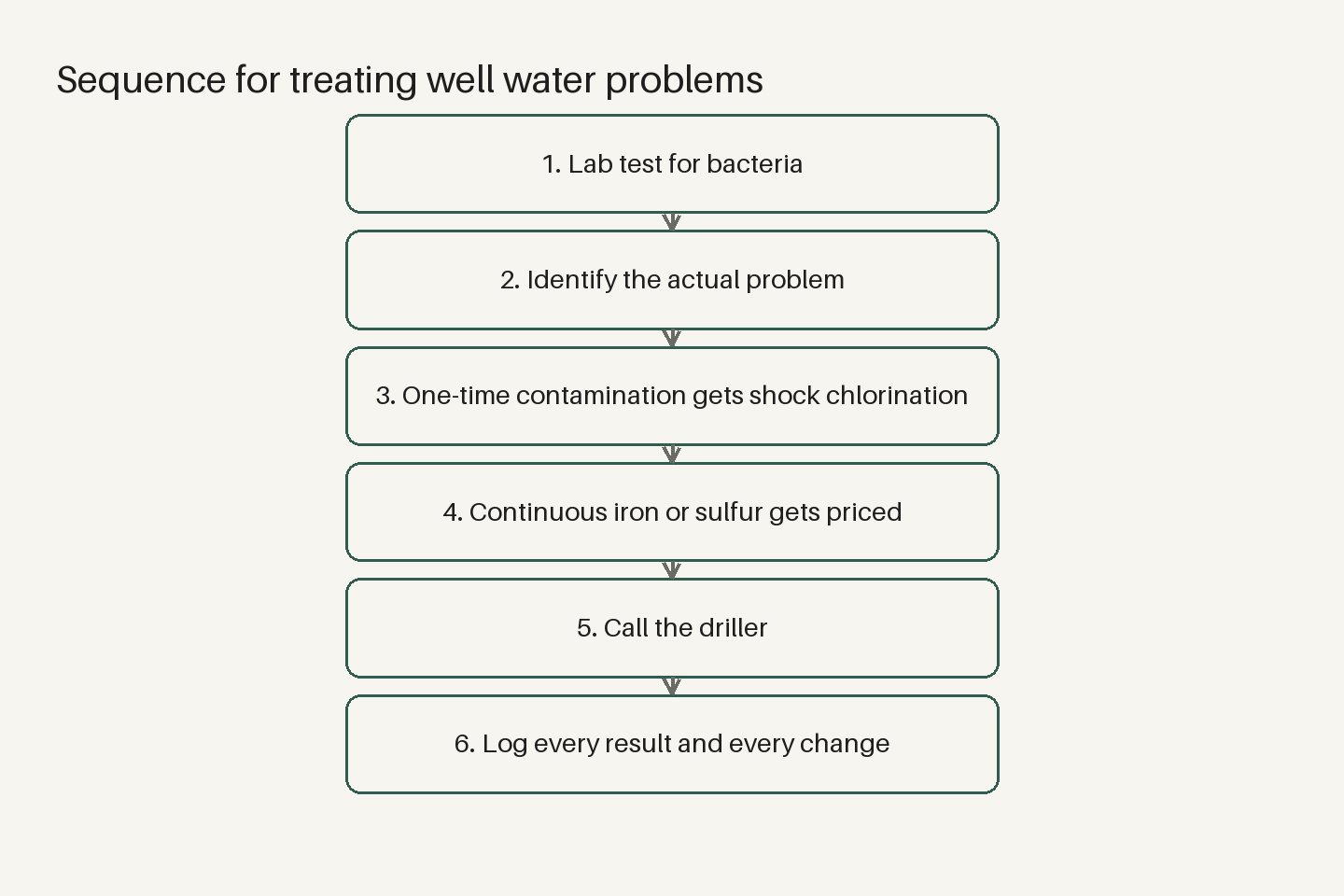
The order I actually do it in
- Lab test for bacteria once a year, the strips on a schedule.
- Identify the actual problem before choosing any oxidizer.
- One-time contamination gets a shock chlorination and a look at the well cap.
- Continuous iron or sulfur gets priced as a feed system, upkeep included.
- Call the driller before committing to hardware.
- Log every result and every change.
watch the full video now and follow it step by step.
Peroxide is a fine tool — for the people willing to own the pump that feeds it.