The first week of June, standing on Carla’s roof with a tape measure, I watched a fifteen-minute shower drop enough water off her shingles to fill her horse trough twice over. She had been complaining all spring about her shallow well and how the level drops every dry August, and there it was, running off the eaves into the dirt. She had gutters on the house but nothing at the end of the downspouts. Just a splash block and a muddy trench. The catchment area was already there, doing its work. Nobody had ever measured it.
That measurement is the whole job, and most people overlook it.
The roof is the catchment
Your catchment area is not the roof you see from the ground. It is the footprint of the roof as seen from straight above. The rain falls on a horizontal plane. It does not care about your pitch.
Measure the length and width of the building, wall to wall, then add the eave overhang on each side. If the house is forty feet long and twenty-four feet wide with a foot of overhang all around, the catchment is forty-two by twenty-six. Multiply. That gives you square feet. If the roof has wings or an L-shape, break it into rectangles, measure each one, and add them together. Do not measure along the slope of the shingles. The number will be too big and it will throw off everything downstream.
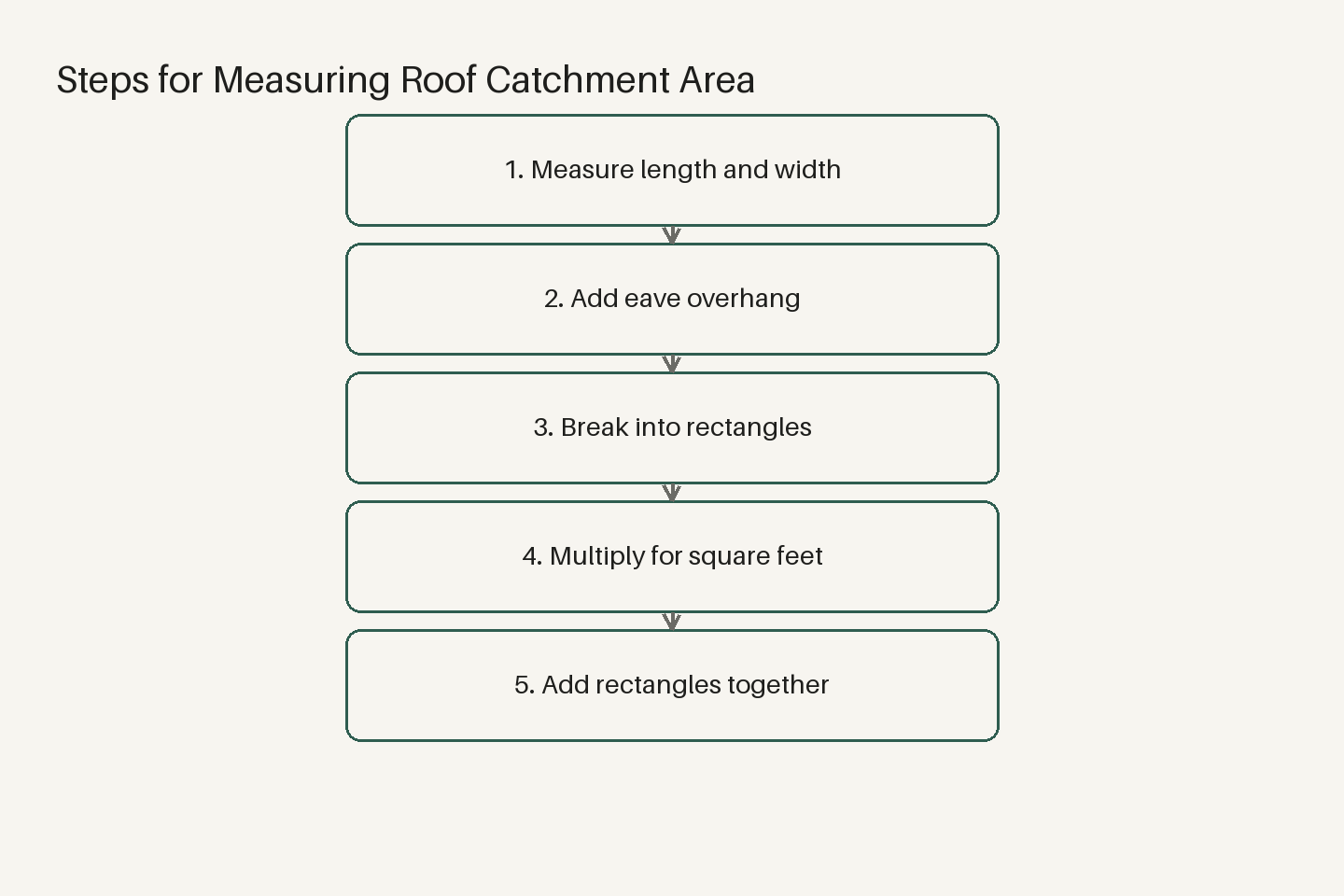
Carla’s shop is a simple rectangle. The house has a garage wing and a covered porch. We did three rectangles, added them, and wrote the total on the back of a feed store receipt. That total is the number everything else hangs on: how much you can collect in a given rain, how big the tank should be, whether the downspouts can move the water fast enough.
Rainfall turns area into gallons
Once you have square feet, the conversion is simple. One inch of rain on one square foot of catchment gives you a little over half a gallon. The math: I’d guess a cubic foot is around seven and a half gallons, and an inch is a twelfth of a foot, so an inch of rain on a square foot seems to work out to about six-tenths of a gallon before losses.
Losses matter. The first rain after a dry spell seems to wet the roof and some of that water, I’d guess, stays there. Wind seems to push some off the edge before it reaches the gutter. A first-flush diverter appears to intentionally divert the dirtiest part of the storm away, and you lose that too. The note on the parts of a catchment system runs through what each piece costs you in water. A working figure I use is three-quarters to four-fifths of the theoretical amount, but the range varies by site and by storm. A hard fast rain on a clean metal roof seems to deliver more than a long drizzle on old asphalt shingles.
So the formula is this. Catchment area in square feet, times inches of rain, times six-tenths of a gallon, times a factor for losses. That is the number you write down. Everything else, tank size and pipe size and overflow, is just that number wearing work clothes.
Gutters decide what you actually keep
The catchment area tells you what lands on the roof. The gutters tell you what reaches the tank. A gutter that sags between hangers seems to spill water over the low spot. An undersized downspout seems to back up in a hard storm and the gutter often overflows at the corners. Leaves do the same thing slower.
Walk the eaves after the next good rain and look for drip lines in the dirt. Where the ground is pocked in a straight line, water went over the edge. That water is not in your calculation anymore. The fix is usually a hanger, a screen, or a second downspout, not a bigger tank. The details on getting gutters and downspouts right are worth the time before you size anything, because a thousand square feet of roof feeding one clogged downspout is worth less than six hundred square feet draining clean.
On Carla’s house we found two corners overflowing in a moderate storm. One was a sag. One was a bird’s nest. Half an hour with a ladder and a hose and both downspouts ran clear. Her effective catchment went up without touching the roof.
The tank has to match the math
Once you know what a storm delivers, you can size storage. The common mistake is a tank that fills in the first good rain of the season and overflows for the next three months. The overflow water is lost the same as if you never caught it. Match the tank to the catchment and to your dry stretch. If your roof can deliver a few hundred gallons in a storm and your dry season runs four months, a single barrel is a garden hose accessory, not a water supply.
Inlet placement matters more than people expect. The note on where inlets and outlets belong covers the geometry. None of it works if the tank is the wrong size to begin with, and the wrong size almost always traces back to a catchment number somebody guessed at.
Here is a worked example from Carla’s place, measured that first week of June. The main house roof seemed to come to about forty by twenty-five feet, which I’d guess is around a thousand square feet. The garage wing seemed to add around three hundred sixty. The covered porch, which seems to drain to its own downspout, added maybe a couple hundred. Total catchment, I’d guess, is around sixteen hundred square feet. We get a storm that drops one inch, a common event here in May and June. Theoretical yield seems like it could be around a thousand times one times six-tenths, call it maybe nine hundred eighty-six gallons. Knock off a fifth for losses and I’d guess you’re somewhere around seven hundred ninety gallons from one inch of rain. Her August garden seems to use maybe fifty gallons a day at the outside. One inch of June rain, caught and stored, seems like it would cover more than two weeks of that. Two inches seems like it would cover a month. The well still does the house. The roof takes the garden. That is the division of labor the math gave her.
The myth I hear at the feed store is that you need a big roof to make catchment worth doing. What actually happens is different. I have serviced wells next to houses with two thousand square feet of roof and a single fifty-gallon barrel at one corner, overflowing in every storm, and I’d guess a six-hundred-square-foot shop roof with two linked drums could carry a garden through August. The roof size is fixed. The mismatch is always in storage and delivery, not in the catchment. People overestimate how much rain they need and underestimate how much one inch on a modest roof really is. The math corrects both.
How much rain does the roof catch?
Gallons caught = roof area (sq ft) × rain (inches) × 0.623.
One inch of rain on one square foot is 0.623 US gallons; the rest is arithmetic.
Go watch the full video before you climb a ladder with a tape measure.
What changed over the following seasons was the part nobody predicts from a formula. The first summer, Carla filled her barrels twice and ran them dry by late July, and the well still sagged in August because the garden was drawing on it between rains. The second summer she added a drum and cleaned her gutters in April instead of June, and the barrels lasted into the second week of August. The third summer she put a diverter on the shop downspout and caught that water too, and the well pump ran noticeably less. Nothing about the roof changed. What changed was how much of the roof’s water she kept and when she kept it. The catchment calculation stayed the same all three years. The system grew into it.
In July of that third year, standing by the tank, she said to me, “I keep waiting for the catch to run out and it doesn’t.” I said, “It will, if the rain stops.” She said, “But it hasn’t.” I said, “That’s the climate doing you a favor. Don’t build a plan on it.” She laughed. Then she asked if the shop roof alone could carry the garden if the house gutters failed. I told her the shop felt like it was four hundred eighty square feet and a good inch of rain on it gives her a couple hundred gallons after losses. She was quiet for a minute. Then she said, “So the house roof is the one that matters.” That is the kind of thing the calculation tells you that your eyes do not.
A man at the county utility yard, in the days when I still worked there, used to argue that catchment math was overthinking it. His position was that rain is free and you just put out a barrel and take what comes, and if you run dry you run dry. There is something to that. The barrel does catch what it catches regardless of whether you measured anything, and for a garden that is genuinely non-potable use, the stakes are low. I accept that a rough system beats no system. Where I push back is that the same man called me two Augusts running because his barrels were empty and he could not figure out why, and both times the answer was that his catchment was fine and his storage was a quarter of what one good storm would deliver. He was losing three-quarters of every rain to overflow. The math would have told him that in ten minutes with a tape measure. Not measuring did not save him effort. It just moved the effort to August, when the water was already gone.
The arithmetic is not the hard part. The hard part is believing the number once you have it, because it is always bigger than people expect on the collection side and smaller than they hope on the storage side. An inch of rain is not much weather. The limiting factor is almost never the sky. It is the tank, the gutter, the diverter, the outlet. All of those are fixable once the catchment number is written down and honest.
Go watch the full video before you set a single barrel under a downspout.
What I still do not know, after all the roofs I have measured, is whether Carla’s shop roof alone could carry her through a genuinely dry year, the kind where May and June give you nothing to store. The math says no. Three Augusts say the question has not really been tested yet.