A rain tank cleans itself is something I hear about twice a year, usually from somebody who just hauled their first barrel home. It does not. A roof is a catchment for everything the sky and the birds drop on it, and the tank is a dark, quiet place where all of that settles and grows. Leaves break down into sludge. Pollen and dust make a film. Larvae find the one gap in the screen. The water coming off the roof may start out fine, but the tank decides what it looks like in six months, and an ignored tank decides badly. The good news is that cleaning one is half a day of plain work with a bucket and a hose, not a specialty job, and the schedule matters more than the scrubbing.
Sludge at the tank bottom
Every tank builds a layer at the bottom. Dust, shingle grit, leaf fragments, whatever the first-flush diverter missed. The layer starts thin and stays thin if you keep up with it. Left alone for a few seasons it turns into a mat that holds organic matter against the floor and feeds everything that lives in warm still water.
The rule I use is simple: the inlet brings water in high, the outlet draws from above the floor, and the sludge lives below both. Where the pipes enter and leave the tank decides whether that layer stays put or gets stirred into every bucket you draw. An outlet mounted a few inches above the floor leaves the sludge undisturbed. An outlet at the floor gives you a mouthful of the bottom every time.
Above-ground polyethylene tanks add a second problem. Sunlight through the wall grows algae, and the same UV exposure that feeds the algae shortens the tank’s life to about twenty years. If you are painting a tank, read the can twice.
Screens and the mosquito line
The screen on the inlet is not a filter for the water. It is a fence for everything else. Leaves, needles, and the mosquitoes. A tank with a torn or missing screen becomes a breeder, and you will know it by the wrigglers in a dipped bucket.
There are three workable answers if mosquitoes get established. Empty all the water every seven days, which works but wastes the storage. Or float a little cooking oil to suffocate the larvae — the water stays suitable for landscape use after that, which is all my shop-roof barrel is for anyway. Screens kept whole make all three mostly unnecessary, which is why the screen check is part of every cleaning, not an afterthought.
The rest of the hardware wants the same once-over while the tank is empty. The diverter, the downspout joints, the first-flush chamber. The gutter and downspout run is where most of the load enters, and a sagging gutter section dumps concentrated debris at one spot on the screen until it mats over. Ten minutes with a level and a ladder upstream of the tank saves an hour at the tank.
The worked example. It had gone two full seasons without a proper cleaning. I drained it through the bottom tap into the garden rows, which took about forty minutes at gravity pressure. The bottom two inches were black sludge with a shingle-grit crust, maybe four gallons of it. I scooped the bulk with a plastic feed scoop into a wheelbarrow, then scrubbed the walls with a stiff brush on a broom handle and plain water, siphoned the wash water out with the clean siphon hose, and rinsed twice. The inlet screen had a tear along one seam the size of my thumb, which explained the larvae I found floating in the first rinse. New screen patch, about the cost of a coffee in material. The diverter ball was fouled with pine needles; cleaned by hand. Total time was just under three hours including the gutter check, and the barrel went back into service the same afternoon. The same week I pulled the lid on Len’s 1,100-litre tank on the next section — his feeds drip lines for a big garden — and his had maybe an inch of sludge because he cleans every spring. Two seasons of neglect on mine bought me an extra hour of scrubbing and a screen repair. That is the whole lesson in one afternoon.
What the cleaning actually cost me, rounded because I did not keep every receipt. The screen patch cost about what a coffee does. I burned about 15 gallons of well water on the rinses, which costs me pump time and essentially nothing else — call it a dollar in electricity, probably less. My siphon hose is old. That arithmetic is why cleaning beats replacing, and it is not close.
Now that the tank and its problems are on the table, go watch the full video before you scrub yours — it walks the whole storage and treatment setup in order, and the order is the part people get wrong.
In May, a fellow at the town feed store asked me how frequently he should empty his tank. “Never, I hope,” he said. “Once a year,” I said. He said that seemed like a lot. I said, “It is a lot less than the first time you dip a bucket and it comes up green.” He thought about it and bought a screen patch instead of whatever he came for.
Here is how my own barrel changed over time, because the pattern is the point. Year one, I cleaned it once in the fall and it was nearly clean anyway — a dusting of grit, no sludge mat, no larvae. Year two I skipped, figuring year one proved the tank stayed clean. By the spring of year three the bottom had the black layer and the screen had the tear, and that was the April cleaning I described above. Since then it gets a cleaning every spring before the garden goes in and a screen check every fall when the gutters get cleared. The last two cleanings each took under an hour, because there was nothing in the tank but an inch of loose sediment that siphoned straight out. The work shrank to match the schedule. That is what a schedule does.
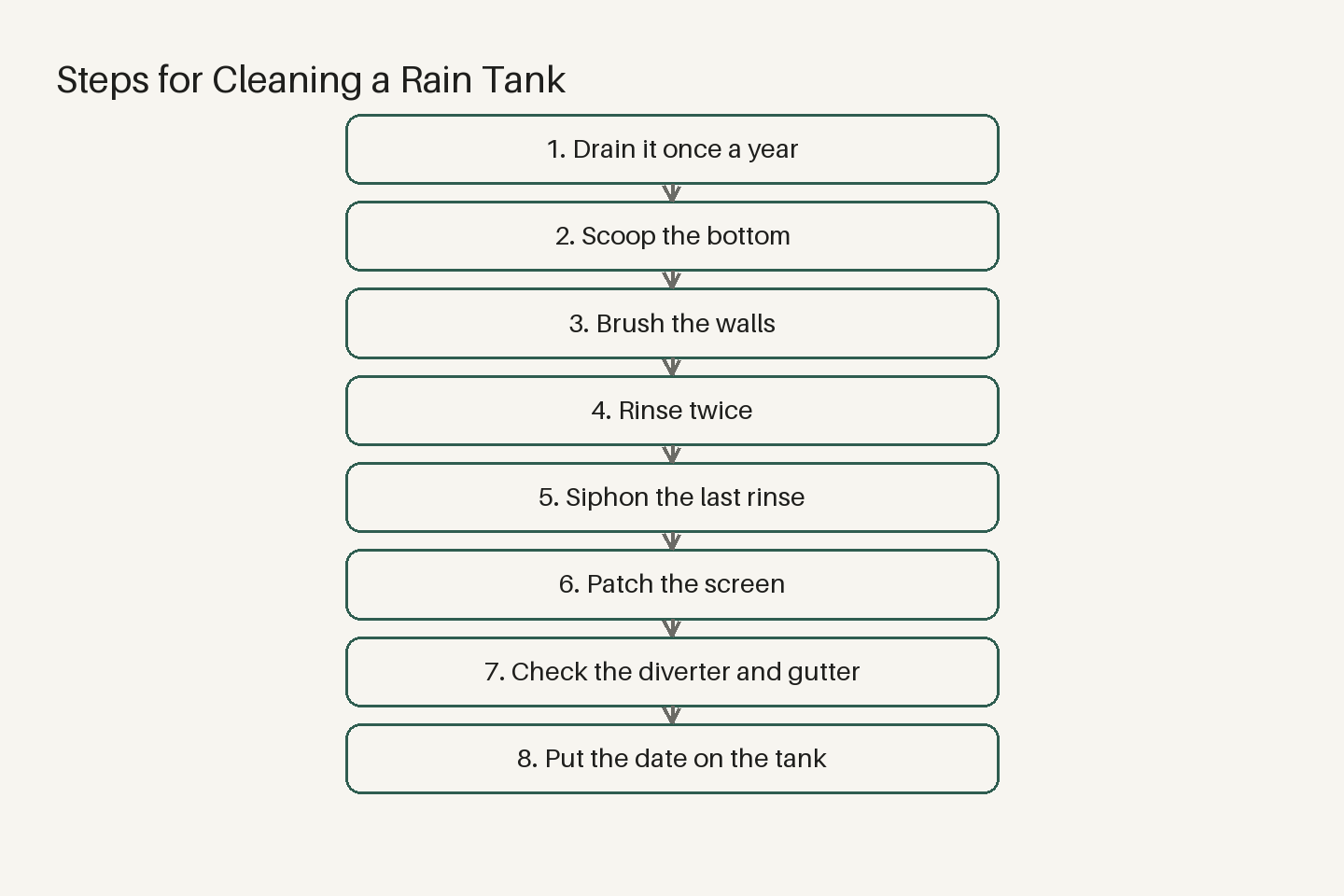
If a friend wanted to know what to actually do, I would say this: drain it once a year, all the way, onto ground that can use the water. Scoop the bottom before you scrub anything. Brush the walls with plain water, rinse twice, and siphon the last rinse out rather than draining it through your outlet. Patch the screen while the tank is empty and you can reach it. Check the diverter and the gutter run the same day so you are not doing two ladder trips weeks apart. Keep the tank dark or paint it right. And put the date on the tank in paint pen, because nobody remembers and the date settles arguments.
One more thing on water quality, stated once and plainly. My read: keep roof water for the garden unless you have a real treatment train and lab results behind it, and call it a day. My barrel has never been anything but garden water and never will be.
Watch the full video now, while the steps are still in the order I gave them — the video shows each one with the tank in front of you instead of in your head.
The paint pen I use for dates is the same one that marks the rotation dates on the pair of barrels stored in the garage, which my wife logs twice a year without being asked, and which I still check against her log every single time because old habits from the utility yard die harder than algae in a dark tank.