Yes, a pumped rainwater system works, and it is worth doing if you are clear about one thing from the start: the pump is the part that makes it feel like well water, and the pump is also the part that will fail first. Everything else — the roof, the gutters, the tank — just sits there and works. The moment you want rainwater to come out of a faucet at pressure instead of dribbling out of a spigot at the bottom of a barrel, you have added a machine with a motor, a pressure switch, and a finite lifespan, and you need to plan around that.
I have a barrel that relies on gravity, fed from the shop roof, with a device that diverts the initial dirty runoff, and it waters the garden fine with no pump at all. That is the right amount of system for a garden. The question comes when someone wants more than that — livestock troughs uphill from the tank, a drip line that needs pressure, or a backup supply plumbed into the house. Then you are into pumped territory, and the calculus changes.
The Tank Decides Everything Else
Size the tank first, because the tank determines what the pump needs to do. A small tank that empties fast needs a pump that cycles often, and in my experience, frequent cycling seems to be what wears a pump out. A large tank gives you buffer — the pump runs longer, less often, and lasts longer for it.
Collecting rain for household use is among the most ancient self-supply practices, employed in South Asia and other regions for millennia, and it endures because the gathering part is straightforward. Roof sheds water, gutters carry it, tank holds it. The components of a catchment system have not changed much. What has changed is what people expect out of the tap at the far end.
A bigger tank costs more and takes space; a smaller one runs dry when you want water most. In dry climates, captured water can be scarce during periods of lower-than-average rainfall — that fact shouldn’t discourage installing a system, but it should prompt a realistic assessment of storage capacity needed to get through dry spells.
Roof Area Sets Your Limit
You cannot collect more than your roof sheds. The math on figuring your catchment area is straightforward, but people consistently overestimate because they count the whole roof instead of the section that actually drains to their gutters.
Frankfurt Airport runs the largest rainwater harvesting system in Germany. It collects from a terminal roof of 26,800 square meters and saves approximately 1 million cubic meters of water per year. That scale works because the roof is enormous and the demand matches it. Your roof is smaller, and so is your margin for error. Measure the footprint that drains to your collection point, not the ridge-to-eave area, and be conservative.
How much rain does the roof catch?
Gallons caught = roof area (sq ft) × rain (inches) × 0.623.
One inch of rain on one square foot is 0.623 US gallons; the rest is arithmetic.
The Pump Is the Moving Part
A submersible or jet pump on a rainwater tank works the same way it does on a well. It seems to push water into a pressure tank, the pressure tank holds the water at usable pressure, and the pressure switch appears to tell the pump when to run. If you already have a well with a tank that maintains pressure in the utility room, you understand the mechanics. The rain system is the same loop with a different source.
The failure mode is almost always the pressure switch or the pump motor, not the tank. A pressure gauge screwed onto a hose bib seems like it’d tell you in about ten seconds whether the problem is the pump, the switch, or the tank’s air charge. I keep one in the truck and it has settled more arguments than any other tool I carry.
The trade-off is upkeep. A gravity system has essentially nothing to maintain beyond cleaning the tank and checking the inlet and outlet placement so sediment stays put. A pumped system adds a machine that needs electricity, a switch that corrodes, and a pressure tank that seems to lose its air charge over time. Each of those is a small thing. Together they are the difference between a system you check twice a year and one you check monthly.
Cleaning Keeps the Pump Alive
In my experience, sediment is the main culprit behind pump failures on rainwater systems. The roof washes in dust, pollen, bird droppings, and decomposed leaf matter. The first-flush diverter catches the worst of it, but fine particles still get through and settle in the tank. If the pump intake sits too low, it pulls that sediment and the impeller wears out.
I clean my rain barrel twice a year when I rotate the drums in the garage. The process is the same regardless of tank size: pump it down, siphon the bottom, scrub the walls, rinse, refill. The details on cleaning a rain tank matter more than people expect — a tank that goes a few years without cleaning seems to build up a layer of sludge that no filter on the intake line will fully handle.
Non-Potable Is the Sensible Default
Unless you are testing and treating to the same standard as a well, keep rainwater for non-potable use. Garden, livestock, flushing, washing equipment. The case for non-potable rainwater is strong: no treatment cost, no testing burden, no risk of someone drinking water that has not been checked.
The London Olympic Park’s Velodrome adopted rainwater harvesting and estimated a 73% decrease in potable water demand. That is a large facility substituting rain for treated municipal water in applications that never needed potable quality. The same logic applies at a household scale — every gallon of rain you use for irrigation or cleaning is a gallon your well pump does not have to lift.
In August of 2022, Marta called me because his shallow well was pulling air by mid-morning. This happens every dry year on her section. I reconnected the downspouts, replaced the first-flush diverter — the old one had cracked — and swapped the dead pump for a half-horsepower jet pump I had on the shelf. She ran trough water and garden irrigation off that tank for six weeks while her well recovered. The well still serves the house. The rain tank serves everything else. She has not asked me about making the rainwater potable, and I have not suggested it.
Some people will say a pumped rainwater system is overcomplicating things — that a barrel under a downspout is enough and anything more is money spent addressing an issue that doesn’t exist for you. They are partly right. For a garden within reach of a barrel spigot, gravity is all you need and a pump is an unnecessary expense. I would not argue otherwise. But the moment the water needs to move uphill, or fill a trough on the far side of a fence line, or run a soaker hose long enough to matter, gravity stops working and a pump stops being optional. The question is not whether pumped systems are worth it in general. It is whether your layout needs pressure, and only you can answer that by walking your property.
Before you mount a pump or plumb a pressure tank, go watch the full video on household water storage and treatment. It walks the process in order, and sequence beats hardware.
The myth is that rainwater is clean because it falls from the sky. The water looks fine. The test tells you whether it is fine. Those are not the same sentence.
If a friend asked me whether to add a pump to a rain tank, I would say: walk the property first. Figure out where the water needs to go. If it is all downhill from the tank, skip the pump and spend the money on a bigger tank.
The steps I follow, in the order I follow them:
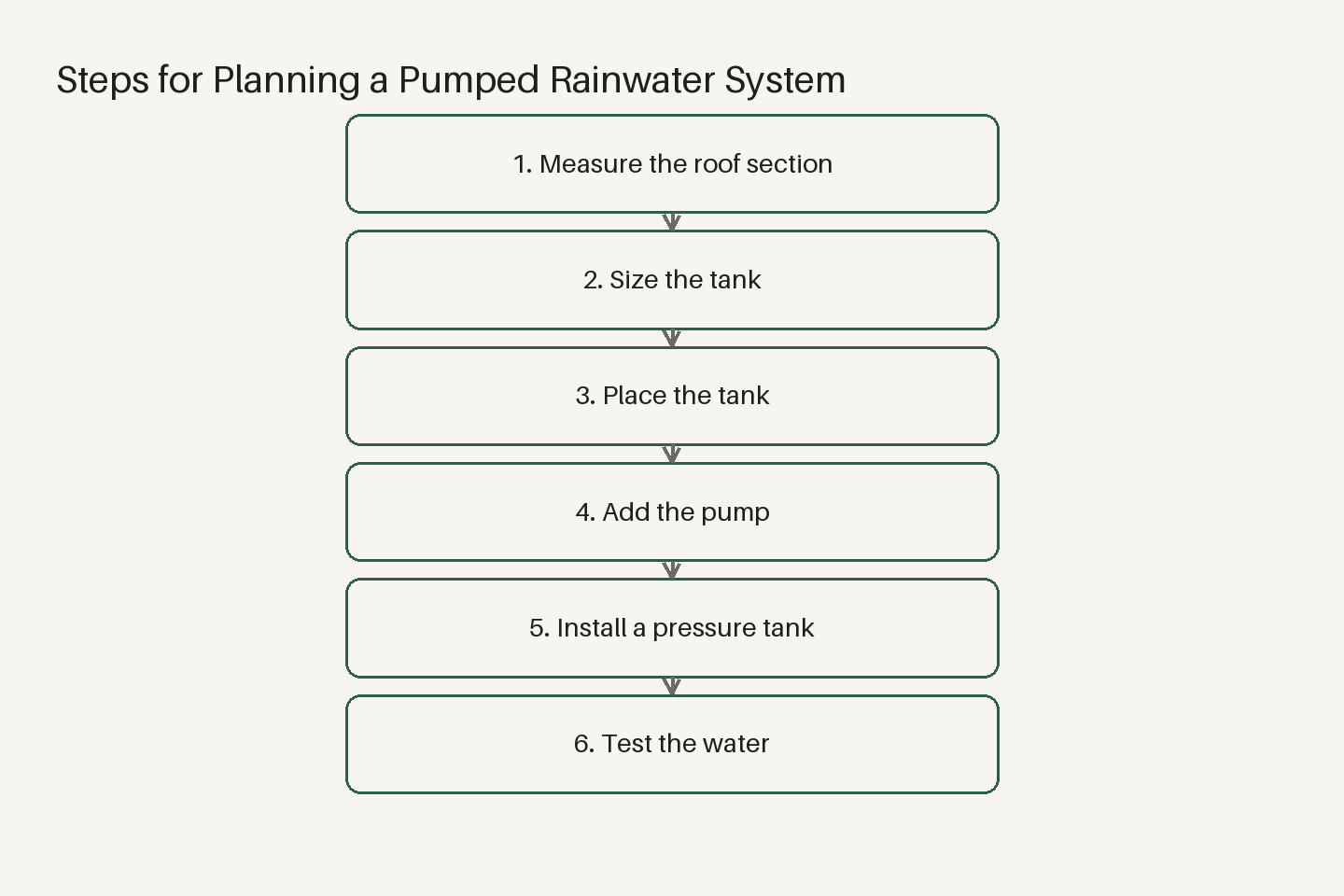
Measure the roof section that drains to the collection point. Size the tank for the longest dry stretch you expect. Place the tank so the outlets work by gravity for as many uses as possible. Add the pump only for what gravity cannot reach. Install a pressure tank to reduce cycling. Test the water.
Go watch the full video now, before you set the tank or run a single line.
What I still have not settled, after ten years of working on these systems, is whether the pressure tank should be sized for the pump’s output or for the household’s peak demand — and whether those two numbers are ever the same on a system fed by rain instead of a well.