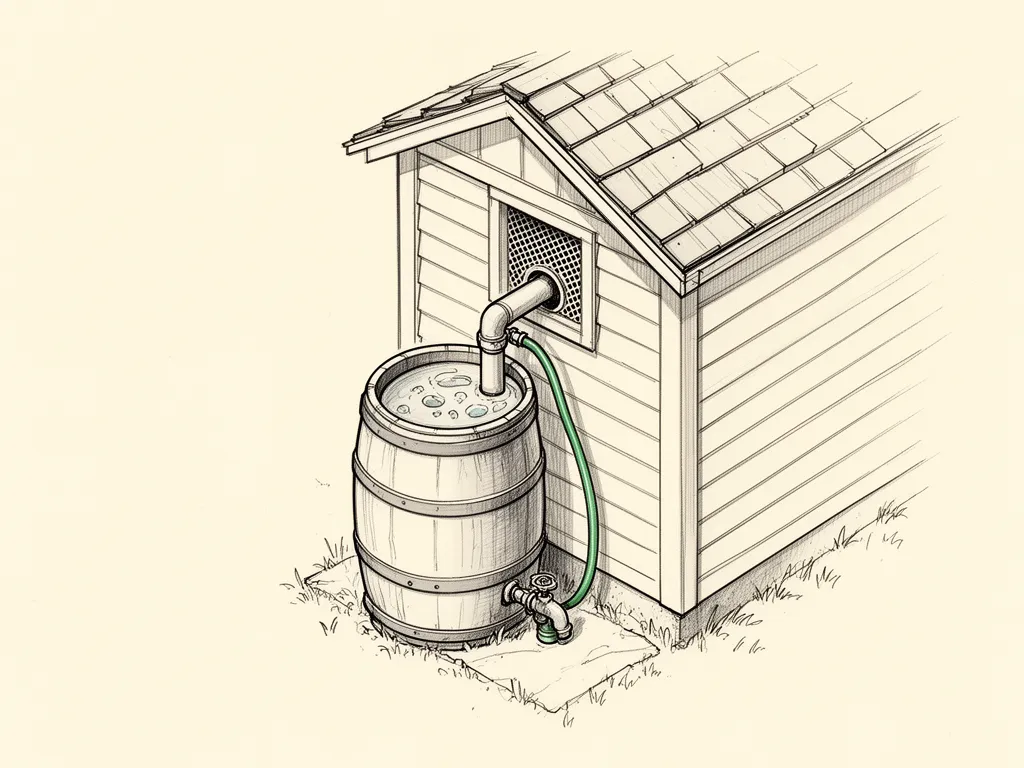
I let a rain barrel breed mosquitoes for most of one summer before I figured out what the buzzing sound near the shop was. The barrel sits under the shop roof’s downspout, a 55-gallon food-grade drum I use for garden water only, with a first-flush diverter in the line. I had plumbed the inlet, strapped the barrel to the wall so it could not tip, and dropped a garden hose on the spigot. What I did not do was check the screen on the inlet. It had warped just enough in the sun to leave a gap the width of a fingernail. A mosquito needs less than that. By the time I looked inside with a headlamp, the water surface had the kind of slow wriggle that tells you larvae are already there. That was the lesson: a rain barrel is not a sealed system just because it has a lid.
Mosquitoes seem to need still water to finish their life cycle, and a rain tank is still water with a roof over it. The eggs hatch, the larvae seem to hang near the surface and breathe through a tube, and if nothing interrupts them they turn into adults and fly off to breed again. The fix is not complicated. The fix is knowing what actually works, in what order, and what each one costs you in upkeep.
The first thing to do is keep them out. Every opening into the tank needs a screen fine enough to block a mosquito, and the screen has to stay in place. On my barrel the inlet is a hole cut in the lid, and the overflow is a pipe near the top that runs out to the garden. Both got screened after that summer. The inlet screen sits in a frame so it seals against the lid. The overflow has a flap valve that lets water out but does not leave a standing open pipe. If you are planning the layout, the note on rain tank inlet and outlet placement covers how those openings get sized and where they go.
Screens fail in quiet ways. UV makes plastic frames brittle. A twig or a wasp nest blocks the overflow and water sheets over the top edge instead. The habit that matters is a look inside once a month in the warm season, headlamp on, checking the surface for movement and the screen for gaps. It takes two minutes.
Flush the tank or treat the larvae
If mosquitoes are already in, you have three workable options, and they are not equal. The first is to flush all the water out once a week. That interrupts the life cycle because the larvae do not get long enough to mature. It works, but it means you are emptying your storage every seven days, which defeats the point of having stored water in a dry stretch.
The second option is a small amount of cooking oil on the surface. The oil spreads into a film that keeps the larvae from breathing through their tubes, and they suffocate. The water is still suitable for landscape use afterward, so this is a reasonable choice for a garden barrel. The trade-off: you would not want that water going to anything else, and the oil has to be renewed as it breaks down or gets skimmed off.
The third is Bacillus thuringiensis israelensis, a naturally occurring pest-control agent that targets mosquito larvae and little else. You add it to the water and it keeps working for a stretch before it needs to be reapplied. This is what I settled on for the barrel, because it did not require me to dump the water or film the surface. None of these three asks you to drain the system or scrub it down unless you have let things go long enough that there is sludge on the bottom. If you do get to that point, the routine in making the tank safe to use again is the order I follow.
Test the water before you use it
Mosquito control is one thing. What is in the water is another. A rain barrel off a roof picks up whatever the roof collected: bird droppings, dust, leaf litter, and whatever the roofing material sheds. I keep the test strips there, and a case of lab bottles next to them for the times a strip is not enough. The strips tell you the basics in a minute. Bacteria needs a lab, and the county lab will run a coliform test if you bring in a sample in their bottle.
The reason to is that the treatment depends on what you are treating. If the barrel is only for the garden, coliform does not matter much. If you are thinking about using rainwater for anything inside the house, the calculus changes. That is not a promise. That is a statement that the risk is low and the testing is cheap, so there is no reason to skip it. If you want the broader picture of what a system like this is for, the note on rain catchment for non-potable use lays out the uses that make sense without treatment.
Pull up the video and follow it step by step before you fill a tank.
The mistake with the warped screen cost me a summer of mosquitoes around the shop and one full flush of the barrel to start over. The flush itself was not hard. I opened the spigot, ran the water out onto the gravel, and let the barrel dry for a day before I put the new screen on. What it cost was time and the water I had been meaning to save. That is the real cost of a gap in the screen: you end up dumping storage you wanted to keep.
Over the next couple of years I settled into a routine. In spring I check the screen and the diverter before the first warm stretch. The mosquitoes stopped being a problem. The barrel has been quiet for two summers now. The part that changed was not the equipment. The part that changed was that I stopped assuming the lid was doing the work.
Flush if you do not mind losing the water. Then I would say: test the water before deciding its purpose. A strip kit seems to take about a minute and a lab bottle, in my experience, often ends up at the county office. Neither one costs much.
The two options I have actually used are the weekly flush and the Bti. The flush works but it ties you to a schedule and it empties your storage. The Bti works and it lets the water sit, which is the point of having a barrel in the first place. The oil I have not tried on my own setup because I did not want the film on water I might want to move to a different use later. The trade-off with every choice here: the flush costs you water, the oil costs you flexibility, and the Bti costs you a small recurring step. None of them cost much money. All of them cost attention.
A rainwater tank can yield a lot of water from a small amount of rain. A 1,000 litres (260 US gal) of water comes off 1 cm (0.4 in) of rain on a 100 m2 (1,100 sq ft) roof. That is why the barrel is worth keeping. It is also why it is worth keeping sealed. If you are sizing a system or thinking about how much roof you need, the note on calculating rain catchment area walks through the math without overcomplicating it.
How much rain does the roof catch?
Gallons caught = roof area (sq ft) × rain (inches) × 0.623.
One inch of rain on one square foot is 0.623 US gallons; the rest is arithmetic.
I have seen the same setup on other places. Ruth, has a shallow well that drops low every dry August. She has a barrel off her barn roof for the stock tank and a screened inlet she checks on the same schedule I do. She does not use it for the house. She uses it so the well can rest in the dry weeks. That is the right use for a rain barrel in this country. It takes pressure off the source you depend on. It does not replace the source.
They ended up tipping the barrel over and leaving it on its side for the rest of the year. The fix would have been a screen and a monthly look inside. The cost of skipping it was a barrel they stopped using and a yard they avoided for two months.
Open the video and play it while you plan the inlet and the overflow.
The barrel off the shop roof is still there. The screen is still on. The Bti still goes in on schedule. I still look inside once a month in the warm season, headlamp on, two minutes. What I do not know is whether the diverter will hold up another five years or whether the next thing that fails will be something I have not thought to check yet.